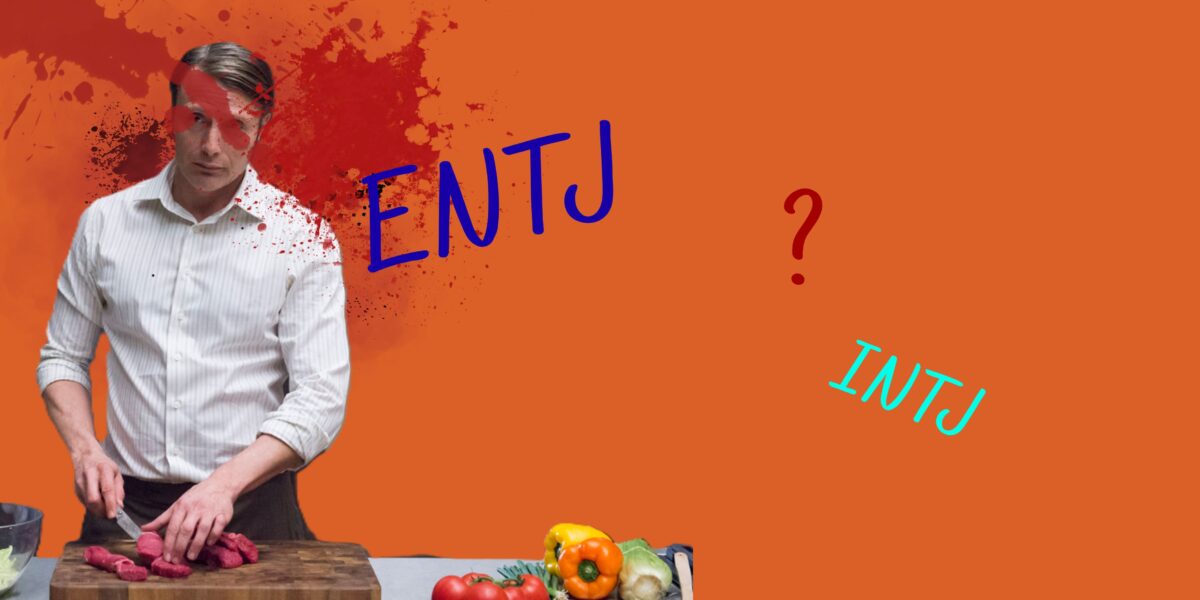
Hannibal Lecter’s behavior consistently reflects a preference for external control, structured execution, and the deliberate shaping of outcomes. Rather than remaining a passive observer, Hannibal actively constructs situations that influence others, using his environment very adaptively as a medium through which he imposes order and realizes his intentions.
There are two sections of Lecter’s MBTI typing.
While identifying Hannibal Lecter’s MBTI dichotomies provides a broad picture of his personality, cognitive functions offer a deeper explanation for how his mind operates beneath observable behavior. Rather than focusing on traits alone, cognitive functions examine the mental processes that shape perception, judgment, and decision-making.
If you wish to dive even deeper, do check out the complete character analysis of Hannibal.
In the NBC series, Hannibal’s behavior reflects more than intelligence, composure, or manipulation; it reveals a structured pattern in the way he interprets people and interacts with reality itself. Examining his cognitive functions allows us to move beyond labels and understand the psychological mechanisms underlying his fascination with transformation, control, and human potential.
His pronounced engagement with sensory experience – through refined cuisine, art, and the physicality of his actions (he even smells Will and Bella without trying to hide it) – further supports the presence of Extraverted Sensing (Se), while his deeply personal yet unconventional moral code reflects an inferior but influential Introverted Feeling (Fi). I have explained these in Hannibal’s cognitive stack further down in this article.
Why Hannibal is Not Likely INTJ
While he shares certain traits with Introverted Intuitive types, Hannibal’s consistent pattern of external engagement, social orchestration, and real-time manipulation of events strongly supports an ENTJ classification. He does not merely understand systems – he operates within them, reshapes them, and ultimately uses them to enforce his vision of order, identity, and transformation. Instead of someone like Thomas Shelby, Hannibal has almost no problem getting out of a bind in very novel situations simply based on psychological leverage which he projects in a primarily social environment.
On the other hand, Hannibal is also more proactive in creating and responding to social stimuli in the moment. This makes Hannibal quite similar and different when compared to someone like Johan Liebert, who is an INTJ-A. Hannibal, like Johan, manipulates people while concealing himself. However, Hannibal observes and takes action ‘in the moment’, while Johan takes more time to go through with a plan, carefully assessing each situation rather than adapting to dangerous situations along the way.
Thus, Hannibal, with his social life (which I have explained more in the main analysis) and his active stance towards manipulating a large number of people is more extroverted than introverted.
Let’s now take a deeper look into Hannibal’s MBTI dichotomies.
Hannibal Lecter’s MBTI Dichotomies as an ENTJ
Extraverted (E): Hannibal Shapes the World Rather Than Retreating From It
Hannibal Lecter is frequently mistyped as an introvert because of his reserved demeanor, controlled emotional expression, and preference for selective rather than broad social interaction. However, MBTI extraversion is not determined by how talkative or outwardly energetic someone appears; it concerns whether an individual primarily engages with and structures the external world. Hannibal consistently demonstrates a tendency to actively involve himself in people, systems, and events rather than remaining a detached observer.
Throughout the series, Hannibal actively observes and authors human behavior. He repeatedly constructs situations that shift the course of events around him. His elaborate dinners, professional networks, psychiatric practice, and social gatherings are not maintained out of obligation but are environments through which he engages with and influences others. Even his relationship with Will Graham demonstrates this pattern. Rather than observing Will from a distance, Hannibal continuously inserts himself into Will’s life, creating experiences and circumstances intended to alter his development.
His preference for lived experience further supports this interpretation. Hannibal immerses himself in sensory and interpersonal experiences rather than withdrawing into abstract observation. His engagement with people is purposeful and selective, but consistently active, suggesting a personality more oriented toward influencing reality than merely contemplating it.
This sets him apart from Joe Goldberg (INTJ) who also influences others but does so through less socially grandiose methods as holding feasts and manipulating multiple people brazenly. An example of this is Hannibal calling the ‘tooth fairy’ right from his prison cell.
Intuitive (N): Hannibal Sees Potential Rather Than Present Reality
Hannibal Lecter demonstrates a pronounced intuitive orientation through his continual focus on hidden meanings, future possibilities, and underlying psychological structures. Rather than taking people at face value, Hannibal appears consistently interested in what exists beneath the surface and, more importantly, what an individual could potentially become. His worldview is directed toward ‘what could be’ rather than just staying at ‘what is’.
This tendency becomes especially visible in his psychiatric practice. Hannibal rarely attempts to suppress impulses or reinforce social norms. Instead, he encourages patients to confront aspects of themselves they might otherwise avoid. He values realization and integration over conformity. This can be observed in his interactions with individuals such as Margot Verger, where his guidance does not aim toward adjustment but toward self-actualization according to his own framework.
His fascination with Will Graham further reinforces this intuitive focus. Hannibal’s interest in Will extends far beyond who Will presently is; he becomes fixated on the possibility of what Will may become through suffering, transformation, and acceptance of hidden aspects of himself. Hannibal repeatedly sees potential where others see fixed identities caged by present circumstances.
Additionally, his symbolic thinking, elaborate displays, and use of metaphor suggest a mind naturally oriented toward meanings and possibilities rather than concrete reality alone.
Thinking (T): Hannibal Prioritizes Internal Logic Above Emotional Convention
Hannibal Lecter demonstrates a strong thinking preference through his tendency to prioritize principles, systems, and internally consistent reasoning over emotional convention or social sentiment. While he is highly aware of his and others’ emotions, he rarely allows emotional reactions to dictate his decisions. Instead, emotion appears subordinate to his personal logic and philosophy.
His interactions with others frequently reveal a detached approach to moral judgment. Hannibal does not evaluate people according to socially accepted ethical standards; rather, he evaluates them according to a highly individualized system involving authenticity, dignity, refinement, and potential. Individuals who fail to meet these standards are often viewed with indifference or contempt regardless of social expectations.
However, does this mean that people with thinking preference do not evaluate based on societal standards? Not exactly.
For example, Patrick Bateman shares the same MBTI as Hannibal, however, his dichotomy of thinking instead of feeling is societally based. But the common thing he has with Lecter is that it is based on rational evaluations rather than emotional ones. Eren Yeager, for instance, makes decisions more on the basis of what feels right, showing signs of Feeling rather than Thinking in MBTI.
Even his relationships demonstrate this tendency. Hannibal forms deep attachments, but these attachments continue to operate within a structured framework of ideas and expectations. He tests Will repeatedly, seeking evidence that Will understands and reciprocates his worldview. Emotional connection alone appears insufficient without intellectual and philosophical alignment.
Although Hannibal is capable of intense feeling, his behavior suggests a personality that consistently filters emotions through a broader system of reasoning and personal principles.
Judging (J): Hannibal Seeks Structure, Deliberateness, and Control
Hannibal Lecter exhibits a strong judging orientation through his clear preference for order, planning, and deliberate control over both himself and his environment. His behavior rarely appears impulsive or spontaneous. Instead, actions are generally calculated and integrated into broader objectives that may unfold over long periods of time.
His lifestyle itself reflects this preference for structure. Hannibal maintains highly organized environments, carefully curated routines, and meticulous attention to detail. His office, clothing, meals, and social interactions demonstrate an intentionality that extends beyond mere aesthetic preference. There is little evidence of disorder or uncontrolled behavior within his personal world.
Even when plans change unexpectedly, he generally responds with controlled adaptation rather than emotional disorganization. However, his ‘judging’ side spills through cracks of his disgust sensitivity, as I laid out in the main character analysis.
In sum, this consistent tendency toward organization and intentional direction strongly reflects a judging orientation.
Hannibal Lecter’s MBTI Cognitive Functions
One interesting part of Hannibal’s psychology is that he looks less like “a strategist who acts” and more like “a strategist who curates reality as a controlled system.” The functions show up in a very integrated, almost aestheticized form rather than the stereotypical corporate ENTJ expression.
Dominant Te: Reality as a Controlled System of Outcomes
Hannibal’s thinking is fundamentally externally structuring (Te), but not in a blunt, efficiency-driven way. His Te is refined into a system of curated causality: he organizes people, environments, and events as if they are variables in an experiment where outcomes can be engineered with precision.
Hannibal’s Te Function Builds the System
What distinguishes his Te is that it is proactive world-building. He does not simply respond to systems; he designs them using anecdotally and social/natural science-based thinking.
Patients, social circles, law enforcement proximity, and even criminal events are positioned as components within a broader structure that he can test, observe, and refine. This is in stark contrast to someone like Lou Bloom (ISTP), who uses the Ti function and whose internal thought is almost completely removed from the conventional patterns of thinking people as a part of a coherent system. Bloom ignores the importance of social boundaries, while Lecter acknowledges and uses them.
Unlike more conventional Te users who optimize for productivity or measurable success, Hannibal optimizes for coherence of unfolding events. The “success metric” is based on whether reality conforms to the internal architecture he has imposed on it. This is why his actions often feel like long-range logistical planning fused with psychological experimentation.
Importantly, his Te is emotionally detached in execution but not indifferent in motivation. He treats human behavior as something that can be organized into predictable systems once properly understood.
Auxiliary Ni: Pattern Completion and Transformational Vision
His Ni is where Hannibal’s psychology becomes distinctly “Hannibal-like.” He does not merely observe people; he projects their eventual psychological form. (Do check out my main character study of Hannibal to get a better grasp of its origins and implications).
Rather than analyzing individuals in terms of present traits, he interprets them as incomplete trajectories. This is why he becomes fixated on transformation narratives – especially with patients who show individuality in how they deal with their traumas. For example, Hannibal was not interested in Randall Tier as a person in a static sense; he is invested in Randall as a becoming, who was to shift psychologically and physically into a beast of prey.
He, along with many other people Hannibal’s interested in, is a psychological equation whose final solution he believes he can anticipate and accelerate.
Interestingly, this is something which Will objects to later on in the series where he notes that Hannibal’s investment is shaping Will’s own behaviors.
He says:
You can’t reduce me to a set of influences. I’m not the product of anything. I’ve given up good and evil for behaviourism
Hannibal’s Ni Foreshadows the Destination of Himself and His Social Environment
This Ni is directive foresight. He does not just predict outcomes; he behaves as though understanding the outcome grants him partial authorship over it.
A key feature of his Ni is its symbolic compression. Hannibal reduces complex human experience into elegant psychological archetypes, moral motifs, and aesthetic narratives. Violence, intimacy, identity, and suffering are variations of transformation within a unified interpretive framework.
This is also why his speech and behavior often carry mythic or metaphorical framing. He is interpreting events as part of an unfolding internal narrative structure only he fully perceives.
Tertiary Se: Sensory Mastery and Aesthetic Domination
Hannibal’s Se is unusually developed for a tertiary function, but it remains highly selective and controlled. It is not impulsive engagement with the present moment; it is curated sensory domination.
He interacts with the physical world with extraordinary precision, relying on sensory cues and stimulation. This shows up in his food preparation, interior design of his office and home, clothing, gesture, and even violence. These actions are executed with an almost artistic attentiveness to form, texture, and timing. This is Se as refinement rather than indulgence.
However, it has a negative affect as well as Hannibal can be gratuitously violent and over-indulgent in pleasurable situations. Take, for example, how he slowly kills Gideon off by cooking him and making him eat his own body.
Hannibal’s Se Executes Selective Real-World Expression
Importantly, Hannibal’s Se is always subordinated to structure and vision. He does not “live in the moment” but rather wants to have maximum sensory and psychological impact. Even pleasure is prepared for with the right ingredients.
This creates a distinctive pattern: Hannibal does not avoid the physical world like a stereotypical intuitive type. Instead, he engages it selectively when it can be shaped into something aesthetically or psychologically meaningful. His sensory engagement is therefore strategic and encompasses multiple scenarios of multiple individuals who affect him.
In stress or escalation, this Se can become sharper and more direct. It can manifest as heightened presence, decisiveness in action (going all in in the physical fight against Jack Crawford; sensing that Jack came prepared for an altercation), and a willingness to physically enact conclusions (blinding Professor Sogliato by first impaling his optical nerve and then killing him) rather than continue abstract orchestration.
Inferior Fi: Personalized Moral Aesthetic Rather Than Social Ethics
Hannibal’s Fi is the most concealed but also the most structurally important to his identity. It does not function as conventional empathy or moral alignment with society; instead, it operates as a highly individualized aesthetic-moral code.
Fi Defines What is Personally Meaningful to Hannibal
He does not evaluate actions as “right or wrong” in a collective sense. Instead, he evaluates them in terms of refinement, authenticity, and aesthetic coherence with his internal value system. This is why indecency can be acceptable in one context and contemptible in another, depending on whether it aligns with his internal sense of elegance and meaning.
His attachments, particularly to Will, are where Fi becomes visible. Beneath Te manipulation and Ni projection, there is a deeply personal emotional investment that is not easily articulated. However, because Fi is inferior, it is rarely expressed directly but through possessiveness, selective loyalty, and moments where control collapses into emotional fixation.
A key aspect of this inferior Fi is moral isolation. Hannibal does not outsource values to society, nor does he fully externalize them in dialogue. His ethical world is internally sealed, and this creates the paradox of being emotionally intense while simultaneously appearing emotionally detached.
When pressured, Fi can destabilize his usual composure by forcing emotional meaning to override structural control, which is precisely what he spends most of his cognition preventing.
Conclusion
What makes Hannibal compelling MBTI-wise is not any single function, but the way Te-Ni fusion turns human life into a designed narrative system, while Fi remains hidden underneath as the silent constraint that determines what he ultimately considers “worth doing at all.”
Looking at Hannibal through a cognitive function framework reveals a personality defined less by isolated traits and more by the interaction of multiple psychological processes working together. His cognition does not appear fragmented; instead, perception, judgment, action, and personal meaning operate as interconnected parts of a larger structure. Much of his complexity comes from the tension between control and personal significance, observation and intervention, vision and execution.
Rather than presenting a collection of disconnected characteristics, the function model offers a more integrated explanation for why Hannibal consistently approaches people and situations in the distinctive manner seen throughout the series.

I am a Clinical Psychologist and a Lecturer of Psychology at Government College, Renala Khurd. Currently, I teach undergraduate students in the morning and practice psychotherapy later in the day. On the side, I conjointly run Psychologus and write regularly on topics related to psychology, business and philosophy. I enjoy practicing and provide consultation for mental disorders, organizational problems, social issues and marketing strategies.
- M Abdullah Qureshi

- M Abdullah Qureshi

- M Abdullah Qureshi

- M Abdullah Qureshi