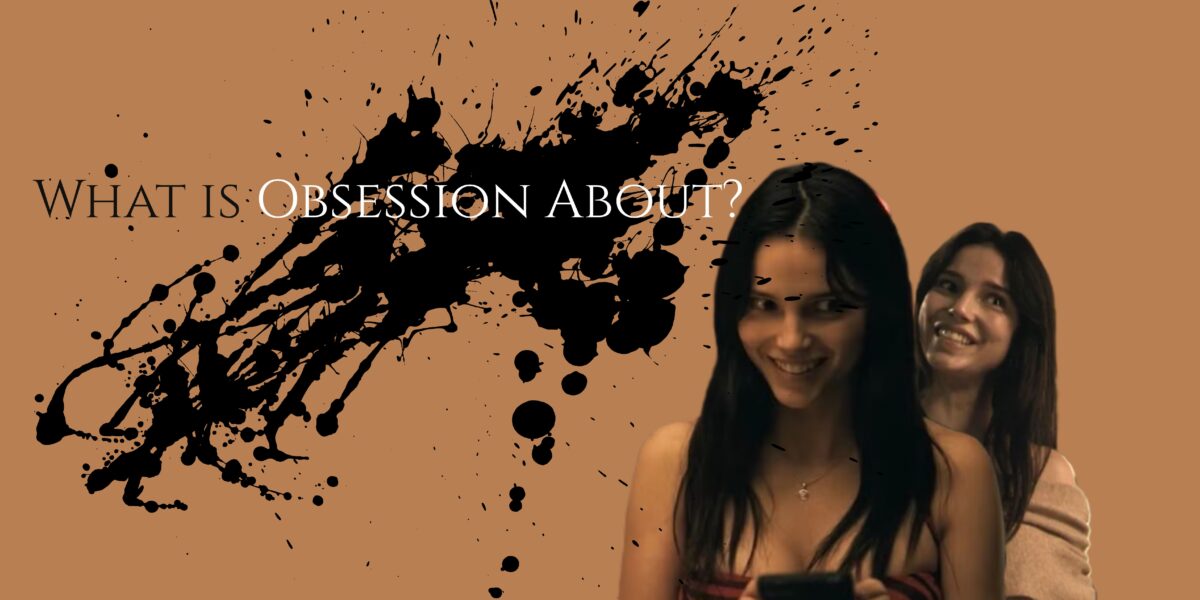
Most interpretations of Obsession focus on the supernatural elements of the story. However, I believe the film’s true horror lies elsewhere.
Obsession targets the age-old longing of magical cures to set our insecurities right. The film asks whether one can actually handle the responsibility of a magical cure (the wish) to insecurities surrounding relationships, without understanding the consequences of intense emotions, love, and the reality of actually pursuing those feelings.
This is shown clearly in the beginning. Bear is not ready to disclose his feelings due to insecurity and fear of rejection. Instead of embracing vulnerability, he wishes for an easy way out.
He chooses not to say anything even when Nikki gives him the chance to.
In this way, the film is also about handling vulnerability in very real-life situations. Consider that almost no scene in the film involves any major supernatural action other than Nikki’s split. The horror emerges from relationships, attachment, insecurity, and emotional dependency.
This interpretation explains almost every major event in the film. First, we’ll go over the interpretation of Nikki’s behavior.
Interpreting Nikki Freedman
My interpretation is that after the One Wish Willow is broken, Nikki becomes a projection of Bear’s psyche manifested as his anima rather than a real person. This does not mean that Wish Nikki is not conscious. Rather, she appears to possess her own consciousness, emotions, and even unconscious motivations.
The crucial difference is that her entire motivational system has been reorganized around one imperative: to love Bear above all others.
The Incongruence in the ‘Real’ Nikki’s Behavior
Given the preoccupation with highlighting Bear’s flaws (understandably so), a key factor in understanding Nikki’s bizarre behavior – especially the glitches where her former self emerges and interferes with behaviors of the Freaky Nikki – is her concept of ‘love’ and ‘romance’ and possible contradictions in her behavior.
Nikki’s Concept of Love and Romance Before the Wish
In the script for Obsession, Nikki explains to Bear in his car before he breaks the One Wish Willow that she believes in love but not romance.
“I don’t think romance is real. I think love is real, but not romance. Romance makes life feel magical, like in movies. Then, your parents split, or they’re so miserable you wish they would. People start telling you love fades, it’s mirage. They’re wrong. Romance fades. Love is a different thing, and that’s what I wanna write. The good, the bad, the ugly. Real shit.”
In reality though, Nikki was also allegedly hooking up with Ian on and off. This does not automatically mean that Nikki was purely romantic with Ian – however, it does seem to contradict her views on romance versus love as a whole. After all, being intimate without committing does not show a preference for a ‘loving’ involvement, but rather a more romantic one.
Nikki’s Own Insecurity About Confessing Love
In the same scene (again, purely mentioned in the script), she says something that reveals her own possible feelings of insecurity/uncertainty.
“When I have a crush on a guy, no one knows.
…I’m really good at hiding my feelings for someone.”
In the movie, this was replaced by Nikki shutting Bear down when he was asking her out.
Nevertheless, if we are to assume that the script Nikki and the movie Nikki (so many Nikkis at this point), are the same person, it shows that perhaps she might have had similar feelings to Bear if she was asked to confess her feelings.
What Does this Say About Nikki?
Nikki may reject romantic fantasy while still engaging in relationships that are emotionally complicated and imperfect. It also means that the real Nikki is more human in that she might not always follow through on her own standards and could possibly have issues with expressing intimacy herself.
After all, notice how almost every time Wish Nikki glitched and the real personality resurfaced, the context surrounded open intimacy where she was the one who began the intimate interaction.
I’ll start my interpretation of Wish Nikki with a hypothesis that could explain her on a conceptual level.
Wish Nikki as Possibly Bear’s Anima
A subtle moment appears shortly after the wish. Nikki says,
“I did just lose my cat… Oh wait, I mean, you lost your cat.”
On the surface, this sounds like an ordinary verbal slip.
However, it can also be interpreted as a brief collapse between Bear’s emotional world and Wish Nikki’s own. Throughout the film, she increasingly treats Bear’s memories, losses, and emotional needs as though they are inseparable from her own experience.
In this light, the line subtly reinforces the interpretation that Wish Nikki is not merely devoted to Bear, but psychologically constructed from his inner world. This is also one reason why she can be interpreted as a manifestation of Bear’s anima rather than an entirely independent personality.
The horror lies here in the fact that the anima is given tangible consciousness.
Was Nikki Possessed in Obsession?
I do not think Nikki was possessed in the traditional horror movie sense.
Wish Nikki behaves less like a demon and more like an autonomous consciousness that is severely malfunctioning both on social and personal levels while being optimized around and for Bear.
She possesses emotional intelligence. She can read Bear’s emotions, interpret facial expressions, adapt her behavior, and pursue goals. However, all of these abilities are directed toward Bear’s emotional state.
She understands that Bear is sad, scared, uncomfortable, or distant. What she struggles to understand is the deeper emotional dynamics behind those feelings. Every problem becomes something that must be corrected.
Wish Nikki is Child-like, Not Demonic
There are various points in the film where Nikki behaves extremely child-like, which portrays horror and could in fact indirectly awoke sympathy in viewers at the same time (possibly even if she wasn’t obviously tragically handicapped and ‘changed’ by the wish).
She crosses her arms, makes upside-down smile faces, maintains an overly animated grin. Not only that, Nikki also appears to be innocent, not really harming anyone else other than herself for much of the film and only kills Sarah in extreme jealousy. These behaviors indicate child-like dysfunctional emotional regulation, often found in dramatic personality disorders (like borderline and narcissistic personalities).
This is understandable as there is indication that Wish Nikki is conscious with a mind of her own but warped around a single objective. Consider this too; effectively, she was born with the memories of the real Nikki albeit warped possibly by denial or evidence-creation (severe defense mechanisms and cognitive distortions).
When Bear becomes afraid, she attempts to remove the fear.
When Bear becomes distant, she attempts to remove the distance.
When Sarah becomes important, she removes Sarah.
This makes her feel strangely human rather than demonic.
Did Nikki Go Crazy in Obsession?
I don’t think Nikki simply “went crazy.”
Instead, her entire personality becomes reorganized around a single objective: loving Bear above all others.
The real Nikki has been explicitly (and implicitly) stated to possess multiple centers of gravity (with regards to her personality):
- Her own personal needs
- Family
- Friends
- Work
- Hobbies
- Values
- Physical wellbeing
- Future plans
Wish Nikki is different.
It’s not that multiple centers of gravity don’t exist. Rather, every center of gravity is derived from her devotion to Bear.
She wants Bear to be happy, to feel safe, to stay close.
She wants Bear to forgive her, choose her and above all else, to love her.
These are all distinct goals, but every one of them is based on Bear.
Making Sense of Wish Nikki’s Emotional Intensity
Consider an individual experiencing something similar to mania. They may become highly energetic, highly motivated, and much less likely to sleep. Wish Nikki displays similar characteristics. She stands and stares at Bear while he sleeps instead of sleeping herself. She also becomes highly irritable whenever her primary goal is obstructed by external circumstances.
Possible Parallels between Wish Nikki’s Behaviors and Mental Disorders
It is easy to interpret Nikki’s behavior as certain borderline personality disorder features. On the other hand, the constant glitching between Real and Wish Nikki indicates an unstable sense of self. Having said that, her continued idealization of Bear instead of ups and downs indicates a lack of splitting. This is why her behavior appears quite similar to Bipolar I disorder, compared to BPD (read about the difference between the two here).
She also exhibits features of a severe dependent personality disorder. This personality disorder is marked by an inability to pursue personal goals, functions and routines without the help of another person (or multiple people) and experiencing chronic loneliness when that person is physically, emotionally or socially not in proximity.
Why Did Nikki Feed Bear His Cat?
Wish Nikki treats objects in the environment as functions of Bear’s emotional system rather than independent entities.
The cat is not merely a pet.
It represents attachment, grief, emotional investment, and a source of affection that exists outside of Nikki.
Because her entire motivational system revolves around Bear, the cat becomes a relational variable rather than an independent being.
Based on this, there are several possible reasons for Nikki’s behavior.
The first is that the funeral failed. The cat appeared important to Bear and perhaps feeding the cat to him was a misguided attempt to provide closure.
The second possibility is that Wish Nikki wanted to eliminate the cat’s body while simultaneously keeping it close to Bear. The cat seemed to hold emotional significance that competed with her own position in Bear’s life. This behavior is somewhat similar to Hannibal Lecter cannibalizing his own sister after she was killed, although in this case, she fed her love object the thing which represented bond; a similar mechanism seems to come into play after she kills and keeps Sarah’s body (explained later in this article).
The third possibility is that Wish Nikki simply does not think about the world in normal practical terms. Shopping for food, planning meals, and considering ordinary routines seem secondary to her fixation on Bear.
A fourth possibility is that it reflects the running joke established earlier in their relationship, with Wish Nikki believing it would bring them closer together.
Regardless of the specific motive, the act is consistent with a recurring pattern throughout the film: objects and people become interpreted through their relationship to Bear.
Why Did Nikki Hurt Herself?
There are often multiple motives behind psychiatric symptoms.
For example, psychosomatic symptoms can possess both a manifest motive and a latent motive.
The manifest motive is the obvious function of the behavior.
The latent motive serves a deeper psychological purpose.
Wish Nikki’s self-harm can be understood through this framework.
The manifest motive may involve self-punishment or emotional distress.
The latent motive is to differentially reinforce attachment.
By placing herself in a compromised position, she increases the likelihood that Bear will care for her, protect her, and remain emotionally engaged.
This interpretation is consistent with Wish Nikki possessing her own consciousness, including unconscious and subconscious motivations, while still being organized around loving Bear above all others.
Why Did Nikki Lie About Her Dad?
Based on the pure semantics of Bear’s wish (a recurring theme in the film), she has to do away with almost every emotional bond she possesses, including her relationship with her father.
So, her lie signifies a complete emotional reset.
At the same time, it creates a situation where Bear can assume the role of protector.
Bear is uncomfortable with direct vulnerability. However, vulnerability becomes easier when it is expressed on behalf of someone else. Nikki’s sadness, whether genuine or fabricated, allows Bear to become her knight in shining armor without exposing his own emotional needs.
This pattern appears repeatedly throughout the film.
Explaining the Real Nikki’s Reappearances After the Wish
There seems to be a commonality between all instances where the real Nikki seems to make a sudden appearance: moments of strong intimacy with Bear, the object of her love.
Earlier in the car, Nikki explained her preference for ‘love’ rather than ‘romance’, which she described as a fleeting, magical and unreal thing. When her ‘real’ personality returns, it usually does so when either the wish Nikki’s nervous system is practically shutdown and/or is in expectation of intimacy from Bear.
Take, for example, her immediate exclamation when she tries to get Bear to come into her house:
“Wait, what the f*ck?
…I’m acting so weird. This is so weird.”
Her real personality is at odds with how she is behaving in the moment, not just on a behavioral level – but on her beliefs around initiating intimacy.
Similarly, during the supposed ‘boys’ night out, she virtually forces Bear to kiss her instead of Sarah. As the situation becomes uncomfortable, she tries to cover up her behavior, but the real Nikki only snaps back when Bear doesn’t respond to her cry for intimacy or to acknowledge her when she hurts herself with the bottle.
Explaining Nikki’s Strange Motor Movements
Why Did Nikki Reverse Walk?
One of the uncanniest moments in the film occurs when Nikki reverse walks abruptly during an intense conversation in Bear’s apartment regarding Nikki’s increasingly erratic behavior during a get-together between Bear and his friends. The erratic behavior in question involved reciting an extremely morbid poem, being openly possessive (which many do consider warranted as Bear was supposed to kiss Sarah during a game) and severely hurting herself.
The conversation then begins moving toward the possibility that Bear may leave her.
At that moment, Nikki gets up and reverse walks into another room.
Many interpretations online cite this scene as an example of the real Nikki being repulsed by her actions – however, as is seen in the film, the real Nikki taking control of her body is never to the point of intense gross motor control (being able to move large muscle groups in unnatural ways). In fact, the only scene where she makes an appearance for an extended time after Bear’s wish is while the Wish Nikki was asleep (it appears as if the two sides of Nikki cannot coexist, as I explained).
Instead, a more understandable interpretation – which can also tie in her behaviors of gaslighting, and genuine attempts at overcorrection – is that this behavior was purely conducted by Wish Nikki.
Because her primary emotion is loving Bear above all others, this can be interpreted as a defense mechanism attempting to “reverse” her mistake. She seems to understand the concept of giving someone space, but interprets it in an extremely literal and simplified way.
Instead of understanding emotional distance, she physically creates distance.
When Bear recoils physically with fear, she immediately runs toward him, almost as if attempting to rescue him from his negative emotional state. However, she appears to stop herself after Bear tells her she is scaring him.
So, this scene highlights how our expectations about intimacy are often unrealistic. Wish Nikki understands emotions, but she processes them in an intensely externalized and action-oriented way. An interesting point here is that she does only the actions which have functional value (based on her perception of what threw Bear off) in such intense situations – thus, the immediate reverse walk away to give him space.
Why Did Nikki Pee Herself?
Many viewers interpret this scene as shock horror.
However, it can be connected to the film’s recurring theme of psychological collapse.
In severe catatonic states, some individuals report being unable to move despite remaining aware of their surroundings. Neuroimaging studies have shown disruptions in brain regions involved in executive control. Urinary incontinence can occasionally occur in severe hypokinetic catatonia when top-down control mechanisms become impaired.
Wish Nikki displays similar characteristics whenever Bear is absent.
She becomes motionless.
She waits.
She stares.
She appears incapable of functioning independently.
Considering that her entire existence revolves around Bear, prolonged separation may resemble a form of psychological shutdown.
Why Did Nikki Kill Sarah?
Sarah represents something Wish Nikki cannot provide – which is not acceptable to the latter. Moreover, Bear’s own ambiguous actions (almost going in for the kiss with Sarah at his friend’s party and then later meeting up with her while Nikki was asleep) seem to spike Nikki’s emotional intensity.
Thus, in an act of taking away this obstacle from their relationship, she bludgeons her repeatedly motivated both by the goal and her own feelings of extreme possessiveness.
But why did Nikki keep Sarah’s body?
Her behavior seems to be somewhat similar to arranging the mock funeral of Bear’s cat. Sarah was someone Bear held affection for. The best way to achieve closure appears to be incorporation rather than disposal. Thus, Nikki wears Sarah’s scalp, dress and even her tattoos – in order to compensate for Sarah’s absence and to further foster attachment between her and Bear.
What Did Nikki Wish For?
Based on Bear’s almost complete reversal of behavior and mood from before Nikki finally broke the one wish willow, it appears that Nikki wished that he would love her back (either above all else – like he wished – or at least as much as she loved him).
This gives another layer to Wish Nikki’s entire personality. Why? Because it shows that she understands that the relationship is fundamentally imbalanced and resorts to a functional solution rather than just trying to hammer herself into his feelings.
This is character development, showing that the Wish Nikki was in fact able to engage in functional methods of producing outcomes. I believe that the film might have actually underexplored Wish Nikki as a possibly real personality.
She gives everything.
She sacrifices everything.
She organizes her entire existence around Bear.
Her final wish may represent a desire for reciprocity.
Having understood Nikki’s behaviors, it is important to get Bear too – as his wish is what ultimately paved the way for (and maintained) the story.
Interpreting Bear
Bear’s Inner Insecurity
To put it simply, Bear appeared to have a difficult time opening up to someone he had feelings for. He explains this in the opening sequence where he practices his confession to Nikki on a waitress; he thought that he was a ‘loser’ and thus he couldn’t confess it earlier. While this confession seemed sweet to the waitress, his friend, Ian, discouraged him stating that Nikki would vomit if he confessed to her in the same manner.
Thus, one can infer that Bear’s best friend – who was allegedly the only person he connected to outside of Nikki – could have played a major role in his insecurity at the present time.
This poor support net comes on the back of a generally despondent life in which he had been recently coping from the death of his grandmother who had left him a house, full of oxycodone pills. His neglect of himself and his pet led to further insecurity and the fact that his own cat died of overdose because he did not secure the pills enough.
These events and factors expose a personality with deep-seated insecurities, negative self-image and hesitation in being vulnerable with Nikki, who Bear idealized as being emotionally intelligent, much more grounded in herself and assertive.
In a nutshell, he placed himself on a lower plane than Nikki – as a result of possibly high neuroticism (a personality trait signifying high emotional instability).
However, as the script itself briefly goes into it, Nikki herself seemed to have insecurities around expression of feelings. In reality, Bear and Nikki might have actually had more things in common than Bear realized.
But with such insecurities, the risk for attachment issues can become high.
Did Bear Truly Love Nikki or the Idea of Niki?
He did seem to have genuine feelings for her. However, it can certainly happen that the style in which one loves can not only evolve (or devolve) but also that it can be both healthy and/or unhealthy.
According to Robert Sternberg’s triangular theory of love, there are three components of love that could combine in different forms and give birth to certain further taxonomies of love. As per this theory, Bear seems to exhibit fatuous love. This kind of love involves passion and commitment, but it lacks intimacy (involving a deep emotional connection and shared vulnerability).
Moving further along with the previous section describing Bear’s insecurities, he did appear to love a perception of Nikki, rather than Nikki herself. So, for example, he has to double confirm with her friend to find out that she is lying about her father and what the exact nature of their father-daughter relationship was. This shows his depth of emotional intensity for Nikki along with the shallowness of his exploration of who Nikki actually is as a person.
Which is how we can understand Bear’s wish.
Why Did Bear Wish Nikki to Love Him More Than Anything Else?
“I wish Nikki Freeman loved me more than anyone in the f*cking world.”
The addition in the end of his wish ‘more than anyone in the f*cking world’ is the semantic part which showcases Bear’s misunderstanding of what it would take for both of them to be in a relationship. While being picky with words is not everyone’s forte, this exclusiveness highlights his own insecurity.
Furthermore, this addition put in their possibly by his insecurity is what makes Nikki respond with fatuous love as well!
This is particularly why it seems to me that Wish Nikki is basically a projection of Bear’s insecurities being overcorrected by someone he has feelings for – in short, his anima.
Let’s contrast this with someone who he genuinely began connecting with.
Did Bear Love Sarah?
I would not say that Bear actually loves Sarah. But the connection between the two seems more natural than the one he had with either side of Nikki.
Sarah appears to represent the possibility of a real relationship.
Bear seems genuinely emotionally engaged with her story, as is shown in the flow of conversation they have between each other, recounting shared experiences and feelings.
A relationship with Sarah would require vulnerability, uncertainty, and the possibility of rejection. However, he is able to genuinely maintain a friendship with her; feelings become escalators of positive emotions rather than negative emotions.
Was Bear the Villain in Obsession?
I do not think Bear is the villain.
However, I do think the film is critical of him.
Bear repeatedly avoids vulnerability. He neglects and chronically doubts himself which culminates in casualties of innocent people around him and eventually his suicide and the potential destruction of Nikki’s life.
What puts him in an even darker position is that he had multiple chances to act without self-interest. This puts him somewhat closer to psychodynamics of characters like Jay Gatsby, who emotionally breakdown when vulnerability is involved.
Instead, he allows his insecurities to keep maintaining a relationship which was truly toxic and could arguably be called ‘taking advantage of someone’.
Having said that, the emotional damage accrued on him does have to be mentioned to make a coherent argument. Toxic relationships could affect emotionally unstable individuals (in this case, Bear) to bond with trauma – such is the case with Stockholm Syndrome.
The True Meaning of Obsession
The true horror of Obsession is not simply Nikki’s biomechanics or the jump scares or even the killings.
The horror is that Nikki appears to be an autonomous consciousness whose entire personality has been violently constructed to serve the interests of a single person. And the object of her interests does so without meaning but continues to move forward, drifting into darkness until it consumes him, his friends and the person he supposedly cared most for.
Thus, the tragedy is that Bear never truly learns the lesson his wish was meant to teach.
Rather than embracing the uncertainty and vulnerability required for authentic intimacy, he first removes the uncertainty (without realizing he did so) by the way of a magical cure; his wish while breaking the one wish willow.
Not only that, he repeatedly allows Wish Nikki to absorb those burdens on his behalf, choosing to kill himself in the end rather than shoulder any responsibility.
In this sense, Obsession is not simply a horror film about obsession.
It is a horror film about what happens when the difficult work of love – the uncertainty, rejection, vulnerability, and emotional responsibility – is outsourced completely to an image of a person that is not real.

I am a Clinical Psychologist and a Lecturer of Psychology at Government College, Renala Khurd. Currently, I teach undergraduate students in the morning and practice psychotherapy later in the day. On the side, I conjointly run Psychologus and write regularly on topics related to psychology, business and philosophy. I enjoy practicing and provide consultation for mental disorders, organizational problems, social issues and marketing strategies.
- M Abdullah Qureshi

- M Abdullah Qureshi

- M Abdullah Qureshi

- M Abdullah Qureshi