
People often ask whether narcissists are born or made, whether poor parenting is to blame, or whether traumatic experiences create narcissistic personalities.
The complete story, however, is more complicated than that.
The Short Answer:
Modern psychological research suggests that narcissism does not develop because of a single event or cause. Instead, it appears to emerge through a complex interaction between biological predispositions, early childhood experiences, personality development, learning processes, and the ways individuals learn to regulate their self-esteem over time. In other words, narcissism is best understood as a developmental process rather than the product of one isolated factor.
This complexity also explains why researchers have yet to reach a single consensus on why some individuals develop narcissistic personalities while others do not. Rather than searching for one definitive cause, contemporary research increasingly focuses on understanding how multiple risk factors interact throughout development.
Importantly, narcissism exists on a continuum. Many people display narcissistic traits, such as confidence, ambition, or a desire for recognition (e.g the pop-culture term main character syndrome), without meeting the diagnostic criteria for Narcissistic Personality Disorder (NPD).
This article assumes a basic understanding of narcissism and focuses primarily on why narcissistic personality traits begin, develop and are affected throughout life.
When Does Narcissism Begin?
B — Moderate empirical support (findings display convergence but variability without showing causal relationship) (see evidence framework)
Narcissistic traits can often be identified in 7 years olds, but the developmental processes that contribute to narcissism begin much earlier. By middle childhood, children’s personalities have become sufficiently stable for narcissistic traits to be reliably observed.
However, this does not mean narcissism suddenly emerges at that point. In fact, there are genetic factors at play.
Are Narcissists Born or Developed?
Current research suggests that narcissism is best understood as a developmental process. To put it simply, biological predispositions (driven by genetics) and environmental experiences begin interacting from infancy and early childhood, gradually shaping how children regulate their self-esteem and relate to other people.
The environmental factors include parenting and learning experiences that could exert direct and indirect influence over whether narcissistic traits emerge.
Biological Predispositions of Narcissism
Role of Genetics and Temperament
Developmental researchers have proposed that temperament may create a neurobiological vulnerability for certain forms of narcissism long before narcissistic traits become apparent. Temperament refers to biologically based differences in emotional and behavioural tendencies that are present early in life – primarily driven by genetics and prenatal environments – and is one of the strongest biological explanations for the predisposition of narcissism.
Is Narcissism Caused by Genetics?
As per twin studies, genetics account for about 50% of the variance of narcissism in the population. This does not mean that genetics directly determine whether someone develops narcissistic traits. Many of the studies rely on correlational (albeit robust) statistics and often do not explore micro-level changes in psychology or social environments which themselves play important roles in altering genetic expression (whether a gene shows up in behavior or not, also known as epigenetics) across lifetime.
Instead, this genetic factor of narcissism can be seen as temperamental predispositions which prime people to behave in certain ways.
How does Temperament Affect Narcissism?
Two temperament systems appear particularly relevant. Both are involved differently, based on whether the narcissistic behaviors are generally overt (grandiose) or covert (vulnerable).
The first is approach temperament, which refers to a neurobiological sensitivity to positive stimuli and rewards. It is largely regulated by dopaminergic pathways associated with the brain’s reward system. Children high in approach temperament are naturally motivated to pursue rewarding experiences, positive emotions, achievement, and social recognition.
Taken together, the available evidence suggests that this heightened reward sensitivity may predispose individuals toward the development of grandiose narcissism, particularly when combined with environmental experiences that reinforce feelings of superiority and admiration.
The second is avoidance temperament, which refers to a neurobiological sensitivity to negative stimuli such as criticism, rejection, punishment, and threat. This temperament is largely regulated by behavioural inhibition systems involving limbic regions of the brain and their interactions with the prefrontal cortex. Individuals with high avoidance temperament often experience negative social evaluation more intensely than others.
Interestingly, research suggests that vulnerable narcissism may be more likely to develop among individuals who display both high approach and high avoidance temperaments. In other words, these individuals simultaneously desire admiration and recognition while also being highly sensitive to rejection and criticism.
This combination may help explain why vulnerable narcissism is characterised by fluctuating self-esteem, hypersensitivity, shame, and a persistent need for external validation despite outwardly appearing less grandiose than their overt counterparts.
Neuroanatomical Findings in Narcissism
Cognitive neuroscience research has also identified structural and functional differences between individuals with elevated narcissistic traits and healthy controls. However, these findings remain correlational and should not be interpreted as evidence that brain differences directly cause narcissism. In particular, brain scans partially explain impairment in two core symptoms of narcissism:
- Lack of empathy
- Hijacking of the reward system by extrinsically motivating factors
Brain Abnormality Possibly Contributing to Reduced Empathy
For one, there seems to be reduced grey matter within the insula, particularly the anterior insular cortex. The insula plays an important role in integrating emotional experiences with bodily sensations and autonomic responses, while the anterior insula contributes to empathic processing and emotional awareness.
Reduced grey matter in this region may therefore help explain why individuals with narcissistic traits often demonstrate difficulties understanding and responding to the emotional experiences of others.
Decreased Connectivity Associated with Perception of Reward
Researchers have also observed decreased functional connectivity between the prefrontal cortex, which is heavily involved in executive functioning and decision-making, and the ventral striatum, a key component of the brain’s reward system. Although these findings do not demonstrate causation, they are consistent with psychological theories suggesting that narcissistic individuals rely disproportionately on external sources of reward such as admiration, praise, prestige, and social status to regulate self-esteem.
The Role of Parenting in Shaping Narcissism
Parenting appears to shape how these biological predispositions are expressed by influencing children’s self-esteem, emotional regulation, and beliefs about themselves and others.
How Parental Overvaluation Contributes
Parents who repeatedly communicate to their children that they are more special, more talented, or inherently better than other people may unintentionally foster narcissistic beliefs about superiority. Rather than encouraging children to develop confidence through effort and personal growth, these messages encourage self-worth based on being exceptional relative to others.
This differs greatly from ‘healthy praise’.
Encouraging effort, perseverance, and competence can demonstrate to children that they are not entitled to superiority that they have not earned. Healthy praise supports adaptive self-esteem, whereas repeatedly reinforcing the belief that a child is inherently superior may contribute to narcissistic self-enhancement.
Permissive Parenting and Lack of Boundary Enforcement
Research suggests that parents who are highly permissive and fail to establish appropriate behavioral and emotional boundaries may also contribute to narcissistic expression. These behaviors can severely impair a child’s behavioral regulation and are an example of parental neglect.
This form of neglect is not necessarily characterized by physical or emotional absence. Rather, it reflects a failure to consistently enforce limits, encourage accountability, or teach children how to regulate their emotions and tolerate frustration.
As a result, children may have fewer opportunities to develop empathy, self-control, and respect for the needs of others.
Having said that, parenting alone is unlikely to create narcissism. Instead, parenting appears to interact with children’s biological predispositions.
How Biological Predispositions and Parenting Practices Interact to Develop Narcissistic Behavior
Children with strong approach temperaments are naturally more likely to engage in social interactions. When narcissistic social behaviors are repeatedly rewarded through admiration, praise, or success and reinforced by parental overvaluation and permissive boundaries, they may gradually develop the grandiose form of narcissism.
On the other hand, children who possess both high approach and high avoidance temperaments may follow a different developmental pathway. They might share similar histories of parental overvaluation and inconsistent boundary setting, but they are also more sensitive to criticism, rejection, and shame. Adverse childhood experiences appear to be more strongly associated with vulnerable narcissism, and these individuals may be less likely to openly express grandiose beliefs despite continuing to rely heavily on external validation to regulate self-esteem.
Rather than viewing themselves as unequivocally superior, their self-esteem often fluctuates between feelings of inadequacy and fantasies of exceptionalism.
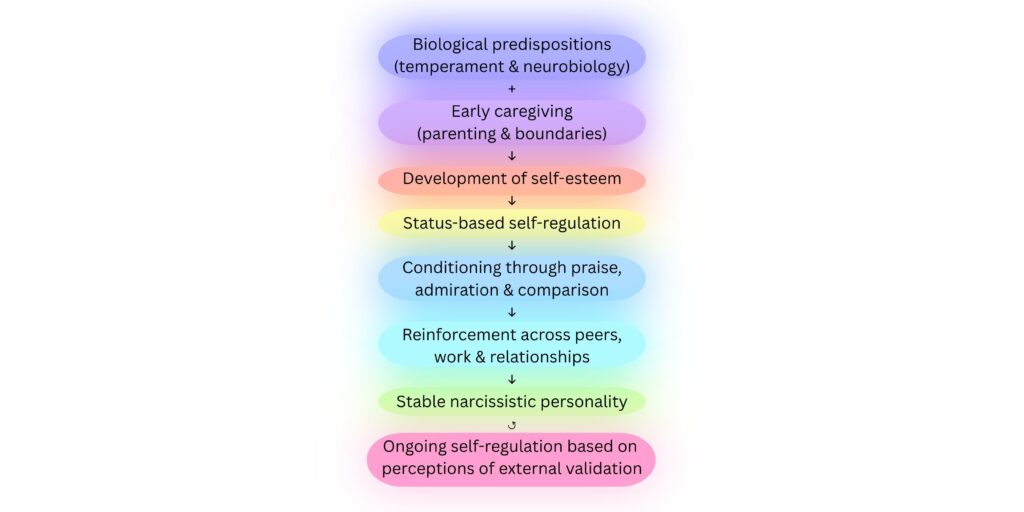
How Early Narcissism Develops into a Stable Personality: Dynamic Self-Regulatory Processing Model
Narcissistic tendencies are products of temperament, neurobiology, parenting and socialization, but these tendencies are shaped and reinforced over time until they become a relatively stable personality pattern. This process can be understood through the self-regulatory model of narcissism.
Basically, narcissistic individuals become particularly concerned with regulating and maintaining their self-esteem from a very young age.
C — Mixed or Developing Evidence (theory-based synthesis integrating several research areas.) (see evidence framework)
Rather than deriving their self-worth primarily from intrinsic growth, personal values, or becoming a better version of themselves regardless of social hierarchies, narcissistic individuals appear to regulate their self-esteem through social comparison and perceived status.
As a result, they become increasingly sensitive to praise, admiration, prestige, popularity, attractiveness, intelligence, and other external indicators of success.
Over time, these external indicators become psychologically associated with feelings of worth through conditioning. Individuals increasingly begin behaving in ways that either primarily favor their own status or diminish the status of others. When these behaviors successfully produce admiration, social dominance, or temporary relief from threats to self-esteem, they become positively reinforced. This is also where people with more clinical narcissism could start exhibiting sadism, feeling pleasure in putting others down. Through repeated reinforcement, these behavioral patterns gradually become habitual, eventually developing into a relatively stable narcissistic personality style (Morf & Rhodewalt, 2001).
Why Status Becomes Central to Self-Worth
Narcissistic individuals could become primed to interpret the social world through a comparative, status-based framework. Rather than asking, “Am I becoming a better version of myself?”, they are more likely to ask, “Where do I stand compared to everyone else?” Their self-esteem therefore fluctuates according to perceived extrinsic elevation over others (such as admiration, prestige, fame, and social status) rather than through intrinsic journeys of personal growth and fulfilment (related to personal growth, close relationships, or community contribution).
What Triggers a Narcissist the Most?
Criticism, rejection, failure, or another person’s success may be experienced as narcissistic injuries because they threaten the individual’s perceived position within the social hierarchy. A narcissist’s motivation to cope with narcissistic injury is thus not necessarily status itself, but rather the temporary restoration of self-esteem that status provides.
How Peer Relationships Strengthen Narcissism
Children with high levels of approach temperament are naturally more motivated to pursue socially rewarding experiences. One possible interpretation of the literature is that these children are more likely to engage confidently within peer groups throughout childhood and adolescence, increasing opportunities to receive admiration, praise, popularity, or social influence.
Do Narcissistic Adolescents Form Bonds with Other Narcissists?
Simple answer: it depends. In general narcissists are more likely to form long-term bonds with people who are less narcissistic, possibly because of possible low competition from non-narcissists. A low competition could benefit the narcissistic friend in elevating their status either through the friends’ success (in case of higher status friends) or serve as targets for downward comparisons (lower status friends). In cases where narcissists are best friends, they tend to share very similar personality traits, propping up similar interests and behaviors as protective factors against competition.
Repeated positive responses from non-narcissistic peers may therefore reinforce the belief that confidence, dominance, or self-enhancement are effective strategies for obtaining approval. Over time, these experiences strengthen the association between external validation and self-worth, gradually reinforcing narcissistic self-regulation.
However, not every socially confident child develops narcissism.
Rather, temperament and early socialization influences cycles of early admiration and then break away, in peer experiences. Thus, these trends could reinforce narcissistic tendencies and punish genuine empathic behavior.
Narcissists Tend to Be Involved in Bullying
Recent research further illustrates how reinforcement may occur through interpersonal dominance.
Is Bullying a Form of Narcissism?
Not all bullies are narcissists. However, there is a complex overlap between bullying and narcissism. Both grandiose and vulnerable narcissism are associated with bullying, but grandiose narcissism is more strongly associated with the role of the perpetrator. On the other hand, vulnerable narcissism is associated with both perpetrator and victim roles.
Bullying Reinforces Narcissistic Tendencies through Possibly Positive Social Consequences
Bullying demonstrates how behaviors associated with social dominance may become reinforced. Within peer groups, dominant behavior can sometimes be rewarded through increased social status, peer approval, or perceived influence. This explains why adolescent vulnerable narcissists tend to engage in cyberbullying partly due to a need to belong.
These positive consequences reinforce behaviors that elevate one’s own status relative to others while allowing individuals with narcissistic patterns to have access to circles with some social influence.
How Evolution in Bullying Behavior Influences Narcissistic Tendencies
Overt bullying thus often declines with age as social norms and consequences change. In place of that, the underlying mechanisms of dominance and status regulation may continue to manifest in more socially acceptable forms. Many narcissists, in later life, exhibit highly controlling leadership styles, exploitative workplace relationships, or, in more severe cases, antisocial behavior showing a clear overlap with psychopathy. Current evidence shows that narcissists who are also bullies in early life are much more likely to be abusive leaders, later on.
Development of Narcissism During Adulthood
The reinforcement cycle does not end during adolescence. Adult environments may strengthen or, in some cases, weaken narcissistic tendencies.
For the sake of better understanding, I will divide this section into maintaining/strengthening and weakening factors.
Factors that Strengthen Narcissism in Adulthood
Environments or lifestyles that shield an individual from accountability, reward aggressive self-advancement, or inflict severe blows to a fragile ego are most likely to increase narcissism in adulthood.
Prestigious Positions, Rapid Promotions and Isolated Roles
Similar to the reinforcement cycle in adolescence, access or inclusion in supervisory work roles could maintain or increase grandiose thinking. On the other hand, the manipulative or exploitative behaviors common in NPD could be reinforced by rewarding functional behaviors that narcissists could develop or perform (e.g displaying credibility as leaders or handling budget).
Interestingly, individuals with high testosterone and narcissistic traits who are given power over a particular group are more likely to abuse that power. This could indicate a possible association between toxic masculinity and narcissism as well.
Chronic Instability and Failures in Relationship
Over the course of life, narcissism declines significantly less in narcissists with several relationship failures or continued instability in intimate bonds.
Self-image is negatively affected in periods of instability in relationships, even amongst mentally healthy couples. Narcissists (especially of the vulnerable type) deal with these negative effects with more defensiveness (particularly to maintain authority) and abusive behaviors. This maintains (or increases) their ongoing toxic behavior.
Moreover, such abusive behaviors could lead to further instability in the relationship thus maintaining a self-sustaining cycle of maladaptive behaviors and beliefs.
On the other hand, breakups, separations and/or divorces could isolate a narcissistic individual, impairing their motivation to apply cognitive empathy and creating even more obstacles in their path to empathize emotionally with others.
Loss of Vitality with Age
Later on in life, people with NPD often go through a severe midlife crisis, which sees a spike in narcissism – specifically vulnerable narcissism – along with complaints about mental and physical health.
This development can usually go two ways:
- Continual combative or aggressively defensive behaviors (especially among people with high narcissism during childhood) or
- A collapse into depressive states.
Factors that Decrease Narcissism in Adulthood: Social Investment Theory
Stabilizing and progressive relationships (whether at work, domestic life or in community) in general tend to be correlated with decreases in narcissism with age. However, this is most true with narcissists having lower levels of narcissism compared to higher levels.
Having said that, the Social Investment Theory posits that entering into mature and social-responsibility driven relationships and environments could lower the levels of narcissism over time and might increase motivation to use cognitive empathy to navigate situations rather than antagonism.
Aside from this, environments which feed the narcissist’s self-esteem also could temporarily prevent the individual from acting aggressively.
Can Narcissists Be Cured?
The quick answer: partially yes. Therapy is often the first line of treatment for clinical narcissism. However, psychotherapy has a notoriously high dropout rate (63-64%) among people with narcissistic personality disorder. Therapeutic alliance (a cornerstone of CBT) is a major factor in preventing dropouts. Moreover, when people do follow through with treatment, they do benefit significantly from therapy (53% remission rate as recorded by Vater et al.).
Despite the remission rate, the underlying traits remained largely stable.
This means that narcissism (especially severe forms, such as NPD) can be treated on the level of temporary states, rather than on the level of the entire personality. Nevertheless, the fact that other psychiatric disorders which exacerbate NPD (including depressive symptoms) also decrease with therapy among narcissists shows the utility of going through proper psychological treatment and management.
Conclusion
Current evidence suggests that narcissism appears to emerge through the interaction of biological predispositions, early childhood experiences, and lifelong learning processes that shape how individuals regulate their self-esteem.
One interpretation of the literature is that narcissistic individuals gradually learn to associate their self-worth with external indicators of status, admiration, and social comparison.
As these experiences are repeatedly reinforced throughout life, narcissistic patterns of thinking and behaving become increasingly stable.
Hence, it is better to view narcissism as a developmental process rather than the product of one isolated cause. Understanding this process not only helps explain why narcissism develops but also highlights why meaningful change often requires more than simply changing a person’s beliefs – it requires changing the ways they regulate and maintain their sense of self-worth.

I am a Clinical Psychologist and a Lecturer of Psychology at Government College, Renala Khurd. Currently, I teach undergraduate students in the morning and practice psychotherapy later in the day. On the side, I conjointly run Psychologus and write regularly on topics related to psychology, business and philosophy. I enjoy practicing and provide consultation for mental disorders, organizational problems, social issues and marketing strategies.
- M Abdullah Qureshi

- M Abdullah Qureshi

- M Abdullah Qureshi

- M Abdullah Qureshi