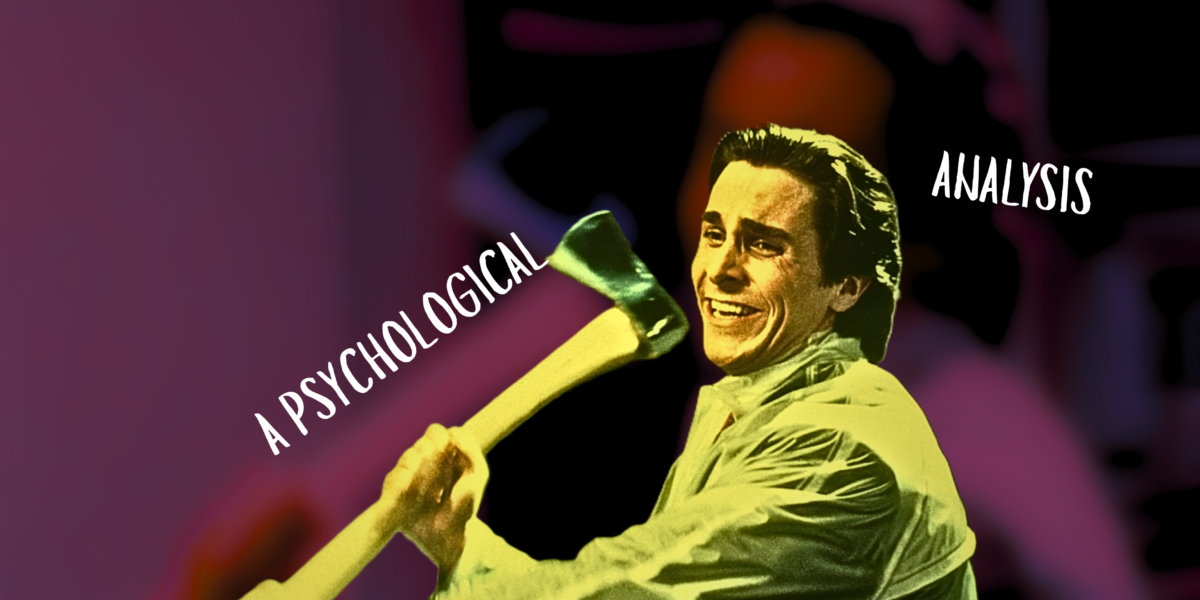
Patrick Bateman is a complicated character. On surface, he is an accomplished 27-year-old man working on Wallstreet. He is engaged and has friends at work.
But he also kills people. Even the reasons behind his killings are complex. There are conflicts within that drive instability. Within his emotional and behavioral states there is an oscillation between control and collapse, identity and emptiness, recognition and concealment.
Bateman is the anti-hero of the novel and film American Psycho. However, for this character analysis I would be using his portrayal in the film.
So, let’s dive right into the warped mindset of Patrick Bateman!
i — Interpretation of behavior based on psychological theory and expertise. (see evidence framework)
Patrick Bateman’s Character and Personality Traits
Patrick Bateman’s Emptiness and Need for Approval
Patrick Bateman feels empty if he is not challenged or at least questioned. Notice how in the first two-hooker sequence, Bateman actively asks them if they’d like to know where he worked. This is not a casual detail as it shows that Bateman actively tries to generate situations where his identity can be acknowledged, tested, or reacted to.
The reason why this brings excitation to Bateman is because he tries to “perform” life as a conformist when he isn’t. He has a certain amount of deluded thinking. For example, he claims he has no emotions other than greed and disgust, but there is also pain, emptiness, sexual impulse, and anger.
These emotional states contradict his own self-description, suggesting that his awareness of himself is incomplete or selectively denied.
I believe that the emptiness of a conformist life and greed to attain more gratification are what destabilize Bateman. Bateman’s behavior is driven by a feedback loop in which the emptiness of a conformist, externally defined life produces psychological pain, which he attempts to counter through increasingly intense forms of stimulation. These attempts generate temporary arousal but fail to resolve the underlying void, leading to deeper emptiness and further escalation.
His killings become more and more erratic as the movie progresses, and his level of excitation also develops alongside it. Both the behavior and the arousal are bidirectional, and the fuel for both of them is a feeling of pain and emptiness from pursuing a conformist life that does not align with his internal state.
Patrick Bateman’s Excitement Seeking
Enjoyment of a Hunt
I have noticed in Bateman a pattern of deriving excitement from being challenged by the other person and then when that challenge overcomes Bateman, he finds it out of his locus of control and he kills people in response to the pain derived from a lack of control over the environment and how he is perceived.
In cases where this challenge is low (e.g Jean and Evelyn), Bateman feels a lack of interest. In cases where this challenge is managed (e.g Timothy Bryce), Bateman feels interested but not enough to escalate challenge. In cases where the challenge is high (e.g Paul Allen) Bateman feels insecure right from the start and looks for ways to escalate the challenge without compromising himself.
However, it’s not just that excitement seeking is only for enjoying a hunt; it is also for stabilizing his personality.
Excitement as the Chief Motive for a Stable Existence
Bateman appears to engage in a challenge–response pattern, but the underlying mechanism is not reward-seeking. Instead, perceived challenges function as narcissistic threats, and his responses – ranging from boredom to symbolic competition to violence – serve to regulate the instability of his self-concept and restore a sense of control.
He literally says:
“My need to engage in homicidal behavior on a massive scale cannot be corrected, but, uh, I have no other way to fulfill my needs.”
Bateman does not seek out challenge, but he becomes intensely aroused by situations of status comparison.
In psychoanalysis, this process is called gratification of id impulses. The only issue here is that operating primarily on the pleasure principle is self-destructive.
These moments amplify both anticipation of dominance and fear of inferiority. When outcomes affirm his constructed identity, he experiences heightened pleasure; when they threaten it, he experiences equally intense narcissistic injury. His violent behavior emerges as a means of resolving this unbearable polarity by reasserting absolute control over both the environment and his perceived identity.
So, conforming to society in almost every public aspect of his personality is an act of self-preservation.
But the issue with using the pleasure principle as the guiding point while maintaining a facade is that once that façade slips, the id impulses burst through – primarily because the id does not want to be contained. I have covered how this spills over in the section on Bateman’s motives and behaviors.
Patrick Bateman’s Severely Impaired Empathy
On the surface, it seems as if Bateman lacks almost all features of emotional empathy. However, it appears that he denies the expression of emotional empathy rather than lacking it entirely.
A tell-tale sign is that Bateman gives appropriate emotional responses to emotional conflicts. For example, he understands Evelyn’s insistence and responds within her emotional logic. The issue is not that he cannot understand – it is that he chooses not to engage authentically.
But why does he deny emotional empathy?
Emotional Empathy, Sadism, and Control
Bateman’s relationship with emotional empathy is complex. While he appears to lack it, there are indications that he understands emotional dynamics but chooses not to engage with them fully.
His sadism suggests that he derives pleasure not only from control but from the denial of emotional reciprocity. This is partly why he engages in intimacy – only to later overpower the other person. The transition from connection to domination reflects his need to convert vulnerability into control.
His killings are largely impersonal, except for Paul Allen, which further reinforces the idea that violence serves a regulatory rather than expressive function. This is in stark contrast to Hannibal Lecter who kills out of disgust and as a way of expressing utility for the victim.
Patrick Bateman’s Isolation
Another important aspect is the level of isolation Bateman exists in. He almost never speaks the truth to anyone, cancels meetings, and maintains shallow interactions. Even when surrounded by people, there is a lack of genuine connection.
His activities during isolation can appear productive – taking care of himself, maintaining routines – but they are paired with more disturbing behaviors, such as working out to the sound of screams from horror movies and consuming pornography in a dissociative manner.
In some ways, Bateman’s apartment reflects his mental state. It is clean, organized, and controlled, but devoid of personality. It is not a lived-in space, but a constructed one. The only people who enter it are those he plans to dominate or control.
Vanity and the Core Paradox
One of the most obvious traits of Bateman is his vanity. It exposes his “monster,” even as society allows him to get away with it.
Examples include:
- dropping Paul Allen’s card
- reacting to status comparisons
- sensitivity to how he is addressed – “your complement was sufficient, Luis” and his very apparent grimace at being called “honey”.
However, this vanity is tied to a deeper contradiction. Bateman has a desire to be understood combined with an inability to tolerate that understanding.
He wants to be understood and does not want to be understood at the same time. This unresolved tension produces continuous oscillation between performative conformity and attempts at differentiation.
As neither state resolves the conflict, he turns to increasingly extreme behaviors in an attempt to assert a sense of realness and control, only to find these efforts absorbed or neutralized by the system he is trying to escape.
Patrick Bateman’s Narcissism
Bateman’s narcissism has been touched on by many film analysts, fans and critics. However, the type of narcissism that Bateman exhibits is mostly vulnerable narcissism masked by grandiosity. While some might argue that the luxurious of his apartment, his outfits and extensive self-care routine point towards grandiosity, all of this is largely shown as a façade rather than something which reflects his identity. In this case, he is very similar to the protagonist of Fight Club. While his apartment is luxurious, he rarely has guests over.
Here is why I believe that Bateman is a vulnerable narcissist rather than a grandiose one:
- Bateman keeps his luxurious apartment usually private; almost exclusively throughout the movie, he has brought people in to kill them.
- He is desperate to portray himself as a member of society rather than someone above it. This is an example of a defensive tactic for self-preservation, used mostly by vulnerable narcissists as compared to grandiose.
- Most of his expressions of grandeur are private (telling the homeless man to get a job, showing off his apartment to prostitutes in secrecy).
- His controlled attempts at seeking need for approval from other colleagues. When he doesn’t get the approval, his emotional state seems very similar to shame, an emotion more prevalent in vulnerable narcissists.
Interestingly, Paul Allen seems to be more of a grandiose narcissist than Bateman – due to his open and loud announcement that he has and can get a reservation at Dorsia.
The Origins of Narcissism in Patrick Bateman
While in the movie Evelyn mentions that Bateman’s father practically owns the firm he works in, this is starkly different from the background Bret Easten Ellis details in the original book. According to the book, Bateman’s father lives in the Carlyle Hotel, distant from the protagonist. He is wealthy and Bateman refers to him in past-tense, implying that he is either dead or being consciously forgotten by Patrick. His mother, on the other hand, was institutionalized at Sandstone, a high-end psychiatric facility. For both of his parents, Patrick feels either repulsion or active repression. Such a history opens grounds for many psychiatric disorders – however, narcissism is not usually predicted by these risk factors.
Instead, it appears as if Bateman’s narcissism could have cognitive and emotional roots rather than primarily genetic ones.
The important distinction here is that having a difficult childhood does not automatically produce narcissism. What matters is how Bateman appears to have psychologically organized his experiences. His relationship with both parents seems characterized by emotional distance, rejection, and the absence of a stable source of attachment or validation. Rather than developing a secure sense of self through meaningful relationships, Bateman appears to construct his identity around external indicators of worth: appearance, wealth, status, achievement, and the recognition of others.
I have explained the difference between the two types of narcissism in greater detail here.
Why Does Patrick Bateman Talk About Music?
One of Patrick’s quirks is his affinity to not only enjoy music but talk in great detail of not just the rhythm but of the backstories of the songs, the artists that made them and their reception. If anything, it seems more as a genuine hobby than performative behavior. Why? Because there is almost nothing to gain from this narration of Hip to be Square or Whitney Houston. In fact, he gives no reaction to someone who finds his interest or narration funny (Patrick’s ex-girlfriend literally chuckled while he was describing the music but he gave no reaction at all).
This does not mean that Patrick’s fixation on music is shallow. Rather, it seems to be the opposite.
There is almost no point in the movie other than when he talks about music where he goes in as much detail. Keeping in mind his isolation, it is easy to see why he bonds with music and its backstory – there is no reciprocal exchange of deep issues. He can listen to art and learn about it and the artist without compromising himself on any level.
Music allows him one-way, transcendental access to his emotions. He listens to it with others only when he wants to share his emotions with them. Normally, this involves killing them.
However, he does not usually express his taste in music to people he does not want to open up to. This is why he denies caring for Huey Lewis and the News when the detective asks him about it. This is also why he does not share his taste with his fiancé; he just does not want to open himself up to people who could compromise him.
Patrick Bateman’s Personality Type (MBTI Framework)
Patrick Bateman can be loosely understood through the lens of ENTJ personality traits, though in a highly distorted and unstable form. His extraversion is directed toward status and perception, his intuition is abstract but fragmented, his thinking is structured but performative, and his judging trait manifests as rigid control and routine.
We have written on the Myers Briggs Type Inventory here, if you are interested in it.
At the level of cognitive functions, dominant external structuring (Te) and sensory escalation (Se) attempt to compensate for fragmented meaning (Ni) and suppressed internal values (Fi). This imbalance produces a personality that appears controlled and dominant on the surface but is internally unstable and disorganized.
The Disintegration of Patrick Bateman’s Behaviors
Why Does Patrick Bateman Kill People?
I’ll go right into the core of Bateman’s homicidal nature. There is a general lack of detail with which his history is treated in the film.
Hence, the obvious explanation is that his traits of excitement seeking, combined with emptiness and isolation along with a way to exert absolute control and power are the main psychological factors behind his killing. Plus, the fact that his father practically owns a (supposedly) big corporation on Wallstreet places him in a position of familial power where he has safety guards for his murderous habits (including a renowned and competent lawyer). His meticulous nature of cleaning after the mess he creates along with usually targeting relatively unknown people to kill also lead to maintaining his habits.
All in all, he can derive excitement and maintain his façade.
But here is a question: what happens if one finds their primal urges to finally surpass their need for self-preservation?
Why Did Patrick Bateman Kill Paul Allen?
Paul Allen represents one of the clearest examples of a high-intensity challenge within Bateman’s social environment.
In cases where the challenge is high, Bateman feels insecure right from the start and looks for ways to escalate the challenge without compromising himself. Paul Allen embodies everything that destabilizes Bateman – status, recognition, and comparison. The business card scene captures this perfectly, where Bateman’s reaction is not proportional but deeply personal, revealing a fragile sense of identity beneath the surface.
The killing of Paul Allen was more of a “Bateman finally spilling over” rather than something that he preferred to do as a routine act. While it was premeditated, Patrick had never shown to kill a colleague before. From this point onwards, his behavior got more impulsive with each subsequent kill.
The act functions as a restoration of control in a situation where Bateman feels overshadowed and destabilized. It also functions as the victory of hedonism and id gratification over conformity.
However, once the id receives significant gratification, it demands much more.
And what happens if an anomaly sucks the enjoyment out of another hunt?
Why Did Patrick Bateman Spare Jean?
Jean is the second colleague who Patrick tried to kill. But Jean seemed to be significantly different from Paul Allen.
One of the most interesting points in the movie is when Patrick decides to let Jean go. The reason partly lies in the progression of the murder weapons he is contemplating to use, asking Jean certain questions, as if qualifying not only whether he should kill her or not but based on what manner he wants to kill her in.
He starts with a short but pointy knife, good for stabbing – an intimate method. He then looks at a cleaver, something with which one could hack at small bones, more intimate and more brutal. Then he contemplates duct tape, making a joke about Ted Bundy – a “fun” way of killing her which might involve keeping her alive for a longer time.
However, when Jean shows her ignorance of Ted Bundy, he switches to a nail gun and positions himself behind her. To the viewer, this seems more shocking because of the size of the weapon, but it appears more impersonal to Bateman, removing some of the “engagement” from the act. Then the phone call from Evelyn dissipates his tension completely, and he asks Jean to leave before any violence occurs.
This gives us an insight into the reason.
The reason why he does not kill Jean is twofold. First, there is immediate tension dissipation due to interruption. Second, based on Jean’s honest and non-exploitative behavior, there is no clear power dynamic between her and him that he can meaningfully exploit. There is almost no material or social gain to her from the interaction, yet she is present in his space without engaging in the same hierarchy-driven dynamics that define his other relationships.
There are some in psychology circles who believe that serial killers kill primarily in order to restore power dynamics in their favor. In Jean’s and Bateman’s dynamic, this was almost completely neutralized by Jean’s honest responses.
Even though she is his subordinate, her attitude is more friendly than submissive. This was not the case with the prostitutes Bateman had murdered beforehand who easily submitted due to an ulterior motive, which was money. Slowly, as he gets to know her, her innocence and genuinely interested attitude shifts him to consider more impersonal methods of killing when he seemed to want to have a more intimate kill.
Moreover, Jean appears more grounded than others in his life, and this grounded-ness makes it difficult for Bateman to convert the interaction into a structured act of domination or symbolic resolution. She sees him for who she is.
Why Did Patrick Bateman Spare Louis?
A very similar thing occurs when Patrick tries to kill Louis. Seeing his card, Patrick saw a clear, world-shattering challenge; similar to Paul Allen but far more visceral because Patrick always looked down on him. Suddenly, Louis seemed to have ‘dominated’ him in a way that was not at all anticipated.
However, Louis’s misreading of Bateman trying to strangle him as a genuine advance towards intimacy also dissipated the tension and showed a side of Louis that admired him rather than belittle.
Did Patrick Bateman Actually Kill Anyone?
The Insanity of Bateman’s World
One of the major reasons why Bateman seems not to have been caught is because society “compromises” and allows him to slip through the cracks of the system – even if he does not want to.
Notice how Bateman’s father owns the company, allowing him to exist without real accountability. His lawyer claims to have had dinner with Paul Allen, even after Bateman believes he has killed him. The detective offers him an alibi rather than pursuing him aggressively.
Even when Bateman attempts to break from conformity as a serial killer, the system absorbs and neutralizes his actions. His attempts to stand out are continuously undermined by a world that refuses to register his deviation.
Bateman does not seem to like compromise, whether it is about getting what he wants or fulfilling what others expect of him. Yet he is trapped in a system that is built on compromise, misrecognition, and surface-level interaction.
This is why it is very slightly implied that it could all be in Patrick’s head. The movie does not leave us with any sort of resolution. However, for all intents and purposes, Bateman did seem to have truly intended to kill. Perhaps there is doubt that he killed Paul Allen, but there is a bigger implication that he did kill the prostitutes along with his ex-girlfriend.
Possible Mental Disorders Present in Patrick Bateman
Was Patrick Bateman a Psychopath or Sociopath?
Bateman is a sadist, and he appears to derive pleasure from withholding emotional empathy. His actions suggest not an absence of awareness, but a deliberate disengagement from it.
This places him in proximity to labels like “psychopath,” but those labels alone fail to capture the instability, contradiction, and escalation that define his behavior.
However, Bateman does seem to fulfil the criteria of personality disorders, especially antisocial personality disorder and narcissistic personality disorder. Hence it would be appropriate to say that Bateman is a psychopath and a narcissist. These are the two psychiatric disorders he most probably possesses.
Does Patrick Bateman Have OCD or Schizophrenia?
Patrick has a vigorous routine around self-care and maintenance of public image. This could be misread as an indication of Obsessive Compulsive Disorder but there is no pattern to suggest that this routine is started or maintained by obsessive thoughts of it. He, thus, probably does not have OCD.
There is also a possibility of psychosis. After all, the people he supposedly killed seemed to not have any remains left at Paul Allen’s apartment. Moreover, even his killing of Paul Allen is questionable.
Not only that, almost nothing comes out of the police pursuing him after he went on a murder spree. All of this is extremely strange.
But, as I covered earlier, the movie seems to make this into a sort of statement on society itself.
I would, however, say that someone with acute psychosis could behave similarly (not in violence, but complete disorientation and paranoia) as Bateman behaved.
Conclusion
Patrick Bateman is not simply a psychopath, nor can he be fully understood through labels like narcissism or antisocial personality disorder. These explanations describe aspects of his behavior, but they fail to capture the instability that defines him.
Bateman is a character driven by a contradiction.
He needs recognition to sustain his identity, yet he cannot tolerate being truly seen.
Through this view, one can see that his violence is not random. There are hedonistic as well as self-regulatory elements behind. It emerges at points of psychological rupture when comparison becomes unbearable, when his sense of control is threatened, or when his constructed identity begins to fracture.
Killing, in this sense, is not simply an act of cruelty but an attempt to restore order, to reassert dominance over a reality that refuses to stabilize around him. Yet these attempts ultimately fail. The more he escalates, the less real his actions seem to become.
This is where Bateman’s world becomes most disturbing. Even his most extreme behaviors, his confessions, his violence, and his attempts to stand out are absorbed by a system that reduces everything to surface-level interaction. Whether or not he actually killed anyone becomes secondary. What matters is that nothing he does is enough to break out of the structure he is trapped in.
In the end, Patrick Bateman is left with a truly unnerving sense of internal conflict and pain. Whatever he does seems to be of no consequence.
This confession has meant nothing.

I am a Clinical Psychologist and a Lecturer of Psychology at Government College, Renala Khurd. Currently, I teach undergraduate students in the morning and practice psychotherapy later in the day. On the side, I conjointly run Psychologus and write regularly on topics related to psychology, business and philosophy. I enjoy practicing and provide consultation for mental disorders, organizational problems, social issues and marketing strategies.
- M Abdullah Qureshi

- M Abdullah Qureshi
- M Abdullah Qureshi

- M Abdullah Qureshi