Why do people repeat what hurts them, even when they know better? Why does love feel both deeply life-giving and strangely destabilizing? And why do creativity, passion, and self-destruction so often appear side by side in the same person?
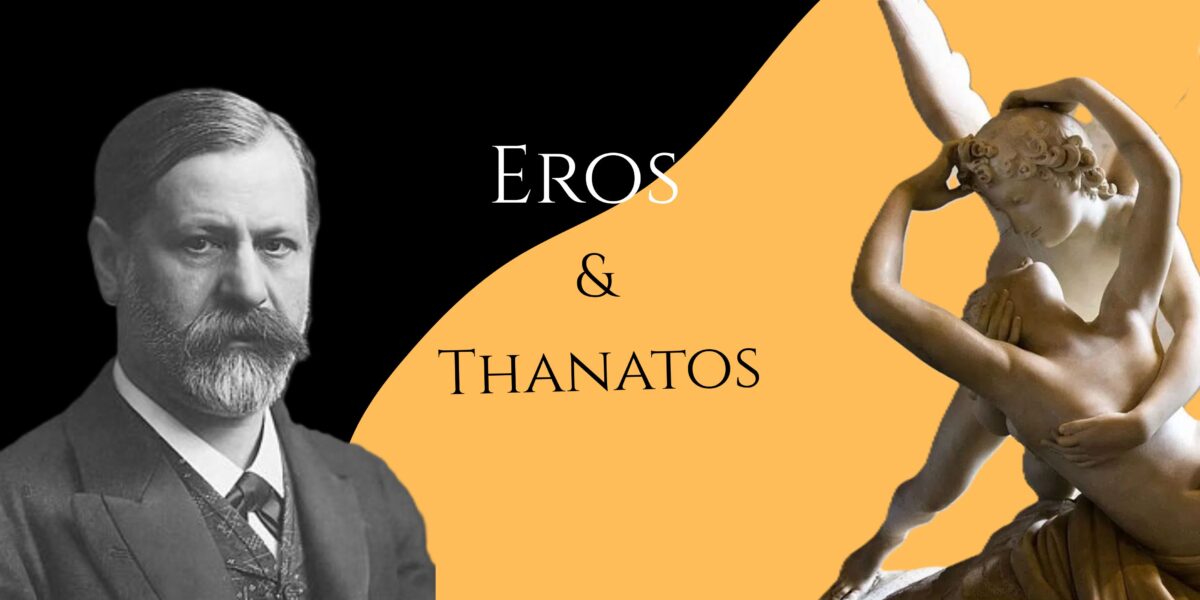
Sigmund Freud, one of the most influential psychologists and the father of psychoanalysis, tried to answer these questions through one of his most powerful and controversial ideas: the conflict between Eros and Thanatos.
This article breaks down the meaning of Eros and Thanatos, how Freud developed the theory, how it applies to modern psychological life, and why this conflict between life and death instincts still feels so relevant today.
Short Summary:
Eros and Todestrieb (Thanatos) are life and death instincts signifying people’s tendency to go towards life-enhancing and/or life-ending situations/states/behaviors. All human behaviors and thoughts occur on the basis of the tension between these instincts, as per Freud. However, modern psychology has moved beyond conceptualizing motivators of behavior as instincts, since such concepts cannot be reliably tested or scientifically demonstrated.
What Does Eros and Thanatos Mean?
In Freudian psychology, Eros and Thanatos refer to two opposing forces within the human psyche. Eros is associated with life, love, pleasure, sexuality, and emotional connection, while Thanatos refers to aggression, destruction, repetition, and the unconscious pull toward dissolution or death.
Eros: The Life Instinct
Freud used the term Eros to describe the life instinct: the force that preserves, binds, creates, and sustains life. While earlier psychoanalytic theory focused primarily on sexuality, Freud later expanded Eros into a broader principle that includes emotional attachment, self-preservation, intimacy, creativity, and the tendency to form greater unities.
In Beyond the Pleasure Principle, Freud moved toward the idea that life is driven not only by pleasure-seeking, but by a force that attempts to preserve and organize living existence. Herbert Marcuse later summarized this idea by describing Eros as the instinct that seeks to establish and preserve “ever greater unities” of life.
Eros therefore includes:
- love
- sexuality
- pleasure
- emotional bonding
- creativity
- survival
- union and connection
Marcuse emphasized that Freud eventually defined Eros as “the great unifying force that preserves all life.”
Hence, Eros becomes a principle of psychological and biological integration.
At its deepest level, the life instinct represents the tendency to move toward attachment, continuity, and meaning.
Thanatos: The Death Instinct
Opposing Eros is Thanatos, often called the death drive. Freud developed this concept (which he called Todestrieb) after observing that human beings frequently repeat painful or destructive experiences rather than avoiding them.
Fun Fact
Freud never actually used the term ‘Thanatos’ in his writings. It was first used by Wilhelm Stekel in 1909 and was only used while speaking by Freud (according to Ernest Jones, his biographer).
In trauma, neurosis, and everyday life, people often seem drawn toward suffering:
- destructive relationships
- compulsive repetition
- aggression
- self-sabotage
- emotional numbness
To explain this, Freud proposed that part of the psyche moves toward the reduction of all tension (as opposed to moving towards growth). In Freud’s later theory, the organism carries a tendency to return to an earlier and more inert state. In Marcuse’s words, it is a “compulsion inherent in organic life to restore an earlier state of things.”
Freud eventually connected this tendency to what he called the death instinct. Marcuse explains that the pleasure principle itself increasingly appears tied to the “Nirvana principle”: the drive to reduce excitation, tension, and disturbance.
Thanatos and Defense Mechanisms
Thanatos therefore refers to tendencies associated with:
- aggression
- destruction
- self-sabotage
- repetition of suffering
- emotional deadness
- withdrawal
- dissolution and tensionlessness
These tendencies are also associated with defense mechanisms. Thanatos could be understood as the framework which guides the ego to deploy defense mechanisms according to a specific trauma or anxiety.
Freud’s theory is more complex than a simple “wish for death”; the death drive reflects a deeper psychological movement toward undoing tension, conflict, and stimulation itself – the work of defense mechanisms.
This is why Freud’s theory remains so unsettling: the psyche appears divided between forces that seek connection and forces that move toward disintegration.
Why Did Freud Create the Theory of Eros and Thanatos?
Sigmund Freud originally explained human behavior in terms of the pleasure principle. But in the latter part of his career, he arrived at it after encountering a problem that the pleasure principle could not fully explain.
Evolution of Freud’s Thoughts on the Pleasure Principle
According to Freud’s earlier theory, the psyche was fundamentally organized around the reduction of unpleasure and the pursuit of gratification.
Yet certain clinical observations seemed to contradict this model.
Patients repeatedly returned to painful experiences instead of avoiding them. Traumatic dreams recreated distress. Neurotic patterns resurfaced even when they produced suffering rather than satisfaction.
As stated in Beyond the Pleasure Principle, Freud became increasingly concerned with this tendency toward repetition. Rather than moving directly toward pleasure, the psyche often seemed compelled to relive disturbing experiences. Herbert Marcuse later described this as Freud’s discovery of “a compulsion inherent in organic life to restore an earlier state of things.”
This idea radically transformed Freud’s theory of instincts.
Instincts were no longer understood simply in terms of biological needs or pleasure-seeking functions. Instead, Freud increasingly viewed them as forces that give psychic life a certain direction.
Freud’s later metapsychology no longer defined instincts by their origin alone, but by the tendency or “life-principle” guiding them.
At the center of this shift was Freud’s growing suspicion that all instinctual life contains a deeply conservative tendency. Even the pleasure principle appeared connected to a more fundamental drive toward the reduction of excitation.
From this perspective, the psyche is not governed by pleasure alone. Beneath conscious goals and rational behavior lies a conflict between opposing tendencies:
- one that binds, preserves, and unifies life
- another that moves toward inertia, dissolution, and the undoing of tension
Freud’s theory of Eros and Thanatos emerged from this conflict.
Eros and Thanatos as Conjoined Instincts
Freud never presented these instincts as completely separate or stable forces. Marcuse repeatedly emphasizes that Freud saw them as intertwined and often fused together. Even Eros retains a “conservative” tendency because it seeks to restore earlier forms of unity.
Likewise, the death instinct is not pure destructiveness for its own sake, but part of a deeper movement toward release from tension and suffering.
This complexity is one reason Freud’s theory remains difficult to categorize. Rather than presenting human beings as simply rational or pleasure-seeking, Freud portrays the psyche as internally conflicted. Civilization, morality, love, aggression, repression, and even thought itself emerge from this unstable relationship between life-preserving and destructive tendencies.
This evolution also extends to Freud’s theory of personality development. Eros, the libidinal energy seeks to resolve and satiate itself while Thanatos interferes through the way of aggression and fixations.
E — Historical or theoretical influence (Early psychoanalytic theory)
Evidence classification system: Psychologus Evidence Framework
Eros and Psyche: The Myth and Its Psychological Meaning
Long before Sigmund Freud used Eros as a psychological concept, Eros appeared in Greek mythology as the god of desire and passionate attraction. His relationship with Psyche later became one of the most psychologically symbolic love stories in Western thought.
The word psyche itself originally meant both “soul” and “mind” in Greek. Because of this, the myth of Eros and Psyche has often been interpreted as a symbolic relationship between desire and the human soul.
The Meaning Behind the Story of Eros and Psyche
In the myth, Psyche falls in love with Eros but is forbidden from fully seeing him. Their relationship becomes shaped by secrecy, longing, mistrust, separation, and eventual reunion after suffering and transformation.
Psychologically, the story can be understood as more than a romance narrative. It reflects the idea that love changes the structure of the self. Desire is not portrayed as simple pleasure, but as something that disrupts certainty and forces psychological development.
This symbolic connection becomes especially interesting when viewed alongside Freud’s later understanding of Eros as a force that attempts to bind, unite, and preserve life.
It could be said, in Marcuse’s words, that Freud ultimately defined Eros as the instinct striving to establish “ever greater unities.”
The myth of Eros and Psyche mirrors this movement toward union, but it also shows how difficult and unstable such unity can be.
The relationship between Eros and Psyche suggests several psychological themes:
- love transforms the self rather than simply satisfying it
- desire destabilizes identity before creating intimacy
- emotional union requires vulnerability, suffering, and growth
- connection often emerges through uncertainty rather than control
The myth therefore reflects a tension already present in Freud’s theory itself. Eros seeks union and attachment, yet intimacy also threatens the ego (I have explained the id, ego and superego here) with loss of autonomy and emotional exposure.
Marcuse points out that Freud viewed sexuality as carrying both constructive and disruptive possibilities simultaneously. Love can create emotional unity, but it can also unsettle established forms of order and identity.
Why Psychologists Still Use the Symbolism of Eros and Psyche
The story of Eros and Psyche remains psychologically relevant because it dramatizes emotional processes that continue to appear in modern relationships and psychotherapy.
At its core, the myth captures the instability involved in becoming emotionally close to another person. Its psychologically deep portrayal of intimacy is captivating.
The story shows that intimacy is a process involving fear, uncertainty, separation, and transformation.
Many modern psychological themes can be seen within the symbolism of the story:
- intimacy fears
- mistrust and emotional injury
- identity formation through relationships
- emotional maturation through suffering
- the tension between dependence and autonomy
The symbolism also parallels Freud’s broader insight that human beings are internally conflicted. Emotional attachment can become both deeply desired and deeply threatening at the same time.
Marcuse expands this idea further by arguing that Eros contains a drive toward connection that exceeds purely functional or socially useful relationships. In this sense, the myth of Eros and Psyche continues to resonate because it portrays love not merely as romance, but as a force capable of transforming the psyche itself.
Reinterpreting Eros and Thanatos: Bion, Marcuse, and the Modern Psyche
While Sigmund Freud introduced Eros and Thanatos as opposing instinctual tendencies within the individual, later thinkers expanded these ideas beyond instinct theory alone.
Two of the major thinkers that worked on the theory were Wilfred Bion and Herbert Marcuse.
Bion explored how these forces operate through thinking and emotional processing. Marcuse examined how modern civilization itself shapes and represses human desire.
Together, their interpretations shift Freud’s theory from a purely biological framework – slightly touching on large social contexts – into a broader analysis of meaning, culture, emotional life, and social organization.
Bion: Eros and Thanatos as Mental Processes
Bion transformed Freud’s instinct theory into a theory of thinking.
His study revolved around whether the mind can emotionally process experience without collapsing into fragmentation, denial, or psychic attack.
For Bion, psychological growth depends on the mind’s ability to create links:
- between thoughts and feelings
- between inner reality and outer reality
- between self and others
- between painful experience and meaning
This linking function resembles what Freud associated with Eros: the movement toward integration, emotional development, and psychic unity.
In Bion’s framework, Eros appears through:
- learning from experience
- emotional containment
- tolerating frustration
- reflective thinking
- sustaining emotional connection
However, Bion also observed that the psyche can unconsciously attack these very processes. In his famous concept of “attacks on linking,” patients destroy emotional understanding precisely when understanding becomes psychologically threatening.
This destructive tendency resembles Freud’s Thanatos, but with greater cognitive depth. Instead of direct self-destruction, the psyche attacks its own ability to think, feel, and remain emotionally connected.
Thanatos-like processes in Bion therefore include:
- fragmentation of thought
- attacks on meaning
- hatred of dependence
- emotional evacuation
- refusal of painful truth
- destruction of relational bonds
What makes Bion’s interpretation powerful is that destructiveness is no longer limited to aggression or overt violence. The mind may undermine itself by rejecting insight, sabotaging intimacy, or attacking emotional reality itself.
Someone who repeatedly destroys supportive relationships, rejects help, or sabotages therapy may unconsciously be attacking the possibility of emotional integration.
The conflict between Eros and Thanatos thus becomes a conflict between growth and the destruction of meaning.
Marcuse: How Civilization Weakens Eros
While Bion focused on the internal structure of thought, Marcuse examined the social world shaping the individual psyche. An important detail to understand of Herbert Marcuse is that he was associated with the Frankfurt School of critical theory. His influence on the theory of eros and thanatos involves critical evaluation of capitalism and modern economic systems.
In Eros and Civilization, Marcuse argued that modern civilization systematically organizes human energy around productivity, discipline, and performance rather than genuine fulfillment. He referred to this system as the “performance principle.”
Under this system, individuals increasingly adapt themselves to socially useful labor while suppressing broader forms of pleasure, emotional spontaneity, and instinctual freedom. Marcuse describes how libido becomes redirected into alienated forms of work and performance.
This repression restricts sexuality and reshapes emotional life itself.
Marcuse argues that civilization weakens Eros by:
- fragmenting pleasure
- subordinating desire to productivity
- reducing intimacy to function
- turning bodies and minds into instruments of labor
- organizing leisure around passive consumption rather than fulfillment
At the same time, this weakening of Eros strengthens destructive tendencies. Marcuse repeatedly emphasizes that excessive repression ultimately intensifies aggression and psychic destructiveness rather than eliminating them.
Modern forms of suffering can therefore be interpreted through this conflict:
- burnout culture
- work without meaning
- emotional numbness
- commodified sexuality
- chronic alienation
- cycles of aggression and violence
Marcuse believed that modern society often produces individuals who appear functional and productive while remaining emotionally disconnected from deeper forms of pleasure, intimacy, and selfhood.
From Freud’s Instincts to Modern Psychological Conflict
Together, Bion and Marcuse reinterpret Freud’s theory in two complementary directions.
Bion shows how Eros and Thanatos operate within the mind’s ability to think and emotionally process reality. Marcuse shows how civilization itself conditions, represses, and redirects these forces.
In both interpretations, the conflict between Eros and Thanatos extends far beyond sexuality or aggression alone. It becomes a struggle over:
- meaning versus fragmentation
- emotional truth versus psychic avoidance
- authentic connection versus alienation
- psychological growth versus self-destruction
Freud’s original theory therefore evolves into something broader than instinct psychology. Specifically, Eros and Thanatos become ways of understanding the emotional structure of modern life itself along with individual suffering.
Parallel between Drive Theory and Modern Psychology
On the other hand, there is also developing evidence regarding the two different types of temperaments (first proposed by Elliot and Thrash in 2010) seen from very early on in life; approach vs avoidance temperament. Individuals with approach temperament tend to be more social and seek positive emotions compared to those with avoidance temperament, who are more likely to isolate and are more prone to negative emotionality (high neuroticism). These two theoretical frameworks (temperament vs drive instincts) also appear to explain the development of narcissism into grandiosity or vulnerability similarly – to an extent.
If there is a parallel with modern research, why is Freud criticized?
The parallel between the two theories (modern temperament theory vs drives) is a superficial one. Both approach and avoidance patterns are demonstrably based on genetic predisposition, based on many scientific studies. However, Freud’s concept of the drive instincts is based on private practice and personal self-analysis that has not been replicable.
Moreover, Freud details a developmental origin with the drives, proclaiming that Thanatos emerged as the first instinct. This is a claim based on theoretical philosophy rather than empiricism.
Eros and Thanatos in Everyday Life
The tension between these forces appears throughout ordinary human life. Freud’s theory continues to resonate because it offers a way of understanding why people often seem divided against themselves: capable of love and creativity while simultaneously drawn toward repetition, aggression, and self-destruction.
Eros in Everyday Life
Eros appears wherever individuals move toward connection, integration, creation, and emotional expansion.
This can be seen in experiences such as:
- falling in love
- creating art or music
- forming intimate relationships
- healing from trauma
- building family and community
- helping others emotionally grow
- transforming suffering into meaning
Creativity, emotional intimacy, and psychological healing, all involve bringing fragmented experiences into meaningful connection rather than remaining trapped in isolation or repetition.
Even the process of emotional maturation reflects this tendency. To love another person, sustain intimacy, or create something meaningful requires tolerating uncertainty, frustration, and vulnerability without collapsing into withdrawal or hostility.
Thanatos in Everyday Life
At the same time, human beings frequently act against their own well-being in ways that cannot be fully explained through rational self-interest or conscious desire.
Thanatos-like tendencies may appear through:
- addiction and compulsive behavior
- destructive relationship patterns
- chronic rage cycles
- emotional shutdown
- repeated infidelity or sabotage
- ruining moments of success or intimacy
- compulsive repetition of suffering
Freud’s concept of repetition compulsion becomes especially relevant here. People often recreate emotional situations that hurt them, even while consciously wanting change. The psyche may remain attached to familiar forms of suffering because they feel psychologically unavoidable or unconsciously meaningful (an example of this instinct at play is in a story on hoarding disorder).
Marcuse extends this insight into civilization itself. He argues that modern society channels instinctual life into systems of performance, repression, and alienated labor that weaken richer forms of fulfillment. As Eros becomes increasingly restricted, destructive tendencies may intensify rather than disappear.
This dynamic can be recognized in many contemporary forms of distress:
- burnout without meaning
- emotional numbness
- compulsive online hostility
- alienation and loneliness
- attraction to outrage and destruction
- cycles of political aggression and social fragmentation
The result is a culture that often appears highly stimulated yet emotionally disconnected.
Why These Concepts Still Matter
Eros and Thanatos remain psychologically powerful because they describe competing tendencies that continue to shape modern life.
They help explain:
- why intimacy can trigger fear as well as desire
- why trauma repeats itself across relationships
- why creativity often emerges alongside suffering
- why societies capable of progress also produce violence and alienation
- why individuals may simultaneously seek healing and resist it
Importantly, these concepts function as psychological frameworks for understanding opposing movements within human experience:
- connection versus withdrawal
- integration versus fragmentation
- emotional growth versus psychic collapse
- creation versus destruction
Freud’s theory endures because it confronts something many psychological models struggle to explain: human beings do not merely seek happiness or rational self-interest. They are often internally divided, pulled between forces that sustain life and forces that threaten to undo it.
Conclusion
Sigmund Freud believed human life is shaped by an enduring tension between opposing tendencies: one that seeks connection, creation, pleasure, and emotional unity, and another that moves toward destruction, repetition, and dissolution.
Later thinkers expanded this conflict beyond instinct theory alone. Wilfred Bion showed how these forces operate within the mind’s ability to think, process emotion, and sustain meaning, while Herbert Marcuse explored how modern civilization can weaken emotional fulfillment and intensify alienation.
Although Eros and Thanatos remain controversial concepts, they continue to resonate because they capture something psychologically recognizable: human beings are often divided between what helps them grow and what pulls them toward fragmentation, repetition, and self-destruction.

I am a Clinical Psychologist and a Lecturer of Psychology at Government College, Renala Khurd. Currently, I teach undergraduate students in the morning and practice psychotherapy later in the day. On the side, I conjointly run Psychologus and write regularly on topics related to psychology, business and philosophy. I enjoy practicing and provide consultation for mental disorders, organizational problems, social issues and marketing strategies.
- M Abdullah Qureshi

- M Abdullah Qureshi

- M Abdullah Qureshi

- M Abdullah Qureshi