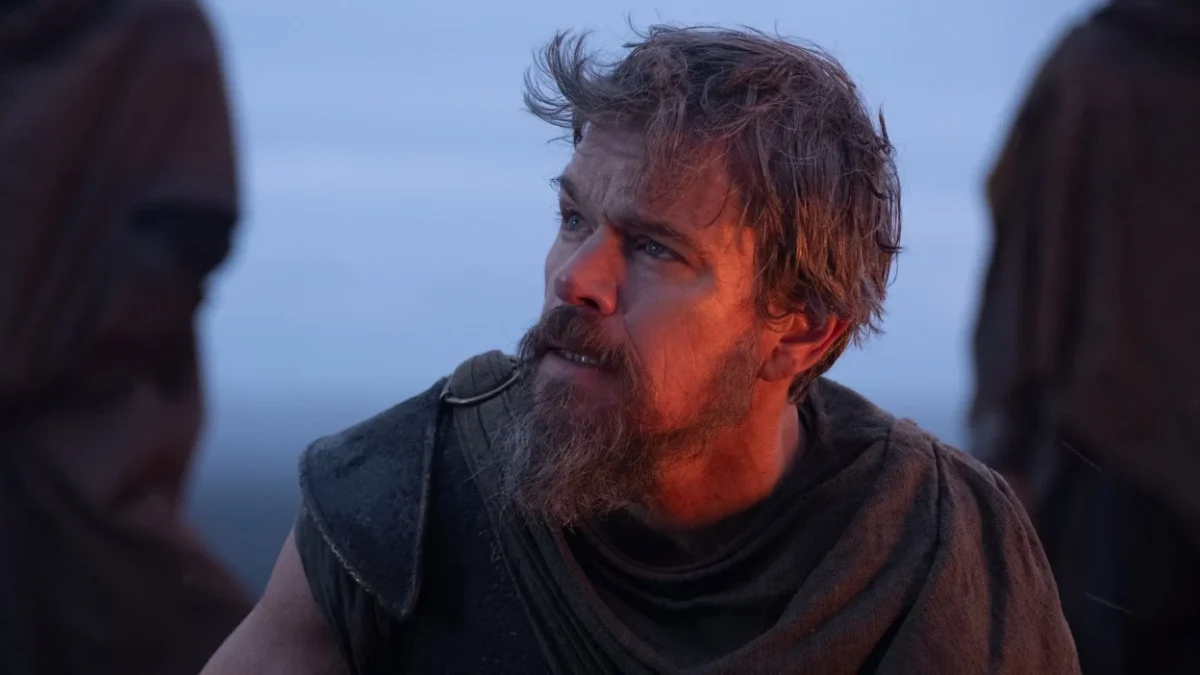
Christopher Nolan’s The Odyssey has already been called, by more than one critic, a film about post-traumatic stress disorder that never once says the word. Matt Damon’s Odysseus doesn’t stride off the ships at Troy as a conquering king. He carries himself like a man who has already lost something he can’t name. Reviewers keep reaching for the same vocabulary: nightmares, guilt, a self that feels broken beyond repair, without quite landing on the clinical term that fits best.
As a clinician, I want to push that reading one step further. What Nolan has actually built isn’t just a portrait of PTSD. It’s a portrait of moral injury, a related but distinct wound, and one far less discussed outside trauma and veteran-care circles. A PTSD researcher and clinician made a similar case shortly after the film’s release, noting how closely Damon’s performance tracks patterns seen in veterans. Watching Damon’s Odysseus through that lens changes what the film is doing, and it gives the myth something useful to say to anyone who has ever come home from something and found they couldn’t fully arrive.
Two Wounds, Not One
PTSD, in its simplest clinical shorthand, is a fear-based injury. The nervous system encodes threat and keeps replaying it: intrusive memory, hypervigilance, a body that won’t stand down even in safety.
Moral injury runs on a different mechanism entirely. It’s the damage done to a person’s conscience when they perpetrate, witness, or fail to prevent something that violates their own values. It tends to cluster around three things: a kind of existential collapse, corrosive guilt and shame, and a pulling away from other people, not because the world feels dangerous, but because the self feels unworthy of connection.
This distinction matters clinically because the two wounds don’t heal the same way. Fear responds to safety and exposure. Guilt and shame respond to something closer to reckoning: acknowledgment, meaning-making, sometimes forgiveness that has to be built rather than simply felt. Nolan’s film, whether or not it was mapped this deliberately, gives Odysseus symptoms of both. But the emotional center of gravity is moral injury.
The Wounds at Troy
Moral injury attaches to specific acts rather than to war in general, and Nolan gives Odysseus two of them.
The first is Sinon. Manipulating his own kinsman into a sacrifice that seals the victory is staged not as clever strategy but as rupture, and Nolan doesn’t let the audience read it as triumph. It plays as the moment Odysseus’s war stops being fought against an external enemy and starts being fought against his own conscience.
The second happens inside Athena’s temple during the sack of the city, and the film holds it back until the third act. It turns out to matter more, for reasons the next section takes up.
Between them, the two events cover the ground the definition of moral injury actually describes: something perpetrated, and something witnessed and not prevented. And this is the clinical distinction that separates moral injury from ordinary battlefield trauma. Neither is something that merely happened to him. Victims of violence carry fear. People who believe they’ve transgressed carry guilt, and guilt is stickier, because it implicates identity rather than circumstance.
The Voyage as Externalized Processing
One reviewer put it well: the film uses a 3,000-year-old war poem to explore PTSD without ever naming the condition, letting monsters and gods do work that clinical language couldn’t. Read as psychology rather than adventure, the Cyclops, the Sirens, and Calypso’s island stop functioning as obstacles delaying a homecoming. They become the trauma story itself, staged in the only language available to someone who cannot yet speak plainly about what happened to him.
Calypso’s island is the clearest example. The lotus flowers that ease Odysseus’s pain and erase his memory of the men he lost aren’t a magical inconvenience. They’re a portrait of avoidance and numbing, the coping pattern the moral injury literature describes in terms of suppression, dissociation, and substance use. The relief is real. So is the cost: as long as he stays, he cannot integrate what happened, and integration is the only route home.
This is also where trauma’s disruption of narrative identity becomes visible. Odysseus doesn’t experience his own story as continuous. It comes to him in fragments, resurfacing out of order, refusing to resolve into a clean account of who he was and who he’s become. That fragmentation isn’t a storytelling device Nolan is using loosely. It’s an accurate rendering of what dissociation does to a person’s sense of self over time.
Athena: The Face He Couldn’t Stop Seeing
Nolan’s most interesting psychological decision isn’t the voyage at all. It’s who Athena turns out to be.
She is not, in this film, a goddess taking an interest in a favored mortal. She first appears during the sack of Troy, in a flashback the film withholds until the third act. Odysseus’s men break into her temple, drag out a young Trojan priestess, and behead her at the same moment a soldier topples and decapitates the statue of the goddess she served. Odysseus watches. He does not stop it.
Every subsequent appearance of Athena wears that girl’s face.
This is a precise piece of psychological construction, and it reframes everything that follows. The definition of moral injury names three routes to the wound: perpetrating, witnessing, or failing to prevent. The temple is the second and third at once. And what Odysseus carries out of it is not fear. It’s a face.
Her first appearance on the voyage comes after Circe transforms his crew into pigs and tells him she hasn’t cursed them, only revealed them. Sitting with that on Aeaea, absorbing what his men actually are underneath, he sees the priestess for the first time since Troy. Note when she arrives: not at the moment of greatest danger, but at the moment of greatest moral confrontation. That timing is the argument of the entire film in miniature. A fear-based injury surfaces when the body registers threat. A conscience-based injury surfaces when a person is made to look at what they, and their own, have become.
For the rest of the voyage she appears intermittently, alone with him on the deck or on empty beaches, and she does two things at once that are usually treated as opposites. She guides him. She also makes him keep looking at the face of the girl his army killed. The film refuses to separate the counselor from the accusation, and clinically that refusal is correct. In the research on self-conscious emotions, guilt and shame pull in opposite directions: shame targets the self and drives concealment and withdrawal, while guilt targets the act and orients a person toward repair. Athena is guilt rather than shame, which is why she can be navigator and reproach in the same body. She is painful, and she keeps him moving.
Then, in Ithaca, disguised as a beggar beside his wife, he begins to say it out loud. Athena appears next to him and takes his hand.
That’s the turn. The figure who spent ten years making him look becomes, at the moment of disclosure, something closer to company. And when the confession is finished, when he has named what happened and accepted his part in it, she is gone.
Read as psychology, that vanishing is the most clinically literate moment in the film. Something that could only be carried as an image, arriving unbidden, resolves once it becomes a story told to another person. That is the mechanism behind decades of work on disclosure and health: what cannot be put into language keeps returning in other forms. Odysseus doesn’t stop being guilty. He stops being haunted, because the material has finally been spoken rather than seen.
One caution about the film’s own framing. Because she disappears, the story invites the reading that Athena was a hallucination and therefore a symptom. That emphasis is worth resisting. Perceptual experiences of the dead are common in grief and are not, in themselves, evidence of psychiatric disorder, and researchers increasingly prefer more neutral terminology precisely because the pathological framing misleads. Odysseus seeing the priestess isn’t a second illness stacked on top of his moral injury. It’s the shape the injury took, which is exactly the thing myth is good at showing.
Shame and the Fear of Being Unlovable
At one point, disguised and unrecognized, Odysseus says something close to what if the man you knew lost his way to Penelope, not as confession, but as a test of whether he’s still lovable if she knew the whole of what happened.
That’s not a plot beat. It maps onto one of the most consistently documented features of moral injury: a conviction that full disclosure would end connection, so disclosure never happens. The clinician writing in The Conversation drew the same parallel, noting how closely that line echoes what veterans say about believing they would not be loved if they were fully known. The isolation moral injury produces isn’t only external; it’s maintained from the inside, by the belief that being truly known is incompatible with being loved. Attachment doesn’t break because someone stops caring. It breaks because the injured person stops believing they’re allowed to be cared for.
Homecoming Isn’t the Ending
Culturally, “homecoming” reads as resolution. Clinically, it’s often the hardest phase of the whole process. The person who returns is not the person who left, and the people waiting have spent years imagining a reunion with someone who no longer quite exists.
Penelope and Telemachus aren’t a reward waiting at the end of Odysseus’s arc. They’re the reintegration phase, and reintegration is frequently more destabilizing than the original wound. It requires two things happening at once: the returning person has to tolerate being known in their changed state, and the people who love them have to tolerate grieving who they were while learning who they’ve become. Nolan’s decision to keep this section tense rather than triumphant is, if anything, the most clinically accurate choice in the film.
Why Myth, Not Diagnosis
None of this needed to be spoken aloud in the film, and that restraint is doing real work. Monsters and gods can carry material that clinical language flattens. A cyclops can hold a magnitude of danger that “hypervigilance” cannot. A goddess who wears the face of a murdered girl, and who leaves only once the truth is finally said out loud, can convey the structure of guilt more precisely than any checklist item. Myth externalizes the invisible, which is exactly what trauma does to the people living inside it: it makes the internal external, whether they want it to or not.
That’s worth remembering in practice, too. Story and metaphor aren’t a softer substitute for clinical understanding; sometimes they’re the more accurate register for describing what a fractured, guilt-carrying, still-fighting-to-get-home version of a person actually feels like from the inside.
Closing
Odysseus is a character, not a patient, and it would be a mistake to diagnose him as though the film were a case file. But Nolan has built something worth taking seriously as a clinician: a hero defined not by the war he survived, but by what he did and failed to stop in it, what it cost his conscience, and how long it took him to let anyone see the whole of what he became. That’s a story a great many people are still trying to tell, about themselves, in their own words, long after the war they carried is over.

Tabraiz is MS Clinical Psychologist and a gold medalist in MSc Psychology. He is passionate about reading and writing on psychological topics and is also an expert in digital marketing. With a deep love for the philosophy of life, he explores the intersection of mind, human behavior, marketing. Member of APA (American Psychological Association)
- Syed Tabraiz Bukhari

- Syed Tabraiz Bukhari

- Syed Tabraiz Bukhari
- Syed Tabraiz Bukhari