More than 125 years ago, an enthusiastic sportsman and master’s level graduate named Norman Triplett chose the topic of competition for his thesis research.
“How does the presence of other people affect us as individuals?” was the main question Triplett set out to answer. His findings were published under the title “The Dynamogenic Factors in Pacemaking and Competition” in the American Journal of Psychology in 1898. The study is widely regarded as the first laboratory experiment in social psychology, and the question it raised grew into research on two major phenomena in social psychology: social facilitation and social loafing.
Triplett was born in Perry, Illinois in 1861 and was involved in a range of competitive sports. Before joining Indiana University as a graduate student, he also worked in a laboratory with William Lowe Bryan (later President of the American Psychological Association). The presence of some of the first experimental psychology laboratories in the country, together with Triplett’s interest in athletic competition, created the setting in which he conducted research that shaped social psychology’s understanding of group dynamics.
Let’s take a look at his competition studies in detail:
The Archival Study: Reviewing Records From Cycling Competitions
Method
For this study, Triplett used official records provided by the Racing Board of the League of American Wheelmen for the 1897 season.
He compared times across three types of races:
- Races against other riders
- Paced races against time
- Unpaced races against time
Results
Average time per mile was faster for the actual races against other riders and for the paced races against time than it was for the unpaced races against time.
In numbers:
- Paced races against time were on average 34.4 seconds per mile faster, a gain of roughly 23 percent
- Paced races against other riders were a further 5.15 seconds per mile (about 3.5 percent) faster than paced races against time, over distances up to 25 miles
Why Were the Cyclists Faster? Triplett’s Explanations
Before running his lab study, Triplett reviewed the explanations that cyclists and trainers of his time offered for why paced and competing riders went faster. They included:
- Suction theory: the pacing machine creates a vacuum that pulls the rider along behind it.
- Shelter theory: the pacer shields the rider from the wind.
- Encouragement theory: friends and supporters on the pacing team cheer the rider on.
- Brain worry theory: the unpaced rider tires faster because he must constantly worry about whether he is going fast enough.
- Theory of hypnotic suggestion: the rider becomes mesmerised by the wheels of the pacer ahead.
- Automatic theory: the pacer takes over the thinking, so the rider’s muscles can work automatically.
- Dynamogenic theory: the bodily presence of another rider arouses the competitive instinct and releases nervous energy that is not otherwise available.
Triplett was not convinced by the mechanical explanations. Wind shelter could account for some of the difference, but it could not explain why head-to-head races, where no one is sheltered for long, produced the fastest times of all. He favoured the dynamogenic theory, and his laboratory experiment was an attempt to test it with physical factors such as wind removed.
Experimental Study: Testing Theory in the Lab
Method
For this experiment, Triplett built an apparatus called the “Competition Machine”, in which two individuals could compete with each other by turning fishing reels as quickly as possible. The task was to wind the reel rapidly and complete the circuit four times as fast as possible.
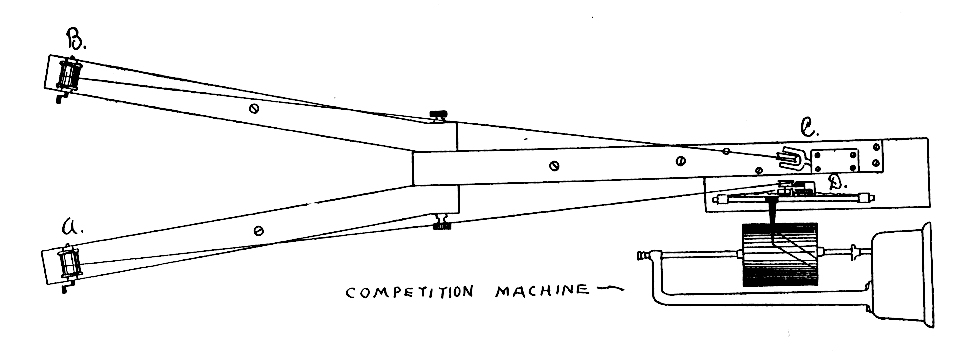
The participants were 40 children aged 8 to 17. Each child completed a series of six trials, with five-minute rest intervals between them to avoid fatigue. Each trial lasted about 40 seconds.
For counterbalancing, the children were divided into two groups that completed the trials in different orders:
Group A: Alone, Competition, Alone, Competition, Alone, Competition
Group B: Alone, Alone, Competition, Alone, Competition, Alone
Results
- 20 children were positively stimulated by competition (they performed better when competing).
- 10 children were over-stimulated (they performed worse when competing).
- 10 children were little affected by competition.
From these results, he concluded: “regarding the laboratory races we infer that the bodily presence of another contestant participating simultaneously in the race serves to liberate latent energy not ordinarily available”.
It is worth noticing what the numbers actually show. Only half of the children improved when racing against another child. A quarter got worse, and Triplett described many of them as “over-stimulated”: they lost control of their movements while trying too hard. So from the very first experiment, the presence of others did not have one simple effect. This detail was largely overlooked for decades, but it later became the key to understanding social facilitation.
From Triplett to Social Facilitation
Triplett did not use the term “social facilitation” himself. It was introduced by Floyd Allport in 1920, who studied how people performed tasks alone versus alongside others doing the same task (known as coaction). Researchers soon identified a second form, the audience effect, in which people are simply watched rather than competed against.
The findings, however, were confusing. Some studies showed that people did better in front of others, while others showed that they did worse. For about forty years, social psychologists had no clear explanation, and research on the topic slowed down.
Zajonc’s Drive Theory (1965)
Robert Zajonc resolved the puzzle in a 1965 paper in Science. He proposed that:
- The mere presence of other members of the same species increases physiological arousal.
- Arousal strengthens a person’s dominant response, the response that is most practised or most likely in that situation.
- On simple or well-learned tasks, the dominant response is usually the correct one, so performance improves.
- On complex or new tasks, the dominant response is often wrong, so performance declines.
This explains Triplett’s “over-stimulated” children very well. For some children, winding the reel as fast as possible was not yet a smooth, well-practised action, and the added arousal of competition disrupted them instead of helping them.
Zajonc, Heingartner and Herman (1969) even tested the theory with cockroaches. Cockroaches ran a simple straight runway faster when other cockroaches watched from “audience boxes”, but were slower in a more complex maze when watched. A classic human example comes from Michaels and colleagues (1982): skilled pool players became more accurate when observed, while weaker players became less accurate.
Personality matters too. People high in extraversion, who naturally seek stimulation, tend to benefit more from an audience, while those who are already highly aroused may tip over into the kind of over-stimulation Triplett observed.
Other Explanations
Later researchers suggested that arousal is not the whole story:
- Evaluation apprehension (Cottrell, 1968): It is not other people’s presence that arouses us, but the worry that they are judging us. In Cottrell’s study, the effect weakened when the audience was blindfolded. People high in neuroticism, who are more prone to anxiety, may be especially sensitive to this kind of evaluation.
- Distraction-conflict theory (Baron, 1986): Other people are distracting. The conflict between attending to the task and attending to the audience creates arousal, which then produces the effects Zajonc described.
A large meta-analysis by Bond and Titus (1983), combining 241 studies, supported the core pattern: the presence of others slightly speeds up simple performance and impairs complex performance. The overall effect, however, is small.
The Other Side: Social Loafing
Triplett’s participants were competing, and each person’s performance could be seen and measured individually. When individual effort cannot be identified, the opposite often happens.
The earliest evidence came from Maximilien Ringelmann, a French agricultural engineer, whose findings were published in 1913. He found that people pulling a rope in a group each pulled with less force than when pulling alone. Latané, Williams and Harkins (1979) later named this social loafing, finding that people clapped and shouted less loudly per person as group size increased.
Social facilitation and social loafing are therefore two sides of the same question Triplett asked. Whether others push us to work harder or allow us to slack off depends largely on whether our individual contribution is being evaluated.
Criticisms and Limitations of Triplett’s Study
Despite its historical importance, Triplett’s research has several weaknesses:
- No statistical analysis: Triplett judged his results by inspecting the data and observing the children. When Strube (2005) reanalysed the original data with modern statistics, he found only weak evidence for an overall competition effect.
- Small, narrow sample: Forty children aged 8 to 17 is a small group with a very wide age range, and tells us little about adults or about other kinds of tasks.
- Subjective classifications: Labels like “over-stimulated” were based partly on Triplett’s impressions of the children’s behaviour rather than on standardised measures.
- Confounds in the archival data: In the cycling records, pacing also provided real wind shelter, and paced, unpaced and competitive races may have attracted different riders. Archival data like this can show a pattern but cannot establish cause and effect.
- Its “first experiment” status: Stroebe (2012) and others have pointed out that Triplett’s study was not really the first social psychology experiment, and that it has been cited far more often than it has been carefully read.
These criticisms do not erase Triplett’s contribution. His real achievement was turning an everyday observation into a question that could be tested in a laboratory.
Social Facilitation in Everyday Life
Triplett’s question is still relevant today:
- Sports: Athletes often set personal records in competition rather than in training, exactly as Triplett saw in his cyclists.
- Studying and working: Many people get more done in a library, café or co-working space than alone at home, as long as the work is familiar.
- Exams and presentations: Being watched while doing something difficult or unfamiliar, such as a first presentation or a new skill, can make performance worse.
- Practice: Drive theory suggests practising a skill privately until it becomes automatic. Only then does performing in front of others become an advantage instead of a burden.
Conclusion
Norman Triplett began with a simple question from the cycling track: why do riders go faster when others are with them? His answer, the “dynamogenic” release of energy through competition, turned out to be only part of the story. His own data already hinted at the rest: the presence of others helps some people and hinders others. Later work by Allport, Zajonc, Cottrell and Latané showed that the effect depends on the task, the person’s skill, and whether their effort is being evaluated. More than a century later, Triplett’s experiment remains a starting point for understanding how groups shape individual behaviour.
References
- Allport, F. H. (1920). The influence of the group upon association and thought. Journal of Experimental Psychology, 3(3), 159–182.
- Baron, R. S. (1986). Distraction-conflict theory: Progress and problems. Advances in Experimental Social Psychology, 19, 1–40.
- Bond, C. F., & Titus, L. J. (1983). Social facilitation: A meta-analysis of 241 studies. Psychological Bulletin, 94(2), 265–292.
- Cottrell, N. B., Wack, D. L., Sekerak, G. J., & Rittle, R. H. (1968). Social facilitation of dominant responses by the presence of an audience and the mere presence of others. Journal of Personality and Social Psychology, 9(3), 245–250.
- Latané, B., Williams, K., & Harkins, S. (1979). Many hands make light the work: The causes and consequences of social loafing. Journal of Personality and Social Psychology, 37(6), 822–832.
- Michaels, J. W., Blommel, J. M., Brocato, R. M., Linkous, R. A., & Rowe, J. S. (1982). Social facilitation and inhibition in a natural setting. Replications in Social Psychology, 2, 21–24.
- Stroebe, W. (2012). The truth about Triplett (1898), but nobody seems to care. Perspectives on Psychological Science, 7(1), 54–57.
- Strube, M. J. (2005). What did Triplett really find? A contemporary analysis of the first experiment in social psychology. American Journal of Psychology, 118(2), 271–286.
- Triplett, N. (1898). The dynamogenic factors in pacemaking and competition. American Journal of Psychology, 9(4), 507–533.
- Zajonc, R. B. (1965). Social facilitation. Science, 149(3681), 269–274.
- Zajonc, R. B., Heingartner, A., & Herman, E. M. (1969). Social facilitation of behavior in cockroaches. Journal of Personality and Social Psychology, 13(2), 83–92.

Tabraiz is MS Clinical Psychologist and a gold medalist in MSc Psychology. He is passionate about reading and writing on psychological topics and is also an expert in digital marketing. With a deep love for the philosophy of life, he explores the intersection of mind, human behavior, marketing. Member of APA (American Psychological Association)
- Syed Tabraiz Bukhari

- Syed Tabraiz Bukhari

- Syed Tabraiz Bukhari

- Syed Tabraiz Bukhari