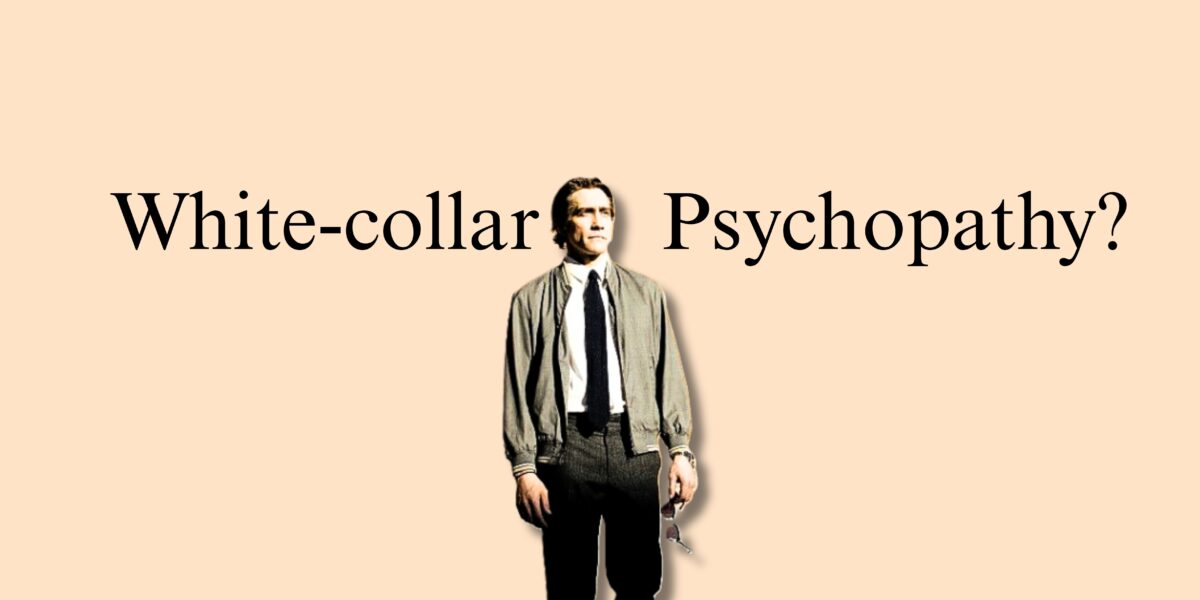
Nightcrawler is a curious film that exhibits how society sometimes allows truly reprehensible acts to not only escape justice, but even be the cause of future success. The film achieves this by portraying a figure, Lou Bloom, as an awkwardly charismatic, morally and emotionally detached individual obsessed with ‘winning’ the lottery and, in the end, actually achieving what he aspired to do while facing almost no consequences of his actions.
I have previously given a detailed character analysis of Lou Bloom. But one question deserves a closer look:
Does Lou fit the description of a white-collar psychopath or not?
A clear answer is yes, Lou Bloom does fit the description of a successful, primary psychopath.
And no, he is not exactly an unusual psychopath.
How Lou Bloom Qualifies as a Successful Psychopath
Louis demonstrates charm that does not permeate his actions. He is a smooth talker, he is expressive and none of that seems odd to many of the people he is talking to. It is the audience which sees how his words are often disconnected from his actions. To most of the characters in the film, he appears (at least, initially) as a cool, ambitious young man who is persistent and conscientious.
However, the audience notes the disengaged manner of speaking, the blank eyes and a general emotional emptiness of his life that stays constant and seems to drive a blanket emotional barrier between Lou and people he interacts or works with.
But how can no one notice that he is not driven by genuine regard but by personal gain?
Let us first look at some of Lou’s interpersonal patterns of behavior.
What is White-collar Psychopathy?
White-collar psychopathy is a term used to describe people who display psychopathic patterns of exploitation, manipulation, deception and antisocial nonviolent behavior while maintaining successful careers and social standing. Famously, pioneering psychopathy researcher and psychologist Dr. Robert Hare said that if he hadn’t started studying incarcerated psychopaths, he would have begun his research by studying people at the Vancouver Stock Exchange in 1980s!
Eventually, his line of research has given rise to terms such as white-collar psychopathy, corporate psychopathy, and successful psychopathy.
Lou Bloom’s Interpersonal Psychopathic Behaviors
The Chameleon Effect
Bloom is very confident, straightforward in his manners and goal-directed. This is a personality orientation mixed with high conscientiousness and low on certain facets of neuroticism that puts him in a position where he could potentially attract followers from both emotionally vulnerable people and some who are actively searching for excitement and leverage the psychological dominance he has over them to get favorable results for himself. Interestingly, his personality outright does not charm people who are not vulnerable, for example, the scrap yard owner he unsuccessfully tries to get a job from, in the beginning of the film.
However, it successfully portrays competence while hiding his ulterior motives.
How Lou Bloom controls Rick in the job interview.
In Nightcrawler, Rick, a seemingly less confident and stress-prone character, is shown to almost instantaneously trust Lou, a confident and self-assured entrepreneur, as an employer. Lou leverages Rick’s current financial turmoil by offering him cash daily and continues to use his services with low compensation despite the business eventually having a high turnover. This eventually breaks down as Rick asks for more compensation, but Rick continues to trust him despite clear signs that Lou is an exploitative employer. A possible reason for this is the chameleon effect that successful psychopaths could often take advantage of; make good first impressions and continually use corporately oriented behaviors to keep exploiting an employee.
The result of this was that Rick continues to trust Lou because of the veil of Lou being a somewhat reasonable man, when it was in fact Rick’s vulnerability that Lou was exploiting. Ultimately, Rick continues to trust Lou until he aids him in a dangerous, highly questionable act which costs Rick his life.
In the movie, he claims to Nina that he has learned about business through online courses and research – and his way of speaking actually resembles language that is very common in corporate circles (also known as corporate-speak). This shows that Lou could possibly blend into the environment of a corporate culture simply by mirroring the language and mannerisms without having been a part of it before.
As I explain later on in the article, this is an example of cognitive empathy being weaponized in isolation of affective empathy.
Manipulation as a Means to Gain Benefit or Avoid Harm
Creating Asymmetry to Show Dominance
Lou officially begins the interview with Rick on the note that he has lost an employee and he is looking for a replacement. This is a clear lie. What it does is setup an asymmetrical dynamic from the start: a ‘seemingly’ well-kempt man who is running a business (with some form of hierarchy) is looking to hire someone to work for him. When Rick seems to falter, Lou seemingly backs Rick up by encouraging him to sell himself. Here, the antihero uses two major manipulative tactics: strategic grandiosity (fueled by superficial charm and apparent competence) and exploitation of interpersonal vulnerability (supporting an insecurity of the other person while having an ulterior motive).
Lou Bloom’s Genuine Non-Manipulative Tactics.
It is easy to dismiss many of Lou’s business tactics as manipulative given the context of his moral depravity. However, Bloom demonstrates exemplary negotiation tactics that involve complete honesty and generally reasonable assertiveness, psychological patterns that many successful entrepreneurs use. His negotiation with Nina which ended up in him receiving 15,000 dollars for a videotape, having his company be legitimately recognized by the TV station and also being introduced to the executives is an example of assertive business dealing which does not involve manipulation or lying. This is why it is better to understand Louis as, what psychologists call, a ‘successful psychopath.’
Strategic Deception
In another scene, during the police interrogation, Lou also tells lies when asked about how he captured the footage of a crime scene before the police came. Here, he shifts his strategy from ‘flat out lies’ to mixing false information with the truth (demonstrating his tactic of FEAR – false evidence appearing real).
One of the reasons why he is able to sustain his morally questionable business conduct and antics is that he engages in strategic lying, which is vastly different from pathological lying. A pathological liar would lie out of compulsion, but Louis is not impulsive and thus deliberates which lie he should tell to gain the most profit and the least social harm. This is a behavior which exhibits his Machiavellian strategy.
Lou Bloom’s Emotional Psychopathic Traits
Callous Nature vs Non-Violent Amoral Behavior
Two of the hallmark features of psychopathy are callousness and low/absent experience of guilt. Oddly, throughout the film, Lou does not actually physically hurt anyone; in fact, he is not directly involved in any deaths or violence. His behavior appears amoral and potentially very dangerous, but it is not outrightly callous.
The true exhibition of callousness in Lou Bloom can be seen through how he talks about violence and people getting hurt.
At the start of the negotiation scene with Nina, Louis compares the utility of two videotapes of crime sites by the characteristics of the victims that were videotaped. He establishes that the race of the victims mattered, the brutality of the crime-scene mattered and that the neighborhoods’ socioeconomic context mattered in deciding which of the two tapes should be more costly.
This shows that while Lou might not have committed overtly callous acts, his philosophy of utility – and quantifying utility – treated people as objects, not as beings with immeasurable value.
Lack of Emotional Accountability
In a general sense, Lou’s emotional detachment as a lack of empathy. But the detachment shows a more pervasive pattern than simply having no emotional accountability. Clinical research is quite clear that psychopaths do have largely intact cognitive empathy, in fact cognitive empathy can play a major role in manipulating others. The issue here is with affective empathy and this is most brazenly shown in the movie in how Lou takes accountability of primarily the instrumental aspects of his decisions, but he does not hold himself accountable for the emotional consequences of his actions.
Cognitive Empathy vs Affective Empathy in Psychopaths.
Research on psychopathy consistently points to a striking dissociation between cognitive and affective empathy. While minor deficits in cognitive empathy can occur, the capacity to understand another person’s thoughts and perspective is generally relatively intact compared with the much more pronounced impairment in affective empathy. Indeed, this preserved capacity to understand others can facilitate interpersonal manipulation.
Affective empathy is also linked to feelings of remorse or guilt and Lou exhibits neither. He does not feel bad about stealing from others and neither does he feel bad about betraying his work partner, eventually causing his death. To Rick, this betrayal was shocking, however, this is because Rick believed that Lou would possess some emotional accountability, especially as he had said yes (although after a somewhat hard but seemingly natural conversation) to Rick’s proposition that the revenue from the company would be split 50/50.
Corporate Greed
One of the main motivating forces behind Lou’s behavior is his constant obsession with climbing the ladder or, as he puts it, “winning the lottery.” This isn’t simply ordinary ambition. Lou repeatedly uses his business as a vehicle for obtaining money, status and greater control, while treating the people around him as resources that can be exploited to achieve those ends. This pattern is characteristic of the kind of instrumental, exploitative behavior associated with corporate or white-collar psychopathy.
For quick money, Lou Bloom is willing to practically do anything. He will steal, he will do some of the most reprehensible actions a reporter could do; he could contaminate the crime scene and effectively manipulate the evidence. To hire someone cheaply, he is willing to tell outright lies and to get rid of a partner who is becoming competitive, Lou Bloom is willing to let him die.
Thus, corporate greed appears to be one particular motivator that ties all of these motivations.
This motivation is particularly visible during Lou’s negotiations with Nina. His sudden shift in tone demonstrates how rapidly his interpersonal presentation can change when the stakes involve his business. He is willing to risk a relationship with someone who could potentially remain useful to him in the future because the immediate opportunity to increase his company’s position is more valuable. Lou does not appear to evaluate relationships primarily in terms of loyalty or emotional attachment; he evaluates them according to their instrumental value.
For Lou, even relationships are ultimately business assets: valuable while they advance his objectives, expendable when they no longer do.
The Psychology of Lou Bloom’s Success
Nightcrawler is an unsettling movie partly because of how Lou Bloom’s Machiavellian ambition actually works. He is disciplined, persistent and willing to put enormous effort into achieving his goals. He learns quickly, understands what people want and knows how to present himself as competent and professional.
At the same time, Lou is not held back by guilt, empathy or loyalty in the way most people are. He can lie, exploit others and make morally reprehensible decisions if they help him move forward.
This combination allows Lou to turn traits that would normally be considered disturbing into tools for advancement. By the end of Nightcrawler, he has gone from an unemployed outsider to the owner of a successful news company.
Lou’s greatest advantage is not simply that he is willing to do terrible things. It is that he is willing to do them while continuing to move forward.

I am a Clinical Psychologist and a Lecturer of Psychology at Government College, Renala Khurd. Currently, I teach undergraduate students in the morning and practice psychotherapy later in the day. On the side, I conjointly run Psychologus and write regularly on topics related to psychology, business and philosophy. I enjoy practicing and provide consultation for mental disorders, organizational problems, social issues and marketing strategies.
- M Abdullah Qureshi

- M Abdullah Qureshi

- M Abdullah Qureshi

- M Abdullah Qureshi