
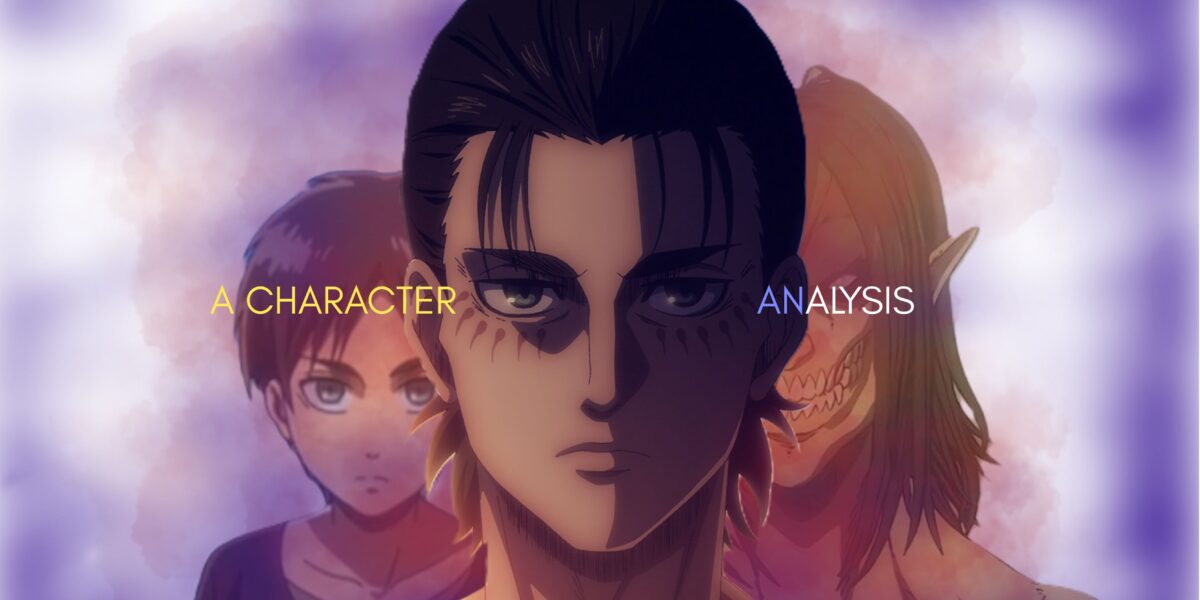
Attack on Titan (Shingeki no Kyojin), written and illustrated by Hajime Isayama, is one of the most psychologically ambitious manga series of the 21st century. Serialized from 2009 to 2021, it began as a post-apocalyptic survival story: humanity confined within massive walls, besieged by grotesque humanoid Titans. Yet as the narrative expanded, the series transformed into a meditation on war, nationalism, inherited memory, moral relativism, and the fragility of identity.
At the center of this transformation stands Eren Yeager.
Eren does not remain the archetypal shōnen protagonist. He does not simply mature; he reorganizes. The impulsive child who swore to eradicate the Titans evolves into a calculating agent of global catastrophe. His ideological pivot – from liberator to destroyer – has polarized audiences, prompting the recurring question: did Eren “turn evil,” or was this trajectory embedded in his personality all along?
To reduce Eren to villainy is to overlook the structural complexity of his psychology. He is assertive yet socially oriented; emotionally volatile yet capable of strategic restraint; deeply loyal yet willing to sever bonds; driven by freedom yet governed by duty. His development is not a sudden rupture but a gradual reconfiguration under accumulating cognitive dissonance and trauma.
Understanding Eren, therefore, requires more than recounting his actions. It requires examining the personality architecture beneath them: his temperament, moral reasoning, openness to new information, patterns of attachment, and eventual consolidation of authoritarian resolve. Only then can we begin to understand why the same individual who once fought to save humanity ultimately chose to trample it.
The following analysis will explore Eren Yeager across three dimensions: his personality structure, his behavioral and emotional transformation, and the philosophical beliefs that culminated in the Rumbling.
Eren Yeager’s Personality
Eren Yeager’s MBTI Type: INFJ or INTJ?
Typing Eren Yeager within the MBTI framework is challenging because his personality undergoes significant restructuring over the course of the series. However, his post–time skip characterization most closely aligns with an Ni-dominant type, narrowing the field primarily to INFJ (Ni-Fe-Ti-Se) or INTJ (Ni-Te-Fi-Se).
Dominant Ni (Introverted Intuition)
Eren’s psychology is unmistakably future-oriented. After inheriting the Attack Titan’s memories, he becomes singularly focused on an end-state – freedom for Paradis – even at catastrophic cost. His thinking becomes linear, inevitability-driven, and symbolic. Rather than reacting emotionally in the moment (as he often did in childhood), he begins operating from an internalized vision of what must occur.
This future fixation, coupled with his tolerance for long-term sacrifice, strongly suggests dominant Ni.
The Fe vs. Te Question
The more complex distinction lies between auxiliary Fe (Extraverted Feeling) and Te (Extraverted Thinking).
Eren does not primarily seek efficiency or systemic optimization in a detached sense, which would suggest Te. Instead, his actions are deeply relational in orientation. He is intensely aware of how he is perceived by Mikasa and Armin and deliberately reshapes that perception in order to distance them from moral culpability. His decision to portray himself as a monster is not merely strategic – it is relationally calculated.
He appears less concerned with global harmony and more concerned with protecting his in-group from emotional and existential burden. This suggests a tribal or selective Fe, rather than impersonal Te.
If Eren were primarily Fi-driven (as an INTJ might be), he would likely be less invested in managing others’ perceptions of him. Instead, he actively engineers his own vilification to preserve relational boundaries. This points toward auxiliary Fe operating under extreme stress.
Pre–Time Skip vs. Post–Time Skip
Pre–time skip Eren displays higher emotional volatility, impulsivity, and overt anger, traits that complicate an INFJ typing at first glance. However, these may reflect developmental immaturity rather than cognitive structure. Under trauma and prolonged war exposure, his emotional expressiveness diminishes, and his Ni-driven fatalism becomes dominant.
This compression into vision-centric, sacrificial authoritarianism is consistent with an INFJ under existential threat, where Fe becomes narrowly tribal and Ni becomes deterministic.
While arguments can be made for INTJ, Eren’s psychological structure more closely resembles an INFJ whose Fe has become defensive and selective under trauma. His tragedy is not merely that he becomes ruthless, but that he reorganizes himself around a future he believes inevitable – sacrificing relational harmony publicly while privately remaining deeply bound to those he seeks to protect.
Eren’s Big Five Personality Traits
Eren’s Extraversion
Eren is socially oriented. His actions have impactful social consequences. He does have people he cares for. Evidence of it is in his reactions on Sasha’s death. There is a visible turn of emotions – fleeting because of psychological strength – higher ambitions and industriousness are also part of Eren’s personality. He undergoes training, largely under Hanje’s supervision.
He is very assertive, not content with lounging about, whether as a child or an adult with heavy responsibilities. He is also work-driven but he is also intellectually deep and will follow a prerogative based on whether that is a net good or not. But what he considers what is good is based on emotional substrate and an attachment with those close to him. His drive is partly instinctual and partly constructed as his father was also a driven man.
Also, Eren has multiple friends (as opposed to only one or two). He also shows signs of assertiveness (often berating soldiers for slacking off or defending his friends against bullies and even literal murderers). There is further a propensity towards warm emotions (helping people out, altruism, empathy – showing that Eren is moderate in agreeableness).
Eren’s Conscientiousness
Eren has a shaky moral compass, he is not above killing innocent civilians. His conundrum is that ‘he has a duty’ to the people of the island. However, Eren seems to have a high amount of conscientiousness. Take for example the fact that based on determination, Eren was able to gain stability on the faulty 3d maneuver gear for a few moments. Eren also possesses an exceptional amount of dutifulness, this is the reason behind his endurance. take for example how when he is cornered by Reiner in episode 78, he cleverly exits his attack titan’s body – possibly endangering himself just to reach to Zeke who he has to contact to achieve his goal of subjugating the founding titan.
However, Eren’s judgement prior to the time skip does seem to waver in times where a soldier should follow a command (e.g. when the recon corps tries to capture the female titan, Eren – who doesn’t know the plan – contemplates repeatedly on violating the chain of command and turning into a titan, granted he was doing it to minimize deaths, but still, a soldier is expected to follow orders).
Nevertheless, it is part of Eren’s deliberation that he in the end chose to follow orders despite looming discord and deaths.
Eren’s Openness to Experience
Eren also exhibits high openness. He can learn Annie’s move by training with her, showing that he is open to different fighting styles – even if it is from someone who he might have some animosity towards (based on how he got humiliated by Annie).
Also, Eren ends up agreeing with Rod Reiss based on receiving evidence that his father was acting wrongly, killing children and Reiss family. This indicates a proclivity towards accepting different points of view compared to one’s own. in fact, it also speaks to Eren’s agreeableness. He is in fact moderately agreeable, tending to even engage in self-destructive behaviors if others seem to be in danger. This is visibly different after the time skip.
There are also indications that Eren has an active imagination or a proclivity to ‘fantasize’. This is most noticeable in how Eren fantasizes about the sea, deserts and the world outside. Instead of choosing the Military Police cadre or Garrison, he chose to be in the force which challenged Paradis the most – both physically and intellectually – going into the wilderness outside of the walls despite a painfully high probability of death or grievous injury.
Having said that, Eren does not seem to exhibit a distinctive aesthetic sense – in styles of appearance or behavior.
Eren’s Agreeableness
Throughout the show, Eren is not shown as particularly argumentative. He does not back away from conflicts, and he is certainly keen on expressing his opinion. However, many of his actions show a regard for humanity. It is perhaps for the sake of humanity or, later, for the sake of his friends that he either becomes aggressive or disobedient. There are very indications of personal ego being a disrupting factor. Thus, being disobedient or disruptive is not a central character to Eren.
Nevertheless, once his mind is set on a task it is usually difficult for him to be convinced otherwise. This, I believe, speaks more to Eren’s determination (a feature of conscientiousness).
Eren trusts his friends deeply – which is why the betrayals of Annie, Reiner and Bertholdt caused him (minor) cognitive dissonance. Moreover, while he may not be as modest as someone like Historia, he does agree that others might be more able to perform many tasks. This is why he maintains contact with the recon corps while he invades Marley at the start of Season 4 (he factors others’ superior strength into his plans).
Eren’s Neuroticism
With regards to neuroticism, Eren displays signs of emotional instability, particularly anger hostility (against the titans and then humanity at large, bar Paradis inhabitants). He also shows a degree of impulsiveness – seen in how he begins the attack on Marley suddenly and single-handedly. Interestingly, this impulsivity is not exactly dysfunctional from a personal point of view since Eren commits to the act entirely, putting his conscientiousness and extraversion to play often getting imperfect outcomes but still coming out moderately successful (e.g. Zeke was captured convincingly but Sasha was killed because of the attack on Marley).
There is also indication of depression. For example, Eren breaks down emotionally at multiple points in the series. After the time-skip the visual outbursts become quiet but Eren is rarely ever smiling. In fact, he seems to have become short-tempered. Furthermore, emotional expression in general becomes infrequent.
This indicates dissociation because of a series of cognitive dissonances (this is to be expected as the founding titan’s memories are filled with rich emotional complexity gained across entire generations that others around him – who have not experienced such memories – have not had the chance to go through.
To be clear, dissociation is not about the changing of identities. Eren remains Eren.
However, he experiences dissociation in the clinical sense of being disconnected from emotions. This is understandable as experiencing heightened emotions for a long time could lead the individual to not feel the emotions as he normally used to. This is internal emotional habituation which is one of the main causes of dissociating from one’s emotion.
Remember, dissociation is not a classic defense mechanism, it is the precursor for defense action.
Eren Yeager’s Philosophy
To understand Eren’s philosophy it is important to consider his various cognitive dissonances. Consider a very driven child who learns to deal with emotional difficulties and social unfairness by fighting it out with the people who he considers to be unfair – and not just discuss matters with them plainly.
This is the fundamental way Eren achieves conflict resolution from the beginning. He engages in verbal fights with soldiers and aggressors towards his friends and himself.
How Cognitive Dissonance Shaped Eren Yeager’s Philosophy
First Cognitive Dissonance: The Fall of Wall Maria and the Death of Eren’s Mother
He sees a colossal titan kick a hole into wall maria and the rubble collapses his house. This child experiences the first major cognitive dissonance in that not only the utility of soldiers in actually protecting seems to be severely lacking but he himself was not strong enough at that point to save his mother. However, rather than this shift in his psychology being majorly driven by cognitive dissonance, it serves to reinforce his present hatred against injustices of the world and tyranny of the titans. This is how he can maintain his original directive while fueling it with rage and hate.
So, Eren stakes his psychological strength onto getting stronger physically. He begins training and he is one of the best cadets of the 104th Cadet Corps. Commander Sadis also comments on his sense of determination as being the chief psychological asset of Eren.
Second Cognitive Dissonance: Eaten by a Titan
The next cognitive dissonance occurs inside the belly of the titan who swallowed Eren when he was trying to save Armin during the battle of Trost district.
This time Eren finds that he is not even able to save himself from the titans. Rage, anger and a sense of urgency and fantasy (to see the outside world as he exclaims during the scene to the horrified onlooking Armin) play a huge role in making Eren more self-sacrificing during the time from this phase onwards. The effects of this cognitive dissonance are seen in the humbling of Eren in front of his superiors who have killed many titans and are capable of killing him if he doesn’t obey or control the titan power he possesses.
Third Cognitive Dissonance: Annie as the Female Titan
The third point where Eren is forced to re-evaluate his beliefs is when he discovers that Annie was the female titan and a traitor. This comes to him as a shock and disorients him psychologically to the point that he is not able to fight her in his titan form. To be more specific, he finds it impossible to even transform into the attack titan because of his feelings towards Annie, an actual friend and a fellow soldier.
After this point, his transformation becomes steadier and under his control. Cognitive dissonance not only fractures beliefs – it can lead to even more concrete beliefs and even positive outcomes. This is of course possible because Eren lets himself be guided and has a respect for the decisions made by his superiors.
Nevertheless, the thought of a friend turning against him to the degree of threatening to erase the world he wanted to protect is new to Eren. The next time a friend betrays or leaves him, Eren finds that he is far more in control.
Fourth Cognitive Dissonance: Eren’s Ego Death in the Cave
The next cognitive dissonance happens during the cave scene with Rod Reiss encouraging his daughter to eat Eren in Season 3. the cognitive dissonance is based on Eren’s experiencing the memories of his father who killed all of the Reiss family except for rod along with the inkling that perhaps his knowledge of the walls was faulty and that for humanity to continue within the walls it is better to be sacrificed himself than to endanger humanity.
Fifth Cognitive Dissonance: Learning About the Hate Towards Eldians
The last major cognitive dissonance – and really the one that predicted the rumbling – is when he learns that the outside world is very similar to the world inside and around the walls.
When Eren came to know of the outer world, he became aware that others hated the people of Paradis – when in fact he had lived all his life lamenting the titans that were to exterminate Paradis, while thinking that the people on the island were the only human beings. these two irreconcilable pieces of information or thoughts caused a clear cognitive dissonance, highlighted by how Eren pointing towards the horizon on the sea asked his friends “so if we kill the enemy, the one waiting for us on the other side of the sea, will we… finally be free?”
This holds emotional weight as Eren had dreamt with Armin about exploring the world beyond the walls, but now he has to think about destroying it to preserve the lives of his friends.
Why Does Eren Become Evil?
Even when Eren says he was disappointed after learning about the outside world – his disappointment was not about the world lacking material wonder but about the world’s continued one-sided, superficial suspicion (that they were willing to give up given some heavy concessions from the Eldians). In this world, the Paradis inhabitants’ only possible identity was the aggressors or monsters.
The disappointment with this superficial characterization and a need to find an identity still (which was endangered by the cognitive dissonance) drove Eren to proclaim himself and the paradise islanders as really being ‘monsters’. He admits this during target practice with Mikasa and Armin after they met with the Azumabitos. This is a defense mechanism known as identification.
Hence, in the absence of a clear solution to the animosity of the world, Eren identifies with the concept of evil.
If we consider the fact that Eren is extremely determined, we can also understand why he increasingly keeps things to himself as the series progresses. This helps in incubating a highly individualistic and concrete philosophy. It is no longer up to debate what should be done – what matters is how quickly it can be done.
The Psychological Evolution of Eren’s Philosophy
In a way, Eren’s philosophy evolves from optimism to pessimism to nihilism. If one tracks each of his cognitive dissonances, his change in belief structures becomes even more apparent.
Let’s start with optimism.
Eren’s Optimism
Consider the fact that Eren maintains a level of optimism throughout much of the first leg of the series. There are points where he becomes dangerously close to pessimism – for example, he breaks down completely when Hannes finally dies at the hands of Freida’s titan and Eren finds that he is unable to save Hannes or even an injured Mikasa.
However, many of these points are quickly followed by an event which uplifts Eren’s spirit anew. So, for instance, right after Hannes’ death, Eren learns that he could have the power to control titans. This, as was revealed later, was only happenstance. If the titan who ate Hannes had not been of a person with the royal lineage, Eren and Mikasa might have not survived.
Having said that, it is Eren’s determination to fight for his beliefs that his shifts in philosophy do not interfere with his overarching goals.
But, what about the times when the breakdown couldn’t be resolved?
The first time his breakdown does not revolve optimistically is the death of his mother and the abrupt change in life when he was still a boy. At that point in time, Eren allows rage to scaffold his optimism. This behaviorally makes him more determined and maintains a workable goal to achieve: exterminating all titans.
Thus, his optimism does not dip considerably.
However, following the fourth cognitive dissonance (in the cave with Rod Reiss and Historia), Eren shifts far more towards a pessimistic view of things.
Eren’s Pessimism
Eren had remained driven throughout his childhood – often relying on a sense of purpose that was inculcated by a healthy upbringing by his industrious father and a compassionate mother.
However, witnessing their deaths (even if he realized his father’s death much later) did seem to trigger the sense that perhaps the goal of achieving peace is far more violent and filled with suffering than he had imagined.
The first time this pessimism is seen full in bloom is where he makes the choice to sacrifice himself for the future of humanity in the cave sequence. He resigns himself to being eaten and foregoing all control over their fate to Historia Reiss, as per the wishes of her father, Rod Reiss. This pessimism is partly created not only by Eren viewing himself as insignificant but also by seeing his own father as a violent titan who killed the Reiss family (bar Rod) to make sure the power in the royal lineage transfers to Eren.
This is where Eren’s pessimism finally peaks.
Historia then decides to go against her father to protect her own autonomy but at that point Eren had already experienced ego-death – which is why he protects others from the ensuing destruction of the cave by swallowing the ‘hardening’ potion.
Many of us can attest to the anxiety of not having control over own life. For Eren, who was already being treated more as a weapon than a living human being, this meant a break in self-confidence. We see Eren gaining this self-confidence back when he decides to take matters into his own hands after the time-skip.
And this is where we notice the next big shift in his philosophy.
Eren’s Nihilism
Eren Kruger while talking to Grisha Yeager (Eren’s father) admitted a very telling thing.
“There is no truth in this world. That is our reality. Anyone can become a god or a devil. All it takes is for someone to claim that to be the truth.”
This nihilism seems to have passed on to Eren as after getting in contact with Royal blood, he is able to access memories of the past incarnations of the Attack Titan.
Due to this single fact, Eren’s weaponized nihilism is distinctly different from Johan Liebert‘s (from Monster) in that Eren did not go through indoctrination since an early age but actually got hit psychologically by a multitude of memories and sufferings.
The attack titan, historically, has been the one that challenged norms.
Furthermore, the cascades of memories retelling burdens and sufferings specifically with this mindset seem to have had a profound impact on Eren. Such an impact can also be observed on the Reiss family titans, whose human carriers became ‘wise’ and seemed to age mentally far beyond the people around them.
Coming from a foundation of pessimism and optimism, the shift towards nihilism makes sense as Eren becomes aware that there are many truths. He does not shut himself off from people. For example, he keeps in contact with Yelena, Floch and his half-brother Zeke. But at a certain point he does understand that he is the only one who can fulfil his own goals.
Thus, he stops arguing for his point. Instead, he speaks selectively to those who he thinks can play important roles in his goals. The only people he argues with in the last leg of the series are Mikasa, Armin and Ymir. As we move deeper into this article, I will touch upon how significant these arguments were to understand Eren.
But there still remain many questions of his motives. Let’s start with his goal.
What were Eren Yeager’s Goals?
Much like how his beliefs seem to change, Eren’s motives also experienced changes and refinement.
Earlier on, the goal seemed to be to advance humanity beyond the walls. This is why Eren was preoccupied with joining the Recon Corps (whose job was to gain intelligence beyond the wall) when he came of age. Suffice to say, up to this point, he was a child with little knowledge of how deadly Titan threat was. He did have some knowledge of their danger but he also seemed to think that the average soldier could deal with them.
Thus, Eren’s earliest goal was to go beyond the walls.
The first contact with the Titans ushered in a new motive.
When Eren’s mother died during the first titan invasion, he understood that the advancement was impossible with the threat of the titans. Plus, having a boisterous personality, Eren was filled with rage as much as with grief. However, being still a child with minimal combat experience, his goal seemed to be grand but doable with enough training.
His helplessness was also shown; not only was he helpless in his current state but so were many of the soldiers – even the senior units.
Hence, Eren would have to train extremely well to not only advance beyond the walls but also to protect the people close to him.
So, now the goal of being free from the walls was added to by the urgency of protecting his people. Moreover, the more urgent goal of killing all the titans became a driving force.
Why did Eren start the Rumbling?
Eren seems to zero in on a single goal: to protect the people of Paradis. This leads to the rumbling. However, how does Eren arrive at this conclusion, given how he longed to explore the outside world and how compassionate he was?
Let’s see why Eren started the rumbling.
As I went into detail above, there seem to be three goals that Eren is aiming for right up to the point he becomes aware that there might be a civilization outside the walls.
- To advance beyond the walls.
- To protect the people inside the walls.
- To exterminate all titans.
These goals helped drive Eren’s behaviors right up to his ego-death in the cave sequence. There, he learned that his own contribution was minimal in achieving his goals. The titans might not need to be exterminated at all. There might not be a point to freeing humanity from the walls either.
Moreover, as a titan, he might end up endangering his friends repeatedly – they were almost killed trying to protect him during the capture of Annie, rescuing him from Reiner and Bertholdt and even during the cave sequence.
As the memories of the founding and attack titan began coming to him, Eren began deferring some of his goals to his comrades. For example, the titans were at last terminated due to Hanje’s methods not due to Eren’s own reasoning. Eren rarely came to the forefront of battles against minor titans – especially the ones created by Zeke in Season 3.
To advance humanity beyond the walls, Eren trusted Commander Erwin with his own prerogative to access Grisha Yeager’s basement.
It is possible that with this diffusion of responsibility – with the understanding that he must not control everything (even his own fate) – might have made Eren feel powerless again, to fate. This is partly why Eren becomes less emotionally expressive and less excited about the future.
It is worthwhile to note that Levi’s assumption of Eren became a self-fulfilling prophecy.
“He is a real monster, and not because of his Titan ability. No matter how hard he’s restrained, no matter what cage he’s put inside, no one can ever tame him.”
I believe that this attitude has largely remained throughout the series especially with respect to the attitude of Levi’s squad (the first one shown in the series) and even other characters. Eren is thought of as a monster – not just by the outside world but also within the walls. This attitude seems dehumanizing to say the least.
But it dehumanizes Eren in two ways:
Firstly, it makes Eren feel sub-human. On the other hand, it convinces him that he has to shoulder the physical burden along with the moral burden of protecting the people he cares about. Basically – to commit heinous acts in order to make sure that his dependents can survive and that they don’t have to commit these heinous acts themselves.
And this is why, to him, the most logical conclusion was to sacrifice himself to protect the people on the island.
This delegation of his goals to others ended when he made a conscious decision to take matters completely in his own hands. The extermination of the titans had already been achieved. Likewise, the Paradis Eldians knew and could now go beyond the walls.
Now, the only goal that remained was to protect the people that were close to him. This was not an easy task in the context of a world that hated Eldians. To Eren, it seems as if Paradis’s approach was too lukewarm and table-talks could not really help solve the hatred.
Besides, important Eldians like Tyber and Zeke proposed plans of genocide and euthanasia plan – both of which appeared barbaric to Eren.
Thus, to shoulder the responsibility and the blame associated with this mass extermination of all possible enemies is the last remaining goal of Eren which he stakes his life upon.
However, if the goal was to protect people who were close to him, why would he push them away?
Why does Eren lie to Mikasa?
Simply put, to make sure she doesn’t become a collateral in the rumbling or in the instance Eren’s plans fail. However, the level of disdain Eren’s voice and expressions imply is too strong to have only love as the motivator.
There has been considerable speculation online on Mikasa’s continued withholding of feelings from Eren. I refer specifically to the chance Mikasa had in Marley to explain her feelings. Perhaps, finding and experiencing love on equal terms might have moved Eren away from considering such a drastic action. Or at least Mikasa might have convinced him to a less violent alternative.
Consequently, it seems like part of the anger with which Eren treats Mikasa during the argument between them and Armin is based on her not admitting feelings when she had the chance to. This could also explain why he harbored even a modicum of hatred against her.
Nevertheless, this is speculation.
What is certain, however, is that Eren did care for Mikasa. His lie to her that Mikasa was only protective of Eren because he was the Attack Titan and she was biologically wired to do so, seems to have been an attempt to keep her away from him and thus, away from danger.
I believe that is also the reason he antagonizes and brawls against Armin. To keep him away from harm as well.
But why specifically antagonize Mikasa and Armin? Well, they knew him the most out of all Eren’s friends and ultimately, they had the highest convincing power. Consider the fact that many of the expeditions after the death of Erwin (and even during Erwin’s lifetime) contained Mikasa and Armin as two of the most important soldiers.
Eren Yeager: The Architecture of a Tragic Personality
Eren Yeager’s transformation is not a descent into madness, nor a simple corruption by power. It is the progressive restructuring of a personality under cumulative psychological strain. Across his development, we observe a socially embedded, emotionally reactive, highly conscientious individual repeatedly confronted with destabilizing cognitive dissonance: the death of his mother, the revelation of Titans as humans, his father’s moral ambiguity, and finally the discovery that the world beyond the walls not only exists – but hates him. Each fracture forces reorganization rather than collapse.
Personality traits that once appeared adaptive – openness to new perspectives, tribal loyalty, intense emotional arousal, and dutifulness – become reorganized under existential threat. His conscientiousness evolves into authoritarian consolidation; his openness narrows into ideological certainty; his tribal warmth hardens into selective protectionism. Dissociation, rather than signaling fragmentation, reflects the developmental containment of overwhelming affect within a functional identity. Emotional intensity does not disappear – it becomes compressed, subordinated to mission.
Within the MBTI framework, Eren most plausibly aligns with an INFJ structure (Ni-Fe-Ti-Se), particularly in his post–time skip phase. Dominant Ni manifests as fatalistic vision and future fixation, while auxiliary Fe – tribal and defensive – drives his need to manage relational burdens, even to the point of orchestrating his own vilification. He does not merely pursue freedom; he absorbs moral contamination so that others may remain psychologically unburdened. What appears as cold strategy may, in fact, be traumatized relational consciousness operating under extreme compression.
Ultimately, Eren’s tragedy lies not in the absence of empathy, but in its narrowing. He does not abandon morality; he reconstructs it around survival and agency. Faced with a world that reduces his people to monsters, he chooses to become one deliberately – transforming imposed identity into chosen destiny. His story illustrates how personality, when subjected to sustained threat and historical weight, can reorganize toward extremity while remaining internally coherent. Eren Yeager is not a contradiction; he is a case study in how identity, duty, trauma, and vision can converge into catastrophic resolve.

I am a Clinical Psychologist and a Lecturer of Psychology at Government College, Renala Khurd. Currently, I teach undergraduate students in the morning and practice psychotherapy later in the day. On the side, I conjointly run Psychologus and write regularly on topics related to psychology, business and philosophy. I enjoy practicing and provide consultation for mental disorders, organizational problems, social issues and marketing strategies.
