
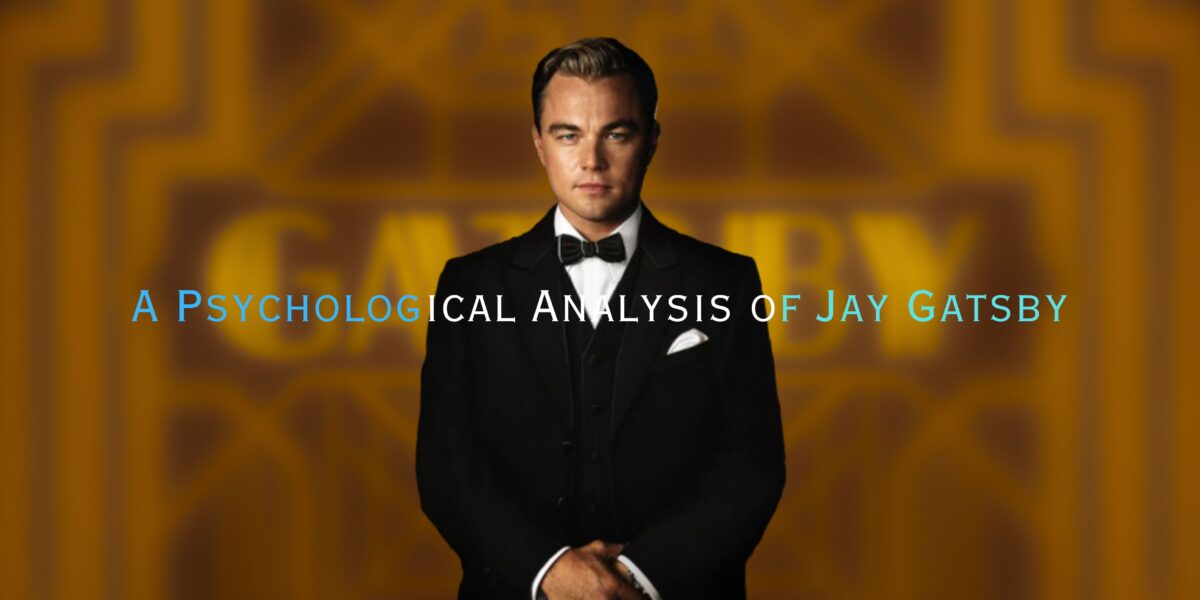
Jay Gatsby is a character originally from the tragedy novel “The Great Gatsby” by author F. Scott Fitzgerald, published in 1925. He is described as a mysterious man who shrouds himself with an extravagant exterior – but an overly ambiguous history and an even more withheld romantic life.
Over the years, there have been two major film adaptations of the novel, one in 1974 and one in 2013.
This article will focus on his portrayal in the 2013 film which is considered a better adaptation of the original novel.
In this essay, I will attempt to decipher the internal psychodynamics of the character along with his possible personality type – as per the Myers-Briggs Type Indicator (MBTI) framework.
For starters, let’s dive right into what I believe could explain the tragic story of Gatsby. So, first stop: defense mechanisms!
Defense Mechanisms in Jay Gatsby
Jay Gatsby’s psychological world is constructed on a complex network of defense mechanisms that operate not merely in moments of stress, but as his default mode of being. Unlike individuals who retreat into defenses only during emotional overwhelm, Gatsby’s identity itself is scaffolded by them, showing an ego that perceives danger readily and has led to integration of a persona guarding his inner states as well as portraying an image grander than life.
These defense mechanisms are continuous, stabilizing forces that help him maintain his reality. While they offer temporary coherence, they ultimately reveal the vulnerability that he spends his entire life working to hide.
Idealization is the cornerstone of Gatsby’s defense system. He idealizes Daisy into an emblem of purity, beauty, and emotional fulfilment – a symbol rather than a person. This idealization also extends inward: Gatsby portrays himself as a man worthy of aristocratic belonging and limitless achievement. This mechanism protects him from acknowledging the painful truth of his origins – the “nobody” he believes he once was.
This signifies an underdeveloped narcissistic bend towards life; however the issues lie deeper still.
Idealization shields him from shame (of himself as well as others) while simultaneously giving him something aspirational to live toward.
“If one thing gives, the other must give as well.”
I might make an error here by viewing this through lingual components (sorry Nietzsche) but in places Jay Gatsby invests in, are opportunities for something to be gained – a transactional personal philosophy. The world – and the people in it – can give him a lot (idealization of the world) but to achieve it Jay has to be part of this world (idealization of himself)
Idealization shows a trauma-colored lens of the world, one that is based on social learning, past stress and behaviors.
Closely linked to this is fantasy, the tool Gatsby uses to bridge the chasm of idealization. His entire identity – from his show of wealth to his “old sport” lingual biases, from his extravagance to his generosity – is built on fantasy.
This is not mere escapism but a psychological necessity. Compared to Gatsby, Thomas Shelby‘s (another dominant male character in charge of a large enterprise) fantasies are not explicitly stated. Hence, Shelby doesn’t use fantasy to influence others as much as Gatsby does.
This is what helps him to maneuver tense social interactions without losing his temper – especially in critical moments.
By constructing an imagined self, Gatsby regulates an internal world that would otherwise be consumed by humiliation, abandonment, and the profound fear of insignificance.
An example of Jay’s penchant for fantasizing lies in the significance of the green light that held his mind for a long time, longing for Daisy to come by him.
Nick notes,
“Possibly, it had occurred to Gatsby that the colossal significance of that light had vanished forever. Now it was once again just a green light on a dock and his count of enchanted objects had diminished by one.”
Fantasy becomes a stabilizing psychological habitat. It regulates his reward system.
Denial also plays a central role in Gatsby’s psychological functioning. He refuses to acknowledge truths that threaten his emotional equilibrium – Daisy’s marriage, her love for Tom, her hesitations, and the actual limits of their relationship. Accepting these realities would collapse the very identity he has built over years.
His refusal to accept Daisy’s divided affections or the permanence of her choices reflects a deeper refusal to accept that the past cannot be resurrected. I will go into further detail later on as this shows a core belief of his regarding love.
Note this dialogue:
Nick Carraway: You can’t repeat the past.
Jay Gatsby: Can’t repeat the past?
Nick Carraway: No…
Jay Gatsby: Why, of course you can… of course you can.
A quieter but equally powerful mechanism is avoidance. Gatsby avoids environments, conversations, and vulnerabilities that could expose the gap between his real and constructed selves. He rarely appears at his own parties, avoids discussing his past, and maintains emotional distance even from those who admire him. Joe Goldberg also exhibits signs of avoidance, but Goldberg does it because he wants a quieter life.
Gatsby is anything but quiet.
This avoidance allows rumors to take the place of truth – a trade he prefers, because ambiguity protects him more effectively than honesty.
Finally, Gatsby engages in overcompensation, presenting wealth, grandeur, charm, and sophistication as exaggerated antidotes to his internal sense of inadequacy. His extravagant lifestyle, cultivated speech, and ostentatious displays of generosity are all compensatory responses to the belief that he must constantly prove his worth.
Together, these defenses create the shimmering illusion of Gatsby – an identity both magnificent and brittle. They allow him to dream boldly, love intensely, and rise socially, yet they also set the stage for his emotional unraveling once he reaches a point that the next goal does not seem attainable.
His defenses do not merely conceal his wounds; they define his life.
In Jungian terms, Gatsby represents the eternal Hero. The man who has to slay a dragon – only the dragon is a metamorph. In Gatsby’s case, thus, the hero never truly goes up or end the journey.
Core Beliefs in Jay Gatsby
Jay Gatsby’s behavior, ambitions, and relational patterns are anchored in a set of core beliefs shaped by early deprivation, emotional scarcity, and a profound sense of social inferiority. These beliefs govern how he interprets others, how he positions himself in relationships, and why he constructs his identity the way he does.
They are not simply opinions he holds; they are psychological laws he feels compelled to obey.
I have arranged these deepest cognitive elements using the cognitive triad. (Do check the original article for the triad out – you can learn a lot about yourself!)
1. “I am a nobody unless I construct a better self.”
This core belief forms the nucleus of Gatsby’s personality. His entire adult identity is a corrective response to the shame of his origins. He ran away from his humble beginnings because that was what he described as ‘the nobody life’.
His lies about his background – being an Oxford man by family tradition, inheriting wealth from deceased parents, belonging to a distinguished lineage – are not aimed at superficial admiration.
Rather, they protect him from the internal conclusion that he is “just a nobody.”
This belief explains why vulnerability terrifies him. When he is confident, he is polished and composed; when vulnerable, he becomes clumsy, self-conscious, and awkward.
Gatsby only shares his genuine past with someone he perceives as emotionally perceptive enough to understand him – in this case, Nick. The belief that his authentic self is unworthy makes secrecy his default and myth-making his emotional armor.
2. “You must offer value to receive value.”
Gatsby assumes that no one engages without wanting an exchange. This belief explains his strategic puffery, his cultivated mystery, and his habit of doing favors – often illicit ones – for people who might become useful later, whether socially, financially, or emotionally.
He interprets relationships through the lens of leverage: people “puffer themselves” to look presentable, and everything operates on an economy of worth. Hence, if Gatsby has to have something done, he has to offer the other person something of equal value.
However, since Gatsby considers himself a nobody (and reacts violently when someone else proves that he has ‘social flaws’), things that he considers valuable to others are of economic value.
This is why he is friends with Wolfsheim, openly introducing him to Nick despite Wolfsheim’s criminal underpinnings.
Social risk is acceptable as long as the relationship yields value.
This belief also explains his immediate offer to Nick – trying to repay the favor of arranging tea with Daisy through a vague business on the side. He does not expect anyone to help without wanting something. The idea of unconditional support, as Nick offers, is entirely foreign to him and therefore destabilizing.
3. “Love must be absolute, exclusive, and timeless.”
Gatsby’s conception of love is rigid and idealized. Once he forms an emotional bond, it becomes permanent. This explains how his love for Daisy persists long after their separation and despite her marriage to Tom.
This guides and is further maintained by Gatsby’s emotional circle.
It remains extremely limited, so the few connections he makes become psychologically magnified.
His idealism is threatened when Daisy cannot deny having loved Tom. For Gatsby, the idea that she could have loved anyone else violates the very logic on which he built his life. This belief drives his insistence that Daisy declare she never loved Tom – not only to secure Daisy’s commitment, but also to assert dominance over Tom (I’ll expand on this in the succeeding sections).
The belief that love must be pure and undivided prevents him from adapting to the complexities of Daisy’s actual emotional world.
One concept I’d like to add here are indications that Gatsby also loves Nick. I’m not only talking about his offerings to Nick but also the fact that Gatsby feels safe with him. He asks Nick for a favor, at his house, asks Nick to join him and Daisy at his own mansion and calls frequently.
This is very understandable, given what I’ve said earlier; Gatsby trusts very few people. When he does, he has the tendency to idealize them, fantasize about them and deny their possible shortcomings.
4. “Everything can be achieved.”
This belief fuels Gatsby’s ambition, idealism, and risk-taking. It justifies his methods of wealth accumulation, including monopolizing the illegal sale of alcohol during Prohibition through his “drugstores” and possibly participating in violent or criminal work as implied through his association with Wolfsheim and others.
It also explains his unwavering conviction that he can recreate the past — that Daisy can love him exactly as she did five years earlier, and that time itself can be bent into alignment with his desires. This belief is not optimism; it is a psychological imperative.
Accepting limits would mean accepting that his childhood insecurities still define him.
Interpersonal Strategies (Jay Gatsby)
Gatsby’s interpersonal strategies are meticulously constructed to protect his core beliefs and maintain the fragile identity he has built. They are not spontaneous social behaviors but engineered relational tactics designed to control perception, regulate shame, and preserve the fantasy of who he must be to win Daisy and to survive the psychological threat of being “James Gatz” again.
1. Curated Mystery / Limited Self-Disclosure
Gatsby’s most consistent relational strategy is the controlled withholding of information. He regulates exactly how much of himself others can access, allowing ambiguity to work as a form of social armor. This curated mystery achieves two functions: it prevents others from detecting inconsistencies in his fabricated identity, and it encourages people to idealize him because the unknown tends to be filled with admiration rather than scrutiny.
His parties exemplify this. Hundreds gather in his mansion, yet almost no one has met him; guests circulate rumors instead. This absence is intentional. By staying unseen, he becomes a mythic presence rather than a man with verifiable flaws. Even when he finally introduces himself to Nick, he does so casually, as if testing how little he can disclose while still maintaining fascination. The mystery keeps others at a safe psychological distance while increasing his perceived significance.
2. Strategic Lying and Puffery
Gatsby’s self-presentation is built on functional falsehoods – not lies for entertainment, but lies that give him relational leverage. His claims about being the son of wealthy people, or being educated at Oxford, are not performative vanity. They are social survival tactics meant to prevent others from viewing him as unworthy of Daisy or the East Egg elite.
He uses these lies most deliberately when doubt threatens a relationship’s stability. During his drive with Nick, when he senses skepticism, he immediately produces medals, photos, and rehearsed lines to reinforce credibility. The lie is not meant to dazzle; it is meant to retain influence. Being perceived as “somebody” is essential for maintaining relational footing. Being unmasked as James Gatz would collapse his entire interpersonal world.
3. Status Signaling
Because he cannot rely on lineage, Gatsby uses aggressive status signaling to manufacture aristocratic legitimacy. His speech patterns (“old sport”), the architectural imitation of a French château, the orchestration of extravagant parties, and the curated narrative of studying at Oxford are all impression-shaping instruments.
These signals are not merely aesthetic; they are deeply relational. Each signal is aimed at persuading others – especially Daisy – that he belongs to her world. His parties exist less as social gatherings and more as demonstrations of power and access. Even his mysterious phone calls from Philadelphia and Chicago reinforce the aura of a man involved in important, possibly dangerous, affairs. Status is a communicative tool that keeps others simultaneously impressed and off-balance.
4. Selective Vulnerability
Gatsby rarely expresses genuine emotion, but when he does, it is deployed as tactical vulnerability. He reveals fragments of truth only when the disclosure shifts the relational dynamic in his favour. For example, after Nick challenges the Oxford story, Gatsby admits he attended for only five months. This partial truth is strategic: it humanises him just enough to regain credibility while preserving the larger persona.
Similarly, his anxiety before reuniting with Daisy appears intimate, but even this vulnerability is tightly controlled; he shares it only with Nick, the one person whose emotional steadiness he needs. He never exposes weakness to those whose perception could destabilise his constructed status. Vulnerability is rationed, not freely given.
5. Favor-Giving as a Relational Strategy
Gatsby’s generosity has a transactional undertone. He gives favors – legal and illicit – because favors create asymmetrical bonds in which people owe him, depend on him, or become psychologically invested in maintaining the relationship.
His relationship with the commissioner, implied through the ability to “fix” a policeman’s traffic stop, signals the kind of illicit reciprocity he maintains.
Even with Nick, Gatsby’s first major gesture after their initial drive is offering him a business opportunity – a disguised payment for arranging the meeting with Daisy. Favor-giving is a way to ensure relational stability; it reinforces a worldview where emotional security is purchased, not organically earned.
6. Highly Selective Emotional Bonds
Despite the illusion of social abundance, Gatsby forms very few real attachments.
The ones he does form are intense, exclusive, and idealized. Daisy is the emotional nucleus around which his entire identity orbits. Nick becomes the stabilizing external witness he needs to regulate anxiety and maintain the narrative of himself. Everyone else – party guests, associates, servants – remains interchangeable background. So, when Gatsby feels his privacy with Daisy to be compromised, he gets rid of his servants.
This selectivity is rooted in fear: true vulnerability risks exposing the underlying inadequacy he works so hard to conceal.
Therefore, he bonds deeply with only those who affirm the fantasy (Nick) or embody it (Daisy). The scarcity of authentic connections underscores how relationally fragile Gatsby truly is beneath the constructed persona.
Schema Triggers of Jay Gatsby
Jay Gatsby’s psychological responses throughout The Great Gatsby can be understood as activations of deep early maladaptive schemas – patterns formed long before his reinvention. These schemas are triggered by specific interpersonal situations, especially those involving status, authenticity, intimacy, or the threat of rejection. Each trigger illuminates how his internal schema system supports, distorts, and sometimes collapses under the weight of his four core beliefs:
- The world is transactional.
- Love should be ideal, perfect, and timeless.
- Everything can be achieved.
- I must not be a nobody.
Schema Triggers (Jay Gatsby)
Jay Gatsby’s psychological functioning is shaped by early maladaptive schemas, which are triggered by specific interpersonal and environmental cues. These triggers illuminate the fragility of his constructed identity and the intensity of his relational strategies. For Gatsby, schema activation occurs whenever his beliefs about himself, love, or social value are challenged. Four primary triggers stand out in The Great Gatsby, each illustrating the dynamic interplay between his schemas and core beliefs.
1. Tom Buchanan
Trigger:
Tom is old money, genuinely elite, socially secure, and already possesses Daisy. His mere presence activates Gatsby’s deepest insecurities and highlights the gaps between his constructed persona and reality. Tom embodies everything Gatsby aspires to be but is not, making him the ultimate relational and social threat.
Underlying Schema: Defectiveness/Shame
“I’m inherently not enough.”
Gatsby’s sense of defectiveness is rooted in his impoverished origins and the constant pressure to reinvent himself. Confronting Tom triggers feelings of inferiority because Tom represents the authentic social and cultural status that Gatsby only simulates. This schema reinforces the emotional intensity with which Gatsby clings to Daisy and his idealized self-image.
Linked Core Belief: “I am a nobody unless I construct a better self.”
Tom’s presence is a direct threat to Gatsby’s constructed and true identity. Gatsby’s obsession with appearances, wealth, and prestige is designed to prevent this schema from dominating his perception of himself. His attempts to impress Daisy, assert dominance in front of Tom, and control the narrative during confrontations are all activated by this trigger, reflecting his desperate effort to maintain the belief that he is “somebody.”
Example:
During the Plaza Hotel confrontation, Gatsby insists that Daisy never loved Tom. His insistence is not merely about claiming Daisy’s love; it is an attempt to overwrite reality that activates the shame schema. The emotional intensity of this scene illustrates how Tom functions as a trigger that brings Gatsby face-to-face with his sense of inadequacy.
2. Rumors About Gatsby
Trigger:
People gossiping, questioning his background, and circulating stories about his wealth and identity provoke significant schema activation. The rumours call attention to the gap between who Gatsby is and who he presents himself to be.
Underlying Schema: Vulnerability / Exposure – “If people knew the truth, they’d reject me.”
Gatsby cannot tolerate the idea that his humble origins and fabricated achievements might be exposed. The schema reflects his chronic fear of being socially invalidated or emotionally rejected. Rumors function as a way to leverage his social appeal to people who seem to be satisfied with the talk of the town.
By this, he can maintain emotional distance and appear mysterious which in turn shrouds his personality in a mist that makes him look larger than life.
Linked Core Belief: “Relationships are transactional – I must present value or lose value.”
The schema reinforces Gatsby’s belief that social and emotional currency must be managed carefully. By limiting disclosure and allowing mystery to dominate, he protects himself from relational rejection.
However, rumors also threaten this protective mechanism because they are outside his control and directly challenge the transactional equilibrium he maintains in all relationships. Which is why he maintains emotional distance and lets rumors fester.
So, his tendency to lie reaches a sort of psychological homeostasis.
Example:
At his parties, Gatsby deliberately remains in the background, rarely interacting with guests. The anonymity allows rumors to circulate, turning potential exposure into a form of social advantage. People think that he is the man to go to if you want to have someone killed ‘free of charge’. This only enlarges his perceived social capital as his parties include people of influence, both the righteous ones and the deviants.
By controlling what is revealed about him selectively, he manages the vulnerability schema and maintains his core belief about relational value.
3. Receiving Unconditional Positive Regard (Nick)
Trigger:
Nick’s support and loyalty challenge Gatsby’s expectations. Nick listens without judgment, accepts him as he is, and even arranges the tea with Daisy without expecting anything in return. He also calls and answers calls from Gatsby during work hours, as a very close friend would.
Underlying Schema: Mistrust / Abuse
“No one helps without wanting something.”
Gatsby’s worldview is shaped by the expectation that every interaction involves a quid pro quo. The schema renders him incapable of instinctively trusting acts of genuine kindness. When Nick demonstrates unconditional support, the schema is activated, causing initial shock and defensive calculation as Gatsby tries to reconcile the anomaly.
Linked Core Belief: “Relationships are transactional.”
Nick’s behavior directly contradicts Gatsby’s core belief. Gatsby is stunned that someone would invest time and effort without requiring reciprocity. This triggers both curiosity and cautious – but genuinely positive – engagement, eventually allowing Gatsby to form a rare emotional bond. This bond is quite child-like in nature. Unconditional positive regard mirrored by unconditional positive regard.
The schema’s activation explains why Gatsby initially offers Nick a business opportunity – attempting to restore the expected transactional balance.
Example:
When Tom Buchanan approaches Nick during his and Gatsby’s trip to New York’s underbelly, initially Gatsby seems guarded. This is not only because Tom is Daisy’s husband – as is revealed later – but also because Gatsby is not used to being the one who is the lesser approached than his associates.
However, when Nick introduces Gatsby to his much older friend, Tom, Gatsby passes a smile. This smile seems too automatic to just be written off as a way to prep himself for a fake interaction.
And even if it was just a way to prep himself, due to Nick, Gatsby tried to greet Tom with energy. This shows how Nick’s unconditional regard for Gatsby makes the latter actually more ready to face uncomfortable circumstances than usual.
Having said that, this vulnerability from Nick means that Nick gets to be the one who is compromised once Gatsby is killed. This is why it is shown right in the beginning that Nick is suffering from anxiety and possibly intermittent explosive disorder.
4. Daisy’s Hesitation / Loving Tom
Trigger:
Daisy’s inability to fully commit or deny her past love for Tom triggers Gatsby’s idealism. His mental construct of love as perfect, absolute, and timeless is directly challenged by her emotional complexity.
Underlying Schema: Unrelenting Standards / Idealism
“Love must be perfect and timeless.”
This schema reflects Gatsby’s lifelong internalization of absolute ideals, both in relationships and personal achievement. He does not try to manage with the cards he is dealt with.
He asks for a completely new deck. Take, for example, how he leaves his parents’ house instead of trying to strive within his means. And so, he expects as much from the person he loves.
Reality contradicts these ideals, creating profound cognitive tension. In fact, any imperfection or deviation in Daisy’s affection activates the schema, generating distress and defensive insistence on perfection.
Linked Core Beliefs: “Love must be absolute and exclusive” and “everything can be achieved.”
Gatsby’s insistence on Daisy declaring she never loved Tom is a manifestation of this schema-core belief interaction. He cannot accept ambiguity because to him, everything can be achieved. The schema drives behaviors such as emotional rigidity, denial of nuance, and attempts to overwrite reality with the imagined ideal.
Example:
During the pivotal hotel scene, Gatsby repeatedly pressures Daisy to articulate exclusive love. His agitation, repeated questioning, and denial of her hesitations illustrate the schema’s activation. The idealism schema forces Gatsby to cling to his core belief that love should be perfect and timeless, even in the face of undeniable evidence to the contrary.
I’d like to quote another instance here as well, when Daisy suggests to Gatsby that they should just run away.
To this, he replies “That wouldn’t be respectable. We’re gonna live here, in this house. You and me.”
At a later point, Jay admits to Nick that, “It’s so sad, because it’s so hard to make her understand. It’s so hard to make her understand. I’ve gotten all these things for her. I’ve gotten all these things for her and now she just… she just wants to run away.”
He then gestures to a shooting star after saying, “My life, old sport, my life… my life has got to be like this. It’s got to keep going up.”
Hence, the idealism is generalized across himself and his love. Whatever comes in the way of its trajectory causes Gatsby severe psychological stress.
I believe that this sharp feeling of distress is the primary reason Jay keeps him at an emotional distance to anyone who he doesn’t consider a true friend.
These four schema triggers reveal how Gatsby’s early maladaptive schemas interact with core beliefs to shape his emotional, social, and relational behavior. Each trigger exposes the architecture of his identity, explaining both his extraordinary ambition and the vulnerabilities that ultimately define him.
With this, let’s move over to Gatsby’s personality.
MBTI Analysis: Jay Gatsby – ISFJ-T (“The Turbulent Defender”)
Jay Gatsby is most convincingly typed as an ISFJ-T, a personality defined by deep nostalgia, emotional idealism, and a duty-driven commitment to personal values. While many readers instinctively lean toward more dramatic or intuitive types such as INFJ or ENFJ, a closer examination of Gatsby’s motives, memory processes, and relational style reveals a profile far more aligned with the Si-Fe cognitive function stack that characterizes the ISFJ.
1. Dominant Introverted Sensing (Si): Memory, Tradition, and Idealized Reconstruction
Gatsby’s entire life is anchored by Si, which revolves around memory, internalized impressions, and the preservation of emotionally important experiences.
This is the function responsible for:
- his fixation on the past (“Can’t repeat the past? Why of course you can!”)
- his rigidly preserved internal image of Daisy, unchanged since 1917
- his ritualistic behaviors – the shirts, the mansion, the parties – all curated to maintain a continuity between what he once felt and what he hopes to feel again
Si types do not merely recall events; they store sensory-emotional imprints and attempt to recreate them. Gatsby’s entire identity is a reconstruction project – a painstaking attempt to restore a personal emotional truth from years ago. That is fundamentally Si, not Ni.
2. Auxiliary Extraverted Feeling (Fe): Social Calibration and the Desire to Be Accepted
Fe drives Gatsby’s interpersonal behavior, shaping how he presents himself and how he interacts with others.
Key Fe indicators in Gatsby:
- His intense need to be liked and admired
- The way he curates his parties to please others, even though he does not participate in them
- His sensitivity to emotional atmosphere – how he overprepares for Nick’s tea gathering with Daisy, anxiously trying to make everything “perfect”
- His self-sacrifice, stepping in to protect Daisy at any cost
Fe’s focus is on harmony, belonging, and emotional connection. Gatsby’s entire persona is oriented toward being accepted into Daisy’s world, not dominating it. His charm is deferential, polite, accommodating – classic high-Fe behavior.
3. Tertiary Introverted Thinking (Ti): Private Rationalization and Self-Justifying Logic
Though Gatsby is emotional and relational, he possesses a quiet, structured internal logic:
- He creates a strict personal system (“the schedule,” “the rules of self-improvement”)
- He rationalizes his decisions in private, especially regarding Daisy
- He constructs a logical narrative explaining why his dream must come true
Ti here functions as a justification engine, not a strategic mastermind. It organizes his inner world but does not dominate his outward decision-making the way an INTJ’s Te would.
4. Inferior Extraverted Intuition (Ne): The Idealized Fantasy and Blind Spot for Possibility
Ne, Gatsby’s inferior function, is responsible for:
- his dreamlike, magical vision of the future, which is imaginative but unrealistic
- his inability to consider alternative outcomes
- his tendency to over-idealize Daisy, ignoring red flags
Inferior Ne creates grand dreams that Si then becomes obsessively loyal to. Gatsby’s tragedy stems from this Si-Ne loop:
He remembers too vividly, and imagines too extravagantly, to let go.
5. The “-T” Variant: Turbulent ISFJ (ISFJ-T)
The Turbulent subtype describes individuals who are:
- self-doubting
- perfectionistic
- sensitive to social evaluation
- emotionally volatile under pressure
This perfectly fits Gatsby’s psychological profile:
- He is anxious around Daisy, rehearsing every detail before seeing her again.
- His self-esteem is fragile, dependent on external validation.
- He is easily flustered, pacing nervously or overreacting to small cues.
- His emotional world is unstable, swinging between hope and despair.
Gatsby may appear confident, but the “T” captures the inner vulnerability beneath the glamour.
6. Why Gatsby Is Commonly Mistyped
A. Mistype: INFJ – Because He’s Idealistic and Mysterious
Why it seems plausible:
- Idealism
- Romantic intensity
- Enigmatic persona
Why this is incorrect:
- INFJs rely on Ni, a future-oriented, symbolic vision. Gatsby relies on Si, a past-oriented memory fixation.
- INFJs reinterpret the past; Gatsby reconstructs it literally.
- An INFJ would evolve; Gatsby cannot let go.
B. Mistype: ENFJ – Because He Is Charismatic and Socially Skilled
Why it seems plausible:
- Warmth, generosity
- Ability to draw people in
- A public persona of charm
Why it’s incorrect:
- His sociability is performative, not energizing – he stands apart at his own parties.
- He is fundamentally introverted, living in his private world of memories and dreams.
- ENFJs lead with Fe; Gatsby leads with Si, evident in his routine-based life structure and nostalgic attachments.
C. Mistype: INTJ – Because He Is Strategic and Purpose-Driven
Why it seems plausible:
- Long-term planning
- Meticulous pursuit of a single vision
- Air of control and composure
Why it is incorrect:
- INTJs rely on Ni-Te, which is abstract, impersonal, and strategic. Gatsby’s planning is emotional, relational, and rooted in memory.
- INTJs don’t build their entire identity on nostalgia or romantic obsession.
- Gatsby’s logic collapses under moderately low (but pinpointed) emotional pressure – something a true INTJ rarely allows.
Conclusion
Jay Gatsby’s character is an example of how childhood grievances and an unending sense of hope and wonder forge a personality that is both ambitious and insecure. His need for an all-encompassing love and an ideal life make him oblivious to very apparent flaws – both in himself and in others. He fails to reconcile with these flaws.
Reality seems to fall well short of his expectations. Paradoxically, in trying to achieve the ideal, he isolates himself. After all, no one is as ideal as he wants them to be, in relationships. The only true friend he acquires also ends up getting wound in Gatsby’s fantasy and loses track of himself, falling into the clutches of rage and anxiety.
I wouldn’t go so far as to call this a cautionary tale, but I would like to stress here the importance of accepting reality as is. Gatsby’s failure to accept the flaws in his love for Daisy mirrors the flaws of the human condition – that as much as perfection entices us, it is unattainable.
In the end, Gatsby died with the false resolution that Daisy finally called him. For him and Nick, the tragedy was that the shooting star finally extinguished.
But this was inevitable. As the proverb goes, “The steeper the rise, the harder they fall.”

I am a Clinical Psychologist and a Lecturer of Psychology at Government College, Renala Khurd. Currently, I teach undergraduate students in the morning and practice psychotherapy later in the day. On the side, I conjointly run Psychologus and write regularly on topics related to psychology, business and philosophy. I enjoy practicing and provide consultation for mental disorders, organizational problems, social issues and marketing strategies.
