
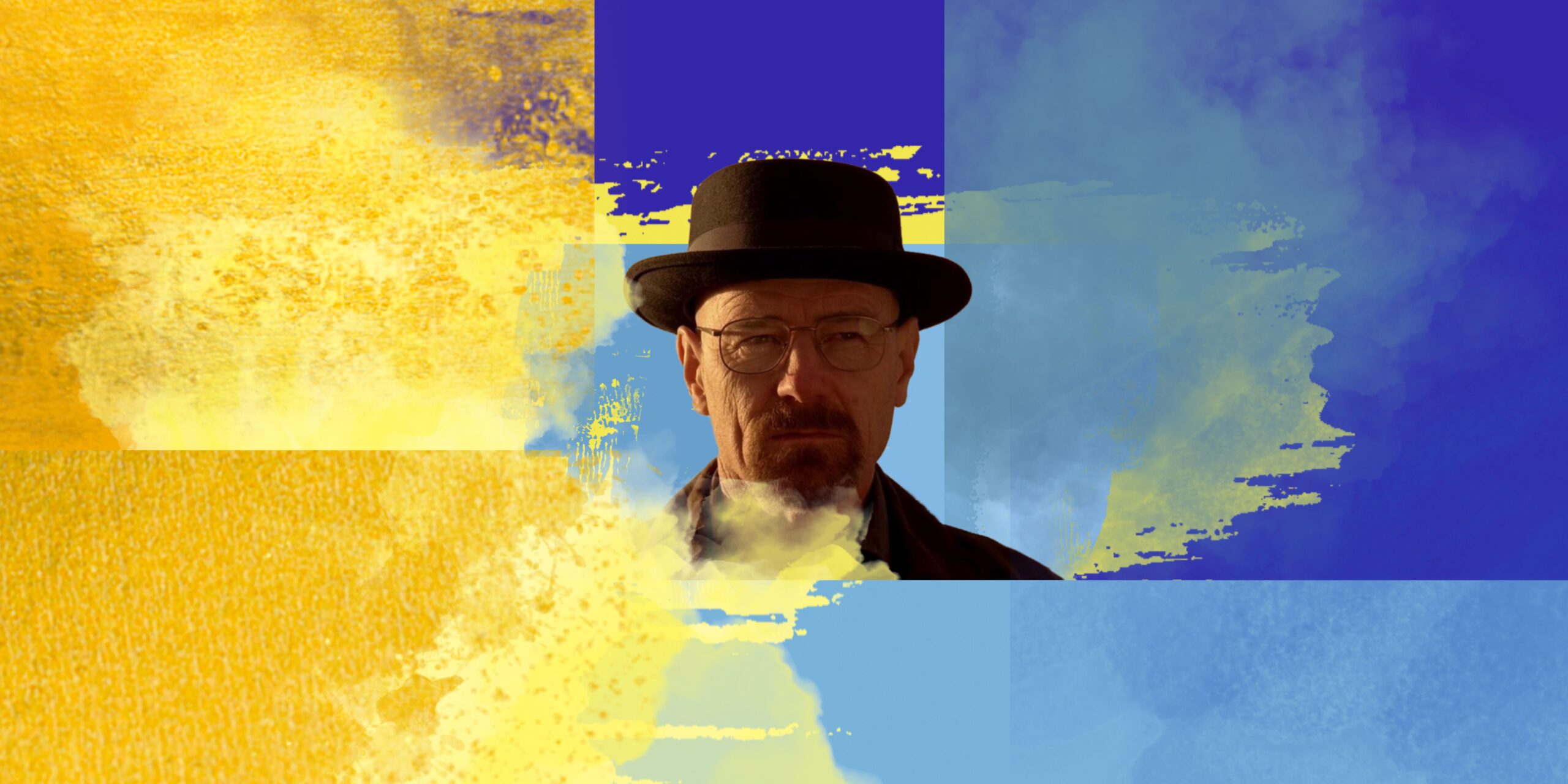

Walter White – aka Heisenberg – is the main protagonist of the American series Breaking Bad.
Played by Bryan Cranston (a great actor), White is a chemistry teacher at J. P. Wynne High School. Safe to say, he has a middle class life, involving all the perks and pits of ‘mediocrity’.
At the start of the series, White discovers that he has lung cancer. This makes him challenge not just the utility of getting a very expensive treatment but also of his own life. But, catering to his family’s wishes and understanding that they need him, he decides to choose to live.
Walter White is a dynamic character. In this essay, I will attempt to analyze him based on his
- Circumstances
- Motives
I will, however, first be laying out Walt’s personality profile. The personality analysis of “Mr.” White would be based on the five factor model of personality.
Below, I’ve written it down in very brief points. If you wish to understand Walter White more deeply than simply his personality traits – read on further until the end!
Let’s begin!
Openness to Experience: Moderately High
Walt is intelligent.
He is also open to other value systems. He can justify crime but, on the other hand, he also shows some understanding of how his drug business does not conform to societal standards of clean living. Moreover, he is also creative; this is shown in how he deals with Tuco, manipulating him effectively and creatively.
It should be said, however, that he could make better aesthetic choices. While the hat on Heisenberg is certainly stylish – the outfit is put together haphazardly. A more aesthetic individual would probably put his outfit together close to someone like Hannibal or Dexter.
Concientiousness: High
Throughout the runtime of Breaking Bad, Walt is shown to be a workaholic, often coming home late.
There are also clear pieces of evidence of his ambitions; such as when he discloses to Pinkman about his plans to expand upon their business, with Gustavo Fring gone. He also organizes his attempts to get rid of threats were carefully.
Extraversion: Moderately Low
Walt does not have a very big social circle.
In fact, the people he confides in are limited to just his immediate domestic and work circle. In the beginning of the show, Walter is visibly inhibited while interacting with the many people who had come to his birthday party.
Other than this, Walt is shown to be outgoing only in situations where he has some other ulterior motive. For example, when he agrees to join Hank Schwader on a drug bust, he only seems to have the intention of seeing how the drug business is run from a house. Otherwise, he had refused Hank previously to go to such operations.
Agreeableness: Low
It will be wrong to say that Walter is not empathic. He certainly understands how Jesse Pinkman feels, when the latter’s girlfriend died early on in the show.
Having said that, Walt stands his ground over points that he disagrees with.
He firmly refuses Gustavo Fring’s offer to work for him early on, until one of his own motives was fulfilled. Furthermore, in an argument with Mike, he chose to work independently of Mike when faced with the choice of giving his money to people who he thought did not deserve it. He is also compliant only when his own interests are involved. When his interests are not met, he seemingly is discarding of others’ worth – as was the case in his paranoia towards Gustavo Fring.
This is very similar to Joe Goldberg‘s (from the Netflix series ‘You’) beliefs about others’ utility as well. There is a psychological theory that psychopaths tend to have a utilitarian moral perspective.
Neuroticism: Moderately Low
Walter appears to handle the news of his death fairly well.
Rather, he is accepting of it.
While there certainly is a factor of being bored and disinterested in his life at the beginning, he does not display enough dysfunction to qualify for depression, anxiety or a fixation on negative emotions.
Even after ‘having lost everything’, Walter does all the tasks that he sets for himself at the end of the show. This is strikingly similar to another popular character, Thomas Shelby – for Shelby, however, his extraversion helps him fall in line with social activities. Nevertheless, Walter’s neuroticism is masked more easily as he generally avoids overly social activities more than Thomas.
There are, however, indications of anger issues. Some of his thoughts seem to be off base. For example, he believes that his former friend Elliott and former fiancé mistreated him, reaping the benefits of his work. However, it was he who impulsively sold his share of Gray Matter Technologies.
Summary
Walter exhibits signs of having a creative, industrious and meticulous personality. He likes to work long hours on his craft to the point where the money that he earns is almost irrelevant. However, he also considers himself to be a dutiful family member, and this justification is often used for his workaholism and continued meth-cooking. He can bear social gatherings, but he would rather spend the time with a few people who are within his closer social circles.
Furthermore, Walt retaliates quickly when he senses danger near to his close social circles, indicating a secure attachment style. Due to his intellectual capacity to formulate complex plans, he is able to stay aloof of both his competitors and the law enforcement.
In some ways, his thoughts and actions seems to align somewhat close to a high-intelligence subclinical antisocial personality.
Here, I think it is important to see what disorder Walt might have.
What Mental Disorder does Walter White have?
Walter White’s psychological decline is best understood not as the revelation of a hidden monster, but as a gradual deterioration shaped by illness, humiliation, and long-standing emotional vulnerabilities.
His cancer diagnosis acts as a psychological rupture, intensifying pre-existing symptoms of depression and anxiety rather than creating them outright.
Even before the diagnosis, Walter shows signs of anhedonia, irritability, and a pervasive sense of inadequacy, rooted in a life he experiences as chronically diminished. The illness introduces an existential threat that amplifies his anxiety, visible in his hypervigilance, obsessive need for control, and increasing intolerance of uncertainty. What emerges is a form of health-related depression compounded by a deep sense of narcissistic injury – less about sadness and more about the terror of having lived an insignificant life.
Is Walter White Narcissistic?
Walter exhibits clear narcissism, but these do not amount to Narcissistic Personality Disorder. His grandiosity, hypersensitivity to disrespect, and fixation on recognition fluctuate depending on context and threat, suggesting a reactive rather than structural narcissism. He is capable of attachment and concern for others, particularly early in the series, and his self-aggrandizement intensifies primarily when his fragile sense of worth is challenged.
This pattern aligns more closely with vulnerable or covert narcissism, in which grandiosity functions as a defense against shame rather than as an expression of entitlement or superiority.
Is Walter White Psychopathic?
Similar to narcissism, Walter increasingly demonstrates psychopathic traits – emotional detachment, instrumental violence, moral disengagement, and a diminishing capacity for remorse. There are indications of his impulsivity earlier on in life as well (selling his side of the company over a pretty manageable disagreement – of course not manageable to White as he is too narcissistic to desist in any way).
However, Walt does not meet the criteria for Antisocial Personality Disorder. ASPD requires a lifelong pattern of antisocial behavior beginning in childhood, which Walter clearly lacks. His moral collapse is progressive rather than developmental, emerging in response to stress, power, and repeated reinforcement of violence as an effective means of control.
What he displays is better described as secondary or situational psychopathy: a callousness acquired under extreme psychological pressure rather than a stable personality structure.
Now, let’s deepen the analysis further and understand what makes Heisenberg the way he is.
Does Walter White have Split Personality?
Walter White does not show convincing indications of dissociation, particularly not in the clinical sense required for dissociative disorders. His transformation into Heisenberg is a conscious, deliberate choice, not an unconscious psychological fragmentation. Dissociation, by definition, involves a disruption in awareness, memory, identity, or perception that occurs outside of volitional control. Walter, by contrast, remains consistently aware of his actions, their consequences, and the identity he is constructing. He plans, reflects, rationalizes, and later even acknowledges ownership of his choices—none of which align with dissociative processes.
The idea that Walter has a “split personality” is therefore a misreading of his character and of psychopathology itself. Dissociative Identity Disorder requires the presence of distinct identity states accompanied by amnesia or significant discontinuity in consciousness. Walter experiences neither. There are no memory gaps, no loss of agency, and no moments in which Heisenberg acts independently of Walter’s awareness. Heisenberg is not an emergent personality that overtakes him; it is a role he adopts, sustains, and strategically deploys.
Let me take you through an example where dissociation can actually occur.
Walter’s relative composure while Tuco violently beats No-Doze – does not necessitate a dissociative explanation. It is more parsimoniously understood as acute shock or freeze response under extreme threat. Remaining outwardly still in the face of sudden violence is a common autonomic reaction and does not imply a dissociative split.
Importantly, Walter does not display depersonalization or derealization across contexts in a way that would support a dissociative pattern.
His outbursts follow a clear, conscious narrative and thought pattern – especially the infamous scene he has with his wife: “I am the one who knocks.”
Heisenberg and Walter White are therefore better understood as personas rather than personalities. A persona is a consciously constructed mode of being – an identity organized around specific goals, values, and behaviors – rather than a fragmented self. Walter adopts Heisenberg as a means of accessing power, authority, and control that his former identity could not tolerate or sustain.
This shift reflects moral and motivational reorganization, not identity fragmentation. In psychological terms, Walter is not losing himself; he is choosing who he becomes, fully aware that Heisenberg is something he is doing, not something that is happening to him.
Circumstances of Walter White
It is impossible to understand Heisenberg without knowing where he comes from. Walter White turns 50 at the start of the series.
With relevance to the story and Walt’s situation, his circumstances can be divided along three major axes.
Work
He is a chemistry teacher at a high school. But he had not pictured himself as being in this position. He had contributed to Nobel-worthy research and he was a partner at Gray Matter Technologies, along with his best friend at the time, Elliot Schwartz.
But Walt sold his share of the company, and the company later grew into a multi-billion dollar enterprise.
Instead of having been in an active lab at a resourceful facility, being financially independent at 50, Walt was stuck teaching to classes of disinterested students and enjoying a meager pay.
So, when the news of his lung cancer is out, Walt does not feel as if he has much to live for.
Except for one major reason.
Family.
Family
Walt is married to Skyler White, with a young boy, Walter White Junior, in middle school and a daughter on the way.
However, it is not like Walt is a perfect father or husband. Rather, he struggles with himself about the fact that he hasn’t provided enough for his family. He appears to be more tired in life but he softens in the pillow therapy scene in the show, for his pregnant wife and son.
Social Circle
It is also important to note that Walt holds some of his relations in high regard. He opened up in the pillow therapy scene partly thanks to his sister-in-law, Marie Schrader, and her husband, Hank Schrader.
Other than his immediate family and his wife’s sister, Walt’s social circle extends only to associates at work and his past friends. However, he is not very happy about his friendship with Gretchen, his former lab assistant and ex-fiance, and Elliott who Gretchen married.
He is tired, dejected, broke. However, he also has a loving family, a stable job, living in a middle-class neighborhood.
The main point of contention here is not feeling unfulfilled. Rather, Walt appears to hate mediocrity.
So, it is this context that sets the stage for the rest of Walt’s life.
Motives of Walter White
We have looked at Walt’s circumstances at the beginning of the story. Now, we will see what drives him.
For the purposes of simplifying White’s motives, I have divided them into two different categories.
Getting Paid and Treated Adequately
Throughout the show, a running theme is Walt being compensated with what he deserves. The central goal is not just money. After all, if he had wanted only money, he would have tried to negotiate a higher price for his services as a meth chef for Gustavo Fring. Indeed, Jesse Pinkman was furious that he had agreed to cook meth for such a small price.
Moreover, I assert here that this central belief of “I should be treated how I deserve to be treated,” runs also in Walter’s work relationship with Tuco, Pinkman, Mike and Fring. When he feels that the other person is not treating as he deserves to be treated, he tries to neutralize the threat.
While sharing finances with Mike and Pinkman, he splits the money in equal proportions. He gives others what he thinks they deserve as aligned with the general logical conception of fairness. When he does all the work, he expects the other person to not take away the outcomes of the work he does.
However, these beliefs about what someone deserves is purely based on who does the work. For example, he claims that there is no other half for Pinkman, as he thought that he was doing all the work himself.
He fights with Mike, arguing against paying off other people when he operates with Mike and Pinkman after Fring.
However, there is another core belief that has often clashed with his belief of getting what one deserves. Let’s look into Walt’s motives regarding his family.
“All I do is For the Benefit of the Family”
This seems to be among the chief rationales for Walter’s sudden move towards selling meth. He understood that this has the potential of paying off his chemo treatment. Moreover, he wants to save and leave enough money for his wife and children to live the rest of their lives in relative affluence. He buys his son a Mustang. Moreover, he discloses his secret to Skyler and then takes her counsel over conducting his business more safely.
Having said that, there are many actions of his that are not justified by the two beliefs mentioned above.
With that, let’s take a dip into Walt’s ego trip. This is where I will refer to Walt as Heisenberg.
I’m Good At It; It Makes Life Worth Living
Based on Walter’s circumstances, one could conclude that he did not really only want to teach. Rather, the way that he teaches his lectures is disinteresting to his students. While he initially tries to pursue it passionately, as seen in the pilot episode, he apparently begins to lose his own interest as well.
His entire resume right until he sells his shares in Gray Matter Technologies, speaks of work that is lab-based and interesting. So, led by his desire to earn far more money than he was earning at the time, Heisenberg constructed his own lab in an RV. Later on, this lab is greatly expanded under Gustavo Fring and when he finally began operating independently of Fring. He appears to be driven while he is working in the lab.
There are two reasons for this:
- Increase in self-efficacy
- Increase in interest in life
For Heisenberg, there is ambition involved in making meth. When Pinkman talks about quitting, Heisenberg argues against this, showing his ambitions for expanding his business.
Another example is when he ends up earning such a significant amount that Skyler loses count of the money – which is not normal for Skyler, who is managing an entire car wash facility. She asks Heisenberg with exasperation about how long he would continue his drug business, because if it was only for the family, then they have enough money to last lifetimes.
Conclusion
Walter White aka Heisenberg is a well-written character who grows as the series progresses. This does not mean that White did not commit many mistakes.
But, don’t we all?
To understand a character or even a living person, it is important to take their circumstances into consideration. Once you do that, you will find that it becomes much easier to trace their motives by how they act in different situations.
Even if the character is a drug-emperor!

I am a Clinical Psychologist and a Lecturer of Psychology at Government College, Renala Khurd. Currently, I teach undergraduate students in the morning and practice psychotherapy later in the day. On the side, I conjointly run Psychologus and write regularly on topics related to psychology, business and philosophy. I enjoy practicing and provide consultation for mental disorders, organizational problems, social issues and marketing strategies.
