
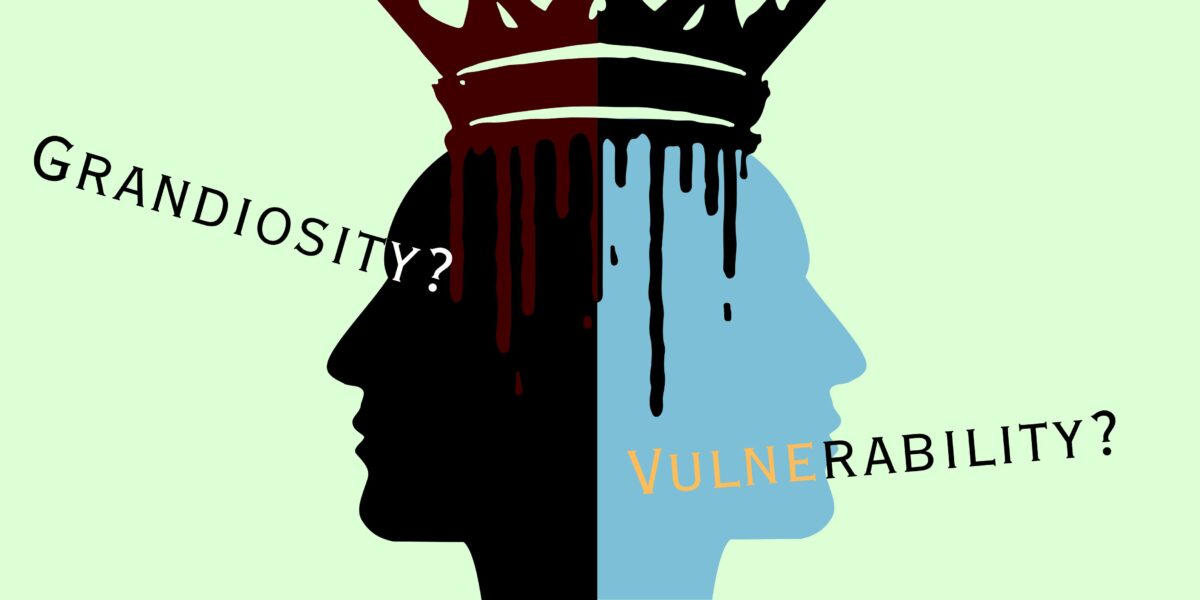
When most people hear the word narcissist, they picture someone loud, arrogant, and obsessed with admiration. The confident boss who can’t take criticism. The partner who always needs to win. The friend who somehow turns every conversation back to themselves.
Recent depictions of narcissism often circle around serial killers like Joe Goldberg or Patrick Bateman (often incorrectly too). These lean more towards the clinical condition of narcissistic personality disorder or psychopathy.
But there’s another quieter version that doesn’t fit that stereotype.
This person is sensitive. Easily hurt. Quietly resentful. They feel misunderstood, overlooked, chronically underappreciated. They may not look arrogant at all – in fact, they may seem insecure.
While the DSM currently might not recognize the latter as such, modern psychology recognizes both of these personalities as forms of narcissism.
What we call grandiose narcissism is the bold, dominant, self-assured expression. Vulnerable (or covert) narcissism is the fragile, reactive, shame-prone expression. On the surface, they seem like opposites. One is thick-skinned. The other is thin-skinned. One inflates. The other withdraws.
But this distinction can be misleading.
In this article, I will lay out how grandiose and vulnerable narcissism originate from the same underlying assumption of heightened self-importance, but diverge based on differences in emotional regulation, self-esteem stability, and responses to threat. (Do check out the comparison between narcissism and main character syndrome).
By examining how each type handles criticism, relationships, fear, lifestyle choices, and emotional regulation, we can move beyond stereotypes – and understand narcissism not as a single personality, but as two distinct regulatory strategies built around the same fragile center.
Core Self-Beliefs of Grandiose and Vulnerable Narcissism
Core Self-Belief: “I Matter More”
At their core, both grandiose and vulnerable narcissism appear to grow from the same underlying assumption:
“My value is greater than the people around me.”
This belief doesn’t necessarily begin as open arrogance. Often, it functions as a psychological stabilizer. The individual assumes specialness or superiority even when there is little objective evidence to support it. The self is elevated – not because reality confirms it, but because reality must confirm it (do check out this article if you want to learn about the issue with having shoulds and musts).
But what if reality does not match with this belief? This is one of the reasons why pop culture notes that narcissists believe their own lies.
From this starting point, two different outcomes tend to emerge.
If the person has relatively stable mood regulation – meaning their emotional system is steady and not easily overwhelmed – the belief can expand outward. It becomes
- confidence,
- dominance,
- and entitlement.
This is what we recognize as grandiose narcissism. The individual feels powerful, assertive, sometimes superior. Their nervous system can sustain the inflated self-view.
But when mood states are more unstable – when the nervous system is reactive, sensitive, or prone to shame – the same core belief becomes fragile. The person still assumes they are special or more important, but they constantly feel unseen, misunderstood, or unappreciated.
The self feels elevated yet threatened at the same time. This is what we call vulnerable (or covert) narcissism.
Research supports the idea that both forms share a common narcissistic core but diverge in emotional regulation patterns, affective stability and nervous system reactivity.
So, the difference may not lie in whether the person believes they are exceptional – but in how securely their emotional system (both psychological and neurological components) can maintain that belief.
I’ll try to simplify the difference in beliefs.
Grandiose narcissism says:
“I am superior.”
Vulnerable narcissism says:
“I am special – but no one sees it.”
Same root. Different emotional climate.
How They Handle Criticism
Criticism is where the differences between grandiose and vulnerable narcissism become especially clear.
Both types experience what psychologists call narcissistic injury – a blow to the inflated self. But the kind of threat that hurts them most differs.
Research by Besser and colleagues (2010) found that grandiose narcissists feel significantly worse in achievement-threatening situations. When their competence, status, or superiority is questioned, it hits hard. Their self-worth is tied to winning, outperforming, and being exceptional.
However, they are less shaken by interpersonal conflict. Why? Because they often protect themselves through externalization. If something goes wrong, the flaw belongs to someone else. They may mentally downgrade the person they’re competing with. This fits with another key trait: grandiose narcissists tend to be more competitive. Criticism becomes a battlefield.
Vulnerable narcissists are different.
They are more deeply affected by interpersonal threat – rejection, exclusion, subtle disapproval. Their nervous system is more reactive to social evaluation. Instead of attacking back, they are more likely to withdraw, sulk, or disengage in order to preserve what remains of their self-esteem.
So, while both feel wounded, the expression diverges:
- Grandiose narcissism entails anger, blame, and counterattack.
- Vulnerable narcissism entails shame, withdrawal, and rumination.
Same injury. Different defensive strategy.
Narcissism in Relationships
If criticism reveals their sensitivity, relationships reveal their expectations.
A study examining partners of grandiose and vulnerable narcissists found two consistent patterns:
- The longer the relationship lasted, the more conflicts increased.
- Higher exploitative traits predicted more relationship problems.
In other words, time exposes patterns of narcissism while the presence of exploitation becomes a major driver of the problems.
Grandiose narcissists were also associated with higher homophily – meaning they tend to choose partners who resemble them. This may suggest that they expect their partner to reflect their own standards, ambition, or image. They often hold strong other-oriented perfectionistic expectations – the belief that others (including their partner) should strive for flawlessness.
Another study found that:
- Grandiose narcissism is associated with expecting perfection from others.
- Vulnerable narcissism is associated with socially prescribed perfectionism – the belief that one must meet others’ expectations to be worthy.
This creates very different relational dynamics.
Grandiose narcissists may pressure partners to perform, improve, or enhance their status. Exploitation here can look like using the partner as an extension of the self.
Vulnerable narcissists, on the other hand, may become dependent on reassurance. Their exploitative behaviors are often subtler – driven by a need to protect fragile self-worth. They may elicit validation, sympathy, or emotional caretaking. In fact, vulnerable narcissism has also been associated with social anxiety.
Hence, in relationships:
- Grandiose narcissism seeks admiration.
- Vulnerable narcissism seeks reassurance.
- Both struggle with maintaining mutuality.
Their Deepest Fear
At first glance, grandiose and vulnerable narcissists look emotionally opposite.
One appears bold, dominant, even intimidating.
The other appears sensitive, insecure, and easily wounded.
But when researchers look at higher levels of narcissism, something interesting happens.
For example, at higher levels of grandiose narcissism, individuals also showed increased antagonism, fear, and vulnerability. In other words, at the extreme end of the spectrum, the emotional core of both types begins to overlap.
The shared fear?
A collapse of self-worth.
At lower levels, however, the difference is clearer:
- Vulnerable narcissism is strongly associated with negative preoccupation about self-worth, especially in social settings.
- Grandiose narcissism appears less fearful – at least on the surface.
Having said that, the fears themselves may not differ dramatically – what differs is how self-esteem is regulated. Vulnerable narcissism shows a stronger association with shame. The threat is internalized.
So while both may fear being insignificant, ordinary, or exposed as inadequate:
- Grandiose narcissism fights the fear with dominance.
- Vulnerable narcissism emotionally reacts to the fear with shame.
Basically, one defends upward. The other collapses inward.
And this helps explain the reaction to criticism, the relational dynamics, and the emotional profile I discussed above.
The fear is the same. The regulation strategy is different.
Lifestyle Patterns
Personality doesn’t just show up in arguments. It shows up in everyday choices.
A recent study examined how self-esteem mediates the relationship between narcissism and consumer behavior. The findings were telling.
Grandiose narcissism was associated with purchasing trendier, higher-cost, brand-related items. Status signaling matters. Consumption becomes an extension of identity – a way of reinforcing superiority.
Vulnerable narcissism showed a weaker association with these visible status purchases.
Interestingly, when it came to social network addiction, there was little difference between grandiose narcissists and non-narcissistic individuals in problematic use or preference for online interaction. In fact, grandiose narcissism did not predict higher problematic social media use.
This suggests something subtle but important.
Grandiose narcissists may actually prefer organic, in-person arenas where they can compete, dominate, and display status directly. Their superiority-seeking is often embodied and outward.
Vulnerable narcissists, on the other hand, are more likely to withdraw socially. Their struggle is less about visible dominance and more about managing internal self-worth fluctuations. This goes along with the research I quoted earlier about vulnerable narcissism being associated with social anxiety.
So, lifestyle differences may reflect regulation strategies:
- Grandiose narcissism largely involves outward striving, visibility, and status signaling.
- Vulnerable narcissism, on the other hand, consists of inward comparison, sensitivity, social hesitation.
Again, same core – “I must be important.”
Different ways of stabilizing it.
The Emotional World
If you really want to understand the difference between grandiose and vulnerable narcissism, look at how they regulate emotion.
A study published in Frontiers in Psychology (2020) found something striking:
- Individuals high in vulnerable narcissism were more likely to use suppression, a maladaptive emotion regulation strategy (somewhat similar to repression – a defense mechanism).
- Individuals high in grandiose narcissism did not show the same reliance on suppression and did not express negative emotions in an uncontrolled way.
- Vulnerable narcissism was positively associated with depressive symptoms and anhedonia.
- Grandiose narcissism was not associated with depressive symptoms.
In simple terms: vulnerable narcissism is emotionally heavier.
Another study published in the Asian Journal of Social Psychology found that:
- Grandiose narcissism was negatively correlated with emotional dysregulation.
- Vulnerable narcissism was positively correlated with emotional dysregulation.
- Self-esteem fully mediated the relationship between grandiose narcissism and emotion dysregulation.
That last point is important.
It suggests that higher self-esteem may buffer grandiose narcissists emotionally. Their inflated self-view helps them maintain composure. They can inhibit negative emotional cues, especially in public, because their internal narrative protects them.
Vulnerable narcissists, however, appear to have more fragile self-esteem. Since self-worth fluctuates more dramatically, negative emotions like shame, envy, and sadness are harder to regulate. Suppression becomes a common strategy – but suppression doesn’t resolve emotion. It buries it.
This helps explain why:
- Grandiose narcissism often looks confident, controlled, even charming.
- Vulnerable narcissism often feels tense, reactive, and internally distressed.
It’s not that grandiose narcissists feel nothing.
It’s that their emotional system is stabilized by inflated self-esteem and defensive strategies like projection or displacement.
Vulnerable narcissists, on the other hand, tend to internalize distress. Their negative emotionality guides behavior more directly – sometimes leading to withdrawal, rumination, or depressive symptoms.
Emotionally:
- Grandiose narcissism involves regulated surface, defended pride – however this can change if rivalry is experienced frequently.
- Vulnerable narcissism involves unstable self-esteem, suppressed distress.
Same core need for importance.
Very different emotional climates.
To summarize these comparisons, I have made a table below.
| Dimension | Grandiose Narcissism | Vulnerable (Covert) Narcissism |
| Core Self-Belief | “I am superior.” High, stable self-esteem supports this belief. | “I am special, but no one sees it.” Self-worth is fragile, reactive to social evaluation. |
| Reaction to Criticism | Feels threatened by achievement-related criticism. Often externalizes blame or attacks. Competitive. | Feels threatened by interpersonal criticism or rejection. Withdraws or sulks to protect self-esteem. |
| Relationships | Chooses partners similar to themselves (homophily). Holds high expectations of others. Exploitative to assert dominance or maintain admiration. | Sensitive to partners’ judgment. Exploitative behaviors aimed at protecting fragile self-worth. Seeks reassurance. |
| Deepest Fear | Losing superiority, being ordinary, or failing. Fear is outwardly defended through dominance. | Collapse of self-worth, social rejection, shame. Fear is inwardly absorbed; leads to withdrawal or rumination. |
| Lifestyle Patterns | Status-driven: prefers visible achievements, brand-related purchases, in-person dominance. Lower problematic social media use. | Avoids high-profile social engagement. Less likely to buy high-status goods. May withdraw socially; social media use not necessarily higher. |
| Emotional World | Emotionally regulated; suppresses negative emotional cues outwardly. Uses defense mechanisms like projection or displacement. Less prone to depression. | Emotionally reactive; suppression of feelings but experiences high depressive symptoms and anhedonia. Negative emotionality drives behavior. |
| Mood Regulation / Nervous System | Better-regulated mood states, less reactive nervous system. Can maintain grandiose self-view. | Dysregulated mood states, reactive nervous system. Self-worth fluctuates, leading to vulnerability. |
| Defense Mechanisms | Projection, devaluation, denial. Directs threats outward. | Suppression, introjection, rumination. Threats internalized. |
Conclusion
Grandiose and vulnerable narcissism may look like opposites, but beneath the surface they are built on a similar psychological foundation. Both revolve around the need to feel more significant than others – not simply out of arrogance, but as a way of stabilizing self-worth. The difference lies in how that stability is maintained.
Grandiose narcissism defends against insecurity by expanding outward. It leans on confidence, competition, status, and dominance. Its emotional system appears steadier, supported by inflated self-esteem and defensive strategies that push threat away. Vulnerable narcissism, by contrast, turns inward. It carries a heightened sensitivity to rejection, a stronger association with shame, and a more fragile regulatory system.
Where one attacks, the other withdraws. Where one asserts superiority, the other fears exposure.
Yet at higher levels of narcissism, the emotional gap narrows. Research suggests that both forms ultimately share a similar fear: the collapse of self-worth. One protects against it by building a psychological fortress; the other protects against it by retreating behind emotional walls.
Understanding this distinction matters. It helps us recognize why some individuals respond to criticism with rage while others respond with silence. It clarifies why some partners feel pressured to perform, while others feel emotionally burdened.
And perhaps most importantly, it reminds us that narcissism is not merely about vanity. Rather, it is about regulation.
Recognizing these patterns does not excuse harmful behavior. But it does offer insight. And insight, when used wisely, allows for clearer boundaries, deeper empathy, and a more realistic understanding of the personalities we encounter – including, at times, our own.

I am a Clinical Psychologist and a Lecturer of Psychology at Government College, Renala Khurd. Currently, I teach undergraduate students in the morning and practice psychotherapy later in the day. On the side, I conjointly run Psychologus and write regularly on topics related to psychology, business and philosophy. I enjoy practicing and provide consultation for mental disorders, organizational problems, social issues and marketing strategies.
