
Portgas D. Ace is one of the characters in the world of One Piece which truly embodies the struggle of existential validation. On the surface it seems like Ace has the persona of a powerful and confident pirate, but a deep psychological analysis reveals a man who is consistently haunted by the original sin of his bloodline.
Let’s dive into a psychological breakdown of a character who questioned whether he deserved to live!
Who is Portgas D. Ace?
When Ace is introduced into the show he is introduced as an accomplished pirate already as the 2nd division commander of whitebeard pirates, which is the pirate group of an emperor and is one of the four most powerful pirates in the world. He is also introduced as the brother of the main character of the show Luffy.
He is introduced as a very likeable character who is very protective of his little brother and seems carefree and has few quirks that are similar to the ones Luffy has, for example “eating like a monster” or “sleeping while in the middle of eating like a monster”.
We do get a brief intro to his personality as he talks to some of the members of the strawhats but we do not get a deeper view of his personality till he gets caught and is ready to be executed at the marineford.
1. The Existential Crisis: “Was I Born to be a Monster?”
Ace’s psychology at its core is an existential vacuum based in childhood trauma. Unlike Luffy, who while raising up had a very strong and clear sense of self, Ace grew up hearing the world curse his father, Gol D. Roger.
The Internalized Stigma
Since his childhood Ace would hear that his father Roger was a “demon” and that his bloodline should be chased and killed and does not deserve to live. Ace internalized the idea and never felt that he deserved to live and thought that his existence was a crime.
The Search for Meaning
It seems that Ace wanted to prove his worth in the world. He had a constant and aggressive battle with himself all his life where he was trying to find the answer to the question “Should I have been born?”. His desire to be a pirate and look for One Piece was also rooted in his desire to prove his worth as a pirate and not just a desire to find the treasure.
This is a classic case of Identity vs. Role Confusion, where his heritage (the son of the Pirate King) conflicted with his desire to be his own man.
2. Defensive Mechanisms: The “Fire” of Reaction Formation
Ace’s personality is defined by a blend of extreme politeness and explosive volatility.
Reaction Formation
In his teens, Ace learned some manners and etiquette purposefully because he did not want to become a barbaric figure like his father and he did not want to be associated with him.
Overcompensation
Ace’s will to never “run away” from a fight which was also a trait he shared with Roger can also be considered psychologically maladaptive. It was a way to “overcompensate” for the inherent “shame” he felt about his birth.
His fire abilities (the Mera Mera no Mi) are a literal manifestation of his burning need to be seen and felt in a world that wanted him erased.
Intellectualization
Ace spent most of his early life asking people what they thought of Gol D. Roger. A lot of the time, he heard people say that his child should never have been born. He tried to “fix” the problem of being alive by getting outside approval.
He wanted Whitebeard to be a new father figure for him because he hated his real father. He changed his name from “son of Roger” to “First Division Commander of Whitebeard” to protect himself from an identity crisis. In a way, he “re-parented” himself to feel like he belonged. It can be considered a healthy way of using a defense mechanism.
3. The Surrogate Father and the Need for Belonging
The most important shift that happened in Ace’s life was joining the Whitebeard Pirates.
From Self-Reliance to Vulnerability
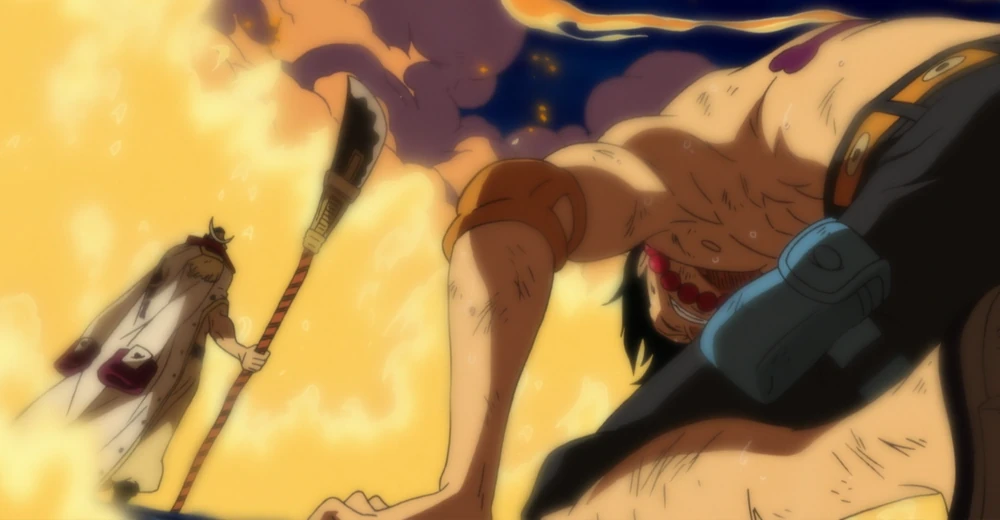
Initially, Ace tried hundreds of times to kill whitebeard while and after he was being forced to stay on the ship. This was a projection of his resentment toward authority and specifically “fathers”.
The “Son” Identity
Whitebeard’s offer “Become my son”gave Ace the validation he was looking for all his life. He transitioned from an individualistic goal of being a pirate king to a common goal of making whitebeard the pirate king which was rooted in his gratitude to whitebeard for providing him with a father figure he can look up to. For the first time in his life his identity was not tied to shame but to belonging.
4. The Fatal Flaw: The Shadow of the Bloodline [Big Spoilers Ahead]
Ace’s death at Marineford and how it actually happens is the ultimate psychological climax of his character.
The Akainu Confrontation
Ace was literally about to escape when Akainu insulted whitebeard. However, his inability to “let go” of an insult specifically to his chosen father mirrored the very “demon-like” stubbornness of his real father which he hated all his life.
The Final Resolution
“Thank you for loving me” were Ace’s last words and they represented a closure and the resolution of his identity crisis. He died realizing that he was not the “monster” everyone thought he was and he had people who cared about him.
I think he was happy at the end that in his own weird way he was able to die protecting the honor of his chosen father and also white protecting his brother.. That is why he was smiling because he finally felt he deserved to be born and also made his stay in the world worthy of living.

Tabraiz is MS Clinical Psychologist and a gold medalist in MSc Psychology. He is passionate about reading and writing on psychological topics and is also an expert in digital marketing. With a deep love for the philosophy of life, he explores the intersection of mind, human behavior, marketing. Member of APA (American Psychological Association)
- Syed Tabraiz Bukhari

- Syed Tabraiz Bukhari

- Syed Tabraiz Bukhari

- Syed Tabraiz Bukhari

- Syed Tabraiz Bukhari

- Syed Tabraiz Bukhari