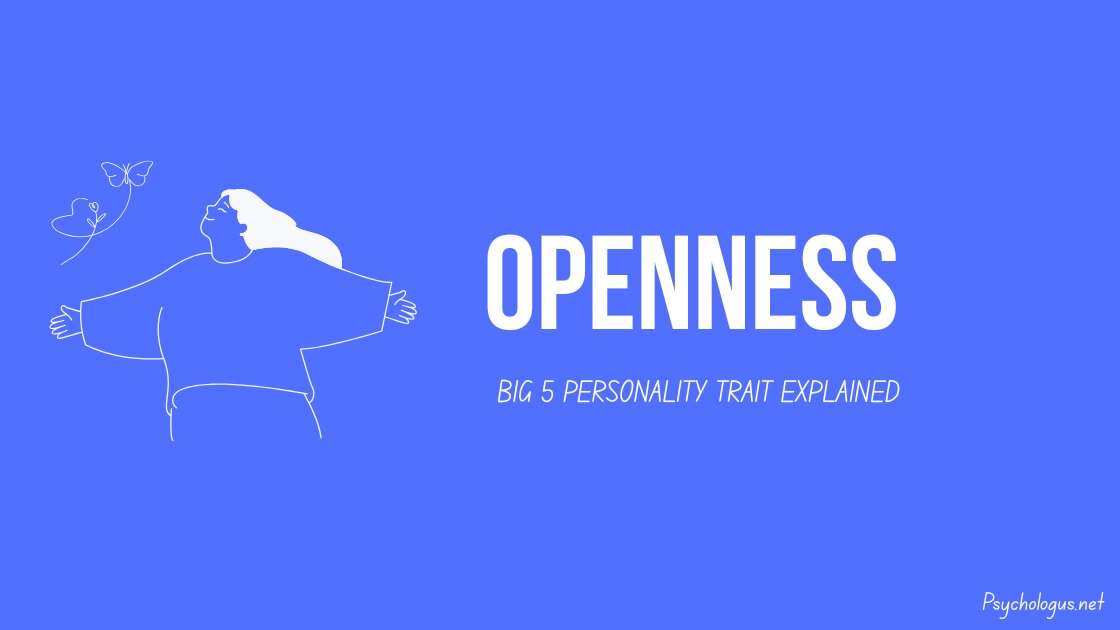
Openness to experience is the personality trait that governs how readily a person seeks out, notices and absorbs new ideas, sensations and ways of seeing the world. It is one of the Big Five personality traits, and the one researchers have argued about the longest. Depending on which tradition you read, it has been called Openness, Intellect, Culture, and Openness/Intellect.
Let’s start with a definition.
Openness to experience represents the tendency of someone to be imaginative, curious, aesthetically sensitive, emotionally receptive, and willing to re-examine established ideas and values rather than accept them as given.
People who score high on openness tend to have an active imagination and notice beauty where others do not. They enjoy abstract argument for its own sake, and treat their own beliefs as revisable. People who score low prefer the familiar to the novel and are generally more comfortable with tradition and routine. They are more practical, conventional and grounded in the concrete.
It is worth clarifying what openness is not. A low score does not mean closed-minded in the pejorative sense, and it does not mean unintelligent. Low openness is associated with efficiency, focus and a preference for the tried and tested qualities. Curious where you sit? You can take our free Big 5 personality test for an instant breakdown across all five traits.
The Six Facets of Openness
Like the other Big Five domains, openness in the NEO-PI-R model is divided into six facets. These were selected on the basis of their historical presence in the personality literature and their empirical distinctiveness. The aim was to build scales that are as non-overlapping as possible while still measuring the same underlying domain.
The fascinating thing about openness is that its facets hang together very loosely. A person can be deeply moved by art but be completely uninterested in having philosophical debates. That is why the facet profile matters a lot when it comes to openness.
1. Fantasy
This facet describes a vivid imagination and an active inner life. High scorers daydream elaborately, not as an escape from a dull reality but because they find the imagined world genuinely interesting. They tend to be the people who can hold a fictional scenario in mind and turn it over.
Low scorers are prosaic and prefer to keep their attention on what is actually in front of them. They often consider daydreaming a waste of time.
2. Aesthetics
Aesthetics captures a deep appreciation for art, music, poetry and beauty. High scorers are absorbed by artistic experience and often report being moved by it in a bodily way for instance getting chills in their body. They do not have to be talented or artistic themselves to score high on this facet.
Low scorers are relatively insensitive to and uninterested in art and beauty. They can enjoy a film or a song, but it does not absorb them afterwards.
3. Feelings
This facet is about receptivity to one’s own inner emotional life. High scorers can distinguish between different feelings better, vividly experience emotions and they consider emotional experience an integral part of a life well lived.
Note the distinction from neuroticism. The Feelings facet is about the range and depth of emotion registered, not its negativity. Someone can be high on Feelings and low on neuroticism. Which means they feel a great deal, and most of it is not distress.
Low scorers have blunted affect and tend not to see feelings as especially informative.
4. Actions
Actions describes a willingness to do new things rather than just think about them: try unfamiliar food, take a different route, travel somewhere unplanned, pick up a new hobby. High scorers find trying new experiences rewarding and routine boring.
Low scorers prefer the familiar and stick with what has worked for them before. They tend to have stable habits, preferences, and a settled way of doing things.
5. Ideas
This facet reflects intellectual curiosity, an enjoyment of abstract problems, philosophical argument and open-ended questions. Crucially, this is curiosity, not ability. High scorers are not necessarily better at thinking than others but they do like it more than others.
Low scorers are narrow in their curiosity and are content to focus their mental energy on a limited set of concerns.
6. Values
Values captures a readiness to re-examine social, political and religious commitments. High scorers treat inherited beliefs as open questions. Low scorers tend toward dogmatism and a respect for authority and tradition.
This is the facet most often misread as a political statement. It is not. The scale does not measure conclusions someone reaches but the disposition to re-examine. Plenty of people arrive at traditional positions after genuinely questioning them, and plenty accept progressive positions without examining them at all.
Where do you fall on the Big Five?
Take our free Big 5 personality test and get an instant visual breakdown across all five OCEAN traits, including your openness score. It takes about five minutes, and we’ll email you a copy of your results.
Openness or Intellect? The Two Aspects Debate
Before we look at the causes of openness let’s visit a debate that has been following this trait for a long time.
DeYoung, Quilty and Peterson (2007) found that each Big Five domain splits neatly into two intermediate “aspects” sitting between the broad domain and the narrow facets. For this trait the two aspects are Openness (aesthetic and imaginative engagement) and Intellect (interest in abstract and logical problems, and perceived intelligence).
The distinction is not academic hair-splitting. Kaufman and colleagues (2016) found that the two aspects predict different kinds of creative achievement: the Openness aspect predicts achievement in the arts, while the Intellect aspect predicts achievement in the sciences. It often seems that the scientist and artist both are “open” but in a totally different way, and this is why it seems so.
What Causes Openness?
Why do some people score higher than others? As with every Big Five trait, the answer is a mixture of inherited disposition and environment but the specific mechanisms proposed for openness are distinctive.
Genetics
Behavioural genetic studies have consistently placed openness among the more heritable of the Big Five. Jang, Livesley and Vernon’s (1996) twin study estimated heritability at around 57% for openness, the highest of the five domains in that sample, with the remaining variance attributed largely to non-shared environment rather than shared family environment.
That last point is often missed. Growing up in a household full of books does not, by itself, appear to make people open. The environmental influences that matter seem to be the ones siblings do not share.
Dopamine and the exploration system
DeYoung (2013) proposed that dopamine functions as the neuromodulator of exploration, and that openness/intellect is the personality expression of this system. In this account, dopaminergic activity signals the value of potential information, the reward of finding something out rather than the reward of consuming something. People with a more reactive exploratory system find unfamiliar ideas and situations intrinsically motivating rather than threatening.
This framework also explains an otherwise awkward finding: openness shares neurochemical territory with both creative achievement and, at the extreme end, apophenia (the tendency to perceive patterns and meaning in noise).
Cognitive ability and prefrontal function
DeYoung, Peterson and Higgins (2005) reported that openness/intellect correlates with prefrontal cognitive function and working memory performance. It is also most reliably correlated with measured intelligence when it comes to the Big Five traits. Crystallised intelligence also comes from the knowledge that you gather by being curious about something your whole life. Ackerman and Heggestad’s (1997) meta-analysis situated openness within a broader cluster of intellectual investment traits.
The causal direction here is genuinely unresolved. Curiosity plausibly builds knowledge, and having knowledge plausibly makes further curiosity rewarding.
Reduced latent inhibition
Latent inhibition is the brain’s automatic filtering of stimuli it has already categorised as irrelevant. Research by Peterson and Carson has found that there is a link between reduced latent inhibition and higher openness.
It is one of the more interesting findings in the personality literature. Low latent inhibition is associated with both individuals who have psychosis and those with high creative achievement.
Interesting Facts About Openness
- Openness is widely described as the Big Five trait least likely to change in adulthood. MacLean, Johnson and Griffiths (2011) found that a single high-dose psilocybin session producing a mystical-type experience was followed by increases in openness sustained over a year. The results of this study are an important addition to the personality literature.
- Openness is the strongest Big Five predictor of creative achievement, and it actually outperforms intelligence in several studies of real-world creative output.
- Mean levels of openness rise through adolescence and young adulthood, plateau, then decline in later life (Roberts, Walton & Viechtbauer, 2006). This is the opposite trajectory to conscientiousness and agreeableness, which continue rising.
- Openness is the Big Five trait most consistently associated with political liberalism across studies, with the Values facet doing most of the work (Carney, Jost, Gosling & Potter, 2008).
- Unlike the other four traits, openness shows the weakest convergence between self-report and observer ratings. That is because in most cases your inner intellectual and aesthetic life is largely invisible to those around you.
How to Assess Openness
Openness is generally measured through self-report scales, in which respondents rate how well a series of statements describes them. Peer report and observer rating can supplement this. It is worth keeping in mind that self-report and observer ratings are further apart in openness than in any other personality trait.
Let’s look at some of the measures of Openness:
1. NEO Personality Inventory-Revised (NEO-PI-R)
Still the gold standard for facet-level Big Five measurement. It is the only widely used instrument that reports all six openness facets (Fantasy, Aesthetics, Feelings, Actions, Ideas, Values) separately, which matters more for openness than for any other trait given how loosely its facets cohere.
2. Big Five Inventory-2 (BFI-2)
Soto and John’s (2017) revision of the classic BFI adds a facet layer, breaking openness into Intellectual Curiosity, Aesthetic Sensitivity and Creative Imagination. At 60 items it is far shorter than the NEO-PI-R while still providing sub-domain resolution.
3. International Personality Item Pool (IPIP-NEO)
A public-domain item pool that correlates highly with the commercial NEO-PI-R. It is free to use, available in versions from roughly 20 to 300 items, and can be customised, which is why it underpins most free online Big Five tests, including the assessment on this site.
4. HEXACO-PI-R
The HEXACO model treats Openness to Experience as one of six factors rather than five. Its openness scale is defined slightly more narrowly than the FFM version, and the model’s additional Honesty-Humility factor absorbs some content that the Big Five distributes across agreeableness.
Prevalence and Cross-Cultural Patterns
Openness levels vary across cultures, though the interpretation of these differences is contested and individual differences are always there. The most extensive comparison remains Schmitt, Allik, McCrae and Benet-Martínez (2007), who surveyed over 17,000 people across 56 nations.
Broadly, that work and subsequent studies have found:
| Pattern | What the research suggests |
|---|---|
| European and Anglophone samples | Tend to score at or above the global mean on openness |
| East and Southeast Asian samples | Tend to score below the global mean, though researchers debate how much of this reflects trait differences versus response style and translation of abstract items |
| African samples | Show mixed and less consistent results, with some studies raising questions about item equivalence |
| Within-country variation | Consistently larger than between-country variation, national averages tell you very little about any individual |
Two cautions are worth stating plainly. First, openness items are unusually abstract (“I have a rich vocabulary”, “I enjoy hearing new ideas”), which makes them more vulnerable to translation and cultural interpretation effects than items about, say, punctuality. Second, cross-cultural mean comparisons in personality remain methodologically contested, and readers should treat the direction of these findings as more reliable than their magnitude.
Disclaimer: The information and assessment tools mentioned in this article are for educational and informational purposes only. They are not intended to be a substitute for professional psychological advice, diagnosis, or treatment. Self-administered tests can provide interesting insights, but they cannot replace a comprehensive evaluation by a qualified mental health professional. If you are experiencing significant distress or are concerned about your mental well-being, please consult a licensed clinical psychologist or healthcare provider.
References
Ackerman, P. L., & Heggestad, E. D. (1997). Intelligence, personality, and interests: Evidence for overlapping traits. Psychological Bulletin, 121(2), 219–245.
Ashton, M. C., & Lee, K. (2009). The HEXACO-60: A short measure of the major dimensions of personality. Journal of Personality Assessment, 91(4), 340–345.
Carney, D. R., Jost, J. T., Gosling, S. D., & Potter, J. (2008). The secret lives of liberals and conservatives: Personality profiles, interaction styles, and the things they leave behind. Political Psychology, 29(6), 807–840.
Costa, P. T., Jr., & McCrae, R. R. (1992). Revised NEO Personality Inventory (NEO-PI-R) and NEO Five-Factor Inventory (NEO-FFI) professional manual. Psychological Assessment Resources.
DeYoung, C. G. (2013). The neuromodulator of exploration: A unifying theory of the role of dopamine in personality. Frontiers in Human Neuroscience, 7, 762.
DeYoung, C. G., Peterson, J. B., & Higgins, D. M. (2005). Sources of openness/intellect: Cognitive and neuropsychological correlates of the fifth factor of personality. Journal of Personality, 73(4), 825–858.
DeYoung, C. G., Quilty, L. C., & Peterson, J. B. (2007). Between facets and domains: 10 aspects of the Big Five. Journal of Personality and Social Psychology, 93(5), 880–896.
Goldberg, L. R. (1999). A broad-bandwidth, public domain, personality inventory measuring the lower-level facets of several five-factor models. Personality Psychology in Europe, 7(1), 7–28.
Jang, K. L., Livesley, W. J., & Vernon, P. A. (1996). Heritability of the big five personality dimensions and their facets: A twin study. Journal of Personality, 64(3), 577–591.
Kaufman, S. B., Quilty, L. C., Grazioplene, R. G., Hirsh, J. B., Gray, J. R., Peterson, J. B., & DeYoung, C. G. (2016). Openness to experience and intellect differentially predict creative achievement in the arts and sciences. Journal of Personality, 84(2), 248–258.
MacLean, K. A., Johnson, M. W., & Griffiths, R. R. (2011). Mystical experiences occasioned by the hallucinogen psilocybin lead to increases in the personality domain of openness. Journal of Psychopharmacology, 25(11), 1453–1461.
Roberts, B. W., Walton, K. E., & Viechtbauer, W. (2006). Patterns of mean-level change in personality traits across the life course: A meta-analysis of longitudinal studies. Psychological Bulletin, 132(1), 1–25.
Schmitt, D. P., Allik, J., McCrae, R. R., & Benet-Martínez, V. (2007). The geographic distribution of Big Five personality traits: Patterns and profiles of human self-description across 56 nations. Journal of Cross-Cultural Psychology, 38(2), 173–212.
Soto, C. J., & John, O. P. (2017). The next Big Five Inventory (BFI-2): Developing and assessing a hierarchical model with 15 facets. Journal of Personality and Social Psychology, 113(1), 117–143.

Tabraiz is MS Clinical Psychologist and a gold medalist in MSc Psychology. He is passionate about reading and writing on psychological topics and is also an expert in digital marketing. With a deep love for the philosophy of life, he explores the intersection of mind, human behavior, marketing. Member of APA (American Psychological Association)
- Syed Tabraiz Bukhari
- Syed Tabraiz Bukhari

- Syed Tabraiz Bukhari
- Syed Tabraiz Bukhari